892-second window · 3 observations · Measured Nov 3, 2026, 8:45 PM UTC · Provider: go_recent_snapshot_v2
Vote Blue on Election Day 2026: Why the Phrase Is Spiking
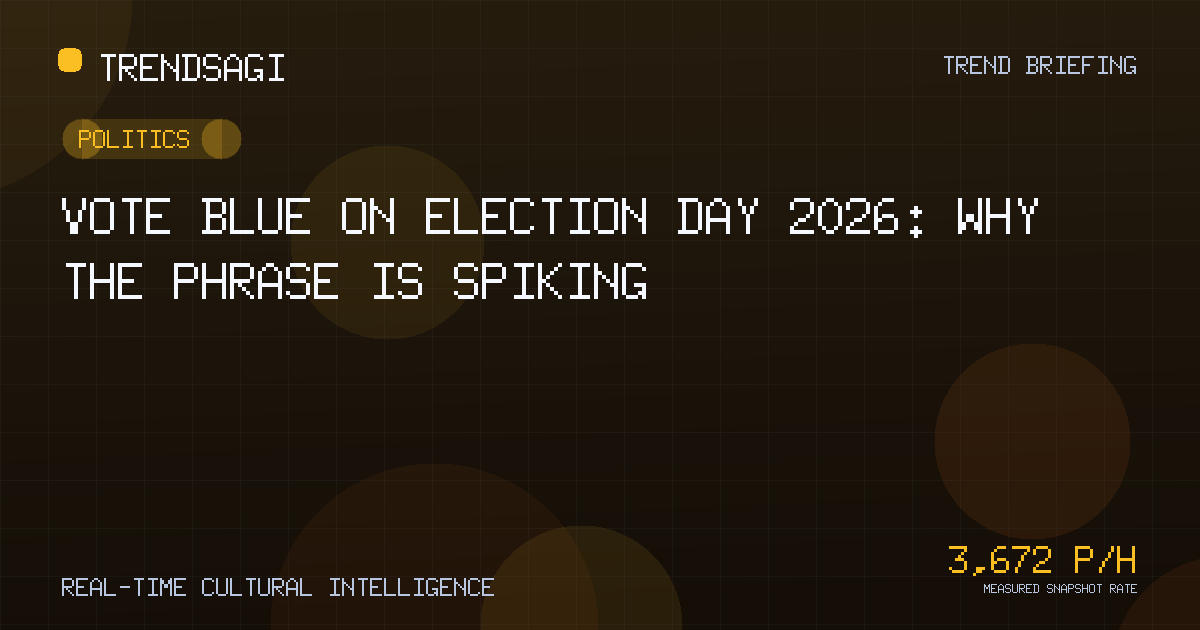
Vote blue is spiking on Election Day 2026: TrendsAGI measured 3,672.3 posts/hour at 20:45:57Z. What the term means, and what the signal can't confirm.
Automated briefing. Generated from stored signal measurements and source-backed research; it is not manually reviewed. Read the methodology and limitations or the editorial standards.
Metrics in this briefing are a snapshot associated with its publication date and may not reflect current conditions.
What changed
"Vote blue" is spiking today because the 2026 U.S. midterm elections are being held on November 3, 2026 — the same day as this measurement. In the 892-second observation window ending at 20:45:57Z, TrendsAGI measured 2,666 posts carrying the topic, at a snapshot rate of 3,672.3 posts per hour across three stored observations. That surge is the clearest verified fact in this briefing: the phrase's online volume is concentrated on election day itself, not spread evenly across the preceding weeks.
The measurement tells you when interest peaked in the window we observed. It does not tell you who is winning, what turnout looks like, or whether any "blue wave" has actually materialized — none of those are established by the signal or by the search-intent sources reviewed here. The articles publishing "vote blue" messaging around October 30–November 3, including a column in The Newtown Bee, are advocacy and opinion framed around an election still in progress. Read the volume as a demand curve for the term, not as a result.
| Observation time (UTC) | Measured posts/hour | Snapshot volume |
|---|---|---|
| 2026-11-03T20:45:57Z | 3,672.3 | 2,666 posts |
Why this topic may be moving
The verified cause is timing. November 3, 2026 is the date of the U.S. midterm elections, and the measurement lands on that date. Sources in the brief — a Newtown Bee opinion column titled "Be A Patriot: Vote Blue," a Mastodon.social post urging readers to "vote blue today," and a Kaikki.org dictionary entry for "vote blue no matter who" — all cluster around the same moment and the same call to action. That convergence is why the term reads as urgent today.
What the brief does not verify is any outcome. There is no confirmed result, no turnout figure, and no proof that a "blue wave" is occurring. Treat claims about a wave as forecast or opinion unless an official count is cited. The measure above is a rate of posts observed over a fixed window — not a live number, not reach, and not a count of distinct people.
Why it matters
Searchers arriving on "vote blue 2026 midterms blue wave" are looking for something concrete: what the phrase means, whether a wave is real, and how to vote before deadlines close. Most of what ranks today is opinion or partisan social content, which leaves the factual questions only partly answered. This briefing separates the measurable from the rhetorical.
- For voters: the clock is the practical issue. Election-day voting, polling-place hours, and any state-specific rules matter more than the slogan.
- For analysts: the spike shows how sharply attention compresses onto election day. Comparing this window with pre-election windows would show whether the surge is concentrated or sustained.
- For readers of results: wait for official counts. A social surge is not a tally.
A spike in the phrase "vote blue" measures attention to an election, not the outcome of one. The only reliable verdict on a "blue wave" is the certified count.
What to watch next
Several concrete signals will tell you more than the slogan's volume:
- Count progression: official tallies reported by election authorities and major outlets, race by race, as they are certified or called.
- Turnout reporting: whether election officials publish turnout relative to prior midterms, and whether early-voting totals are reconciled with election-day numbers.
- Rate behavior after election day: whether the measured post rate stays high, decays quickly, or is replaced by result-focused terms — a shift that would suggest the conversation has moved from urging votes to interpreting counts.
- Keyword drift: volume moving from "vote blue" toward "blue wave results" or specific race names, which typically follows the count.
- Source quality: whether coverage shifts from opinion columns and social posts to results desks and official statements.
Frequently asked questions
What does 'vote blue' actually mean in U.S. politics?
It is a shorthand call to vote for Democratic candidates, using the party's traditional blue color. In practice it is used as both a get-out-the-vote slogan and a signal of partisan alignment.
Is a 'blue wave' expected in the 2026 midterms?
Forecasts and opinion pieces discuss the possibility, but nothing in the verified sources confirms that a wave is occurring or will occur. Treat wave talk as expectation, not result.
What is at stake in Congress in the November 3, 2026 election?
The midterms determine control of Congress and shape the legislative agenda for the remainder of the term. The verified sources in this brief do not specify seat-level outcomes, so the balance of power should be read from official results rather than commentary.
What does 'vote blue no matter who' (VBNMW) mean?
According to the Kaikki.org dictionary entry cited in the brief, the phrase is a slogan urging voters to support the Democratic candidate regardless of individual preferences. It is a partisan rallying phrase rather than a neutral description.
How can I still vote on November 3 if I missed early voting?
Where election-day voting is available, polls are open on November 3 and voters should confirm their assigned polling place and hours with local election officials. Rules differ by state, and this briefing does not verify state-specific deadlines, so check your state or county election office directly.
Which states and races are key to whether Democrats win?
The verified brief mentions Pennsylvania's governor's race and the congressional balance but does not enumerate decisive races. Key-race lists should come from official election sources as results are reported.
Methodology and limitations
This briefing is built on a stored TrendsAGI signal: snapshot volume of 2,666 posts observed at 2026-11-03T20:45:57Z, with a measured rate of 3,672.3 posts per hour across an exact 892-second window using three stored observations. The rate is a measured snapshot rate, not a live or current rate, and it is not a forecast, reach estimate, engagement metric, or unique-person count. Posts may repeat, and the measure does not identify users.
The signal establishes that the topic was highly active in that window on election day. It cannot establish election results, turnout, the size of any political movement, or whether a "blue wave" occurred. Search-volume data and independent verification of the rate were not available in the reviewed material. Where the cause of the spike is attributed, it rests on the verified date coincidence and the election-day messaging in the cited sources; any residual ambiguity is stated rather than resolved.
Sources
Track This Topic for New Signals
Set alerts for future velocity or sentiment changes around this topic.
Explore Tracking PlansAbout TrendsAGI research
TrendsAGI's automated research pipeline publishes dated signal snapshots, methodology notes, and practical workflows for teams evaluating cultural momentum. Read how signals are scoped, scored, and limited in our research methodology.