15-minute window · 3 observations · Measured Oct 28, 2026, 1:45 PM UTC · Provider: go_recent_snapshot_v2
Netanyahu Election Results 2026: Seat Count and Coalition Math
Search interest in Netanyahu election results is spiking after Israel's Oct 27, 2026 vote. TrendsAGI measured 1,787.6 posts/hour; results remain unverified.
Automated briefing. Generated from stored signal measurements and source-backed research; it is not manually reviewed. Read the methodology and limitations.
Metrics in this briefing are a snapshot associated with its publication date and may not reflect current conditions.
What changed
Israeli parliamentary elections are being held on October 27, 2026, so searches for Netanyahu election results are spiking as voters and observers look for a clear winner. The verified brief confirms the timing of the vote and that Netanyahu's political survival is in doubt, but it does not verify actual results, seat counts, or exit polls. TrendsAGI measured a snapshot rate of 1,787.6 posts per hour over an exact 900-second window using three stored observations, observed at 2026-10-28T13:45:03Z, with a latest snapshot volume of 2,769 posts. That is a measured snapshot rate, not a live or current rate.
| Observation time | Measured posts/hour (snapshot rate) | Snapshot volume |
|---|---|---|
| 2026-10-28T13:45:03Z | 1,787.6 | 2,769 posts |
Why this topic may be moving
The brief verifies the reason social and search attention is peaking: Israel is holding its first parliamentary elections since the October 7, 2023 Hamas attacks, and Netanyahu's political future is uncertain. Coverage is concentrated on the vote and its immediate aftermath. What the signal cannot establish is the precise sub-story driving the posting surge—results, coalition talks, or security incidents—because the brief does not verify actual results or exit polls. Treat any claim about who won as unconfirmed until official figures are available.
Why it matters
For readers searching "Netanyahu election results," the stakes are concrete: the outcome determines whether Netanyahu remains prime minister, whether his bloc can assemble a governing coalition, and how Israel's security and press-freedom landscape shifts. The brief notes that Xinhua published an analysis of five challenges facing Netanyahu ahead of the election, ABC (Australian Broadcasting Corporation) reported on a mushroom-cloud social post and cryptocurrency talk as the vote loomed, and RSI Radiotelevisione svizzera covered Netanyahu's bid for a new mandate. Those are verified publisher attributions, not evidence of the result.
The useful question is not only who won, but whether either bloc can reach 61 seats—because Israel's proportional-representation system can leave the largest party short of a governing majority.
What to watch next
- Official count and exit polls: Wait for verified seat tallies from official Israeli sources; the brief does not supply them.
- Coalition arithmetic: Track whether Likud and its allies, or the opposing bloc, cross the 61-seat threshold in the 120-seat Knesset.
- President's role: After results are certified, Israel's president consults parties and assigns a candidate to form a government—usually within weeks.
- Social velocity by sub-story: Watch whether the measured posting rate spikes around results, coalition talks, or security incidents; TrendsAGI can separate those threads.
- Press-freedom angle: The RSF legacy angle appears in one outlet only; watch whether it resurfaces in post-vote coverage.
Frequently asked questions
Did Netanyahu win or lose the 2026 Israeli election?
The brief does not verify a winner or loser. It confirms the election was held on October 27, 2026, and that Netanyahu's political survival is in doubt, so any definitive claim should be treated as unconfirmed until official results are published.
What do the exit polls and seat counts show for Likud versus the opposing bloc?
No verified exit-poll or seat-count figures are supplied in the brief. Readers should rely on official Israeli election authorities or major verified outlets for the running tally.
Can Netanyahu assemble a governing coalition without a majority?
The brief does not verify coalition outcomes. In Israel's proportional-representation system, a party can be the largest but still fall short of 61 seats, making coalition partners decisive; whether Netanyahu can assemble one is unconfirmed here.
What happens to Netanyahu politically if he loses?
The brief does not verify post-election scenarios. If he loses, he would likely face leadership pressure and a possible opposition role, but any specific outcome is unconfirmed.
Why is this election considered historic or high-stakes?
The brief verifies it is the first parliamentary election since the October 7, 2023 Hamas attacks, and Netanyahu's survival is in doubt—both factors make the vote unusually consequential for Israeli politics.
How did security issues and the October 7 attacks shape the vote?
The brief confirms the election follows the October 7 attacks and that security is part of the context, but it does not verify how those issues affected the result. The ABC report on a mushroom-cloud social post and security rhetoric suggests security was salient in the closing campaign, though the brief does not verify the post's authenticity beyond ABC's description.
Methodology and limitations
TrendsAGI measured a snapshot rate of 1,787.6 posts per hour over an exact 900-second window using three stored observations at 2026-10-28T13:45:03Z; the latest snapshot volume was 2,769 posts. This is a measured snapshot rate, not a live or current rate, forecast, reach, engagement, or unique-person count. The signal cannot verify election results, seat counts, exit polls, coalition formation, the authenticity of the mushroom-cloud post, or the precise cause of the velocity spike beyond the verified election timing. Attribute external facts to their publishers as named above. Where the cause of the surge is unclear, this briefing says so plainly.
Sources
- News Analysis: Five challenges facing Netanyahu ahead of Israeli election (Xinhua) — english.news.cn
- Netanyahu posts mushroom cloud, talks cryptocurrency as election looms (Australian Broadcasting Corporation) — abc.net.au
- Elezioni in Israele, Netanyahu vuole un nuovo mandato (RSI Radiotelevisione svizzera) — rsi.ch
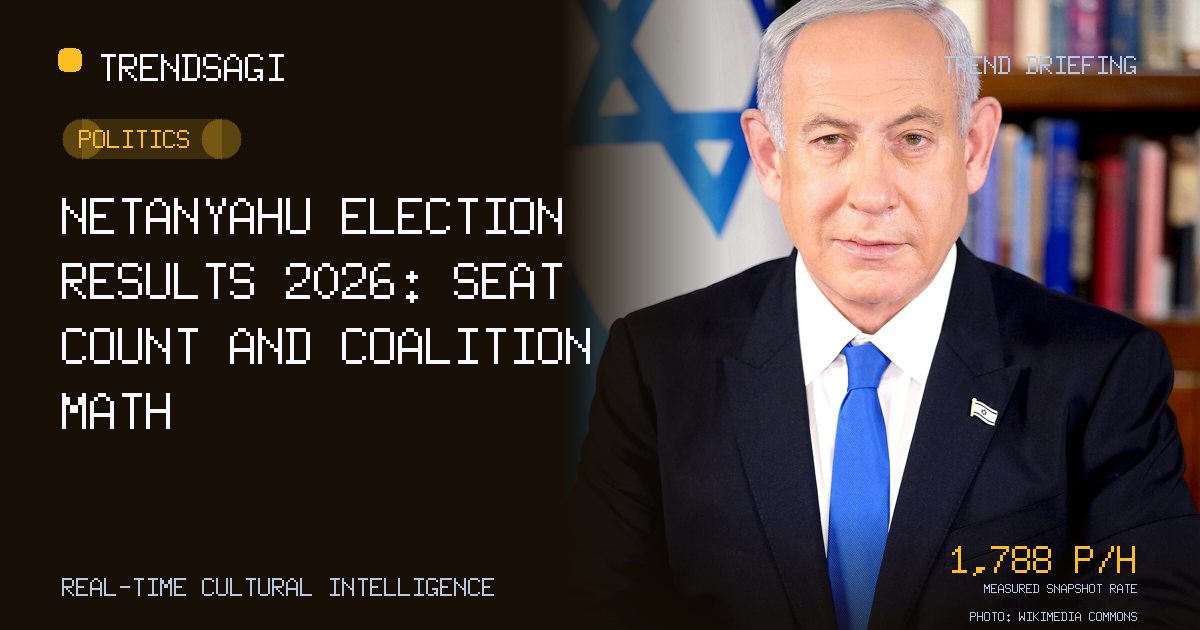
Image: Benjamin Netanyahu by Avi Ohayon, CC BY-SA 3.0, via Wikimedia Commons. The thumbnail adapts this photo with a title overlay and is shared under the same licence.
Track This Topic for New Signals
Set alerts for future velocity or sentiment changes around this topic.
Explore Tracking PlansAbout TrendsAGI research
TrendsAGI's automated research pipeline publishes dated signal snapshots, methodology notes, and practical workflows for teams evaluating cultural momentum. Read how signals are scoped, scored, and limited in our research methodology.