15-minute window · 3 observations · Measured Oct 28, 2026, 2:59 PM UTC · Provider: go_recent_snapshot_v2
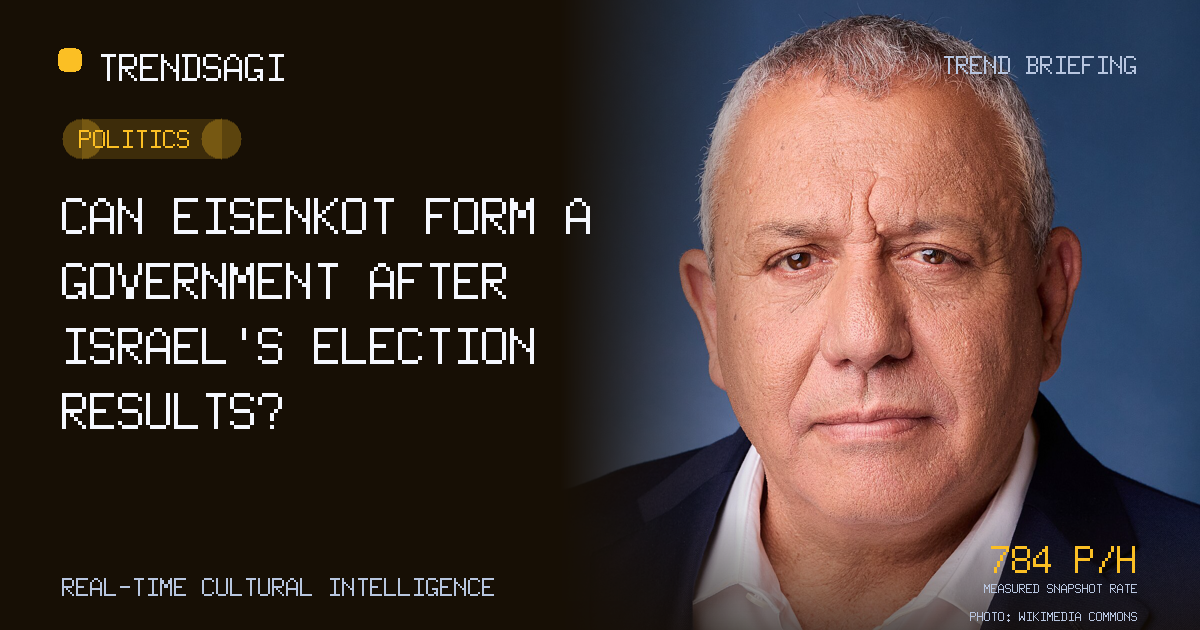
Can Eisenkot Form a Government After Israel's Election Results?
Eisenkot says he is ready to form a government after Israel's 27–28 October 2026 election, but no bloc has 61 seats. What the result means for Netanyahu.
Automated briefing. Generated from stored signal measurements and source-backed research; it is not manually reviewed. Read the methodology and limitations.
Metrics in this briefing are a snapshot associated with its publication date and may not reflect current conditions.
What changed
Israeli parliamentary election results were reported on the night of 27–28 October 2026, and Gadi Eisenkot — described by CNN as Benjamin Netanyahu's main challenger — said the public voted for change and declared himself ready to form a new government, according to N-TV. The decisive fact is that neither bloc has a 61-seat majority, so the question searchers are asking — can Eisenkot form a government — is still open, not settled.
Interest is moving fast. At the snapshot observed at 2026-10-28T14:59:55Z, the topic carried 473 posts in the latest measurement window and a measured rate of 783.6 posts per hour, calculated over an exact 900-second window from three stored observations. That is a measured snapshot rate for this window, not a live or forecast figure, and it indicates an intense reaction rather than predicting any political outcome.
| Observation time | 2026-10-28T14:59:55Z |
|---|---|
| Measured posts/hour | 783.6 (measured snapshot rate, 900-second window, 3 observations) |
| Latest snapshot volume | 473 posts |
Why this topic may be moving
The verified driver is post-election coalition uncertainty. Election results landed overnight on 27–28 October 2026, and Eisenkot — a former war cabinet member under Netanyahu, per Anadolu Ajansı — immediately framed the result as a mandate for change and said he is ready to form a new government, N-TV reported. At the same time, no bloc reached the 61 seats needed for a majority, so the next phase is coalition arithmetic and negotiation rather than a clean handover.
Searchers are arriving with a bundled question: who Eisenkot is, whether his Yashar party actually won, and what all of this means for Netanyahu. Much of the existing coverage is pre-election profile material that has not caught up with the post-vote seat math — which is precisely the gap driving fresh searches.
Who Eisenkot is, briefly
CNN profiles Eisenkot as Netanyahu's principal challenger in these elections. Anadolu Ajansı notes that Eisenkot sat in Netanyahu's war cabinet, which matters for how readers interpret his break with the prime minister. Beyond that, this briefing is deliberately narrow: the verified sources establish his role as challenger and former war cabinet member, and that he has positioned himself as the candidate of change — they do not establish a full platform or biography, so treat fuller profiles as needing their own verification.
What the signal can and cannot establish
The attention signal is strong and precisely measured: 473 posts in the window, 783.6 posts per hour over 900 seconds from three observations. That tells you the public reaction is intense right now. It does not tell you who will govern.
- Can establish: the speed and volume of attention around Eisenkot and the election result at the observation time.
- Cannot establish: final seat counts for the Yashar and Likud blocs, which the verified sources do not specify.
- Cannot establish: whether Eisenkot will ultimately succeed in forming a coalition.
- Cannot establish: the precise effect of reported backing for Netanyahu from US President Trump — that is reported but not analyzed in the verified brief, so treat its impact as unconfirmed.
Read the surge as a measure of public intensity, not a prediction: the election result created a genuine coalition puzzle, and the rate of posts reflects how urgently people want the who/what/now-what answered.
Why it matters
For readers in Israel and the wider region, the outcome determines who negotiates on security, Iran policy, and the domestic accountability debate over the October 7, 2023 failures. Because neither side cleared 61 seats, the practical question is who can assemble a working majority — and that process, not the raw vote, is what will shape policy. The attention data shows this is not a niche political story; it is being followed at a rate of hundreds of posts per hour measured at the snapshot time.
What to watch next
- Seat totals and bloc math: the moment final counts are confirmed, the 61-seat question becomes answerable.
- Coalition talks signals: which parties Eisenkot and Netanyahu court first, and any public statements about red lines.
- Deadlock indicators: repeated failed rounds or calls for another election would confirm the uncertainty is deepening.
- Accountability moves: any formal step on a state inquiry into October 7, 2023.
- External backing: how reported US support for Netanyahu is received domestically — currently unconfirmed in its effect.
Practical next checks: verify seat counts against election authority reporting as they finalize; distinguish declared readiness to form a government from an actual majority; and separate campaign rhetoric on unity and security from coalition commitments.
Frequently asked questions
Who is Gadi Eisenkot and what is his background?
Eisenkot is Netanyahu's main challenger in the 2026 elections, according to CNN, and he served in Netanyahu's war cabinet, per Anadolu Ajansı. The verified sources describe his role in this election and his cabinet history; they do not provide a complete biography.
Did Eisenkot's Yashar party win the Israeli election?
The verified sources do not specify final seat counts, so a definitive yes or no is not established here. What is verified is that Eisenkot said the public voted for change and declared himself ready to form a new government, while neither bloc reached a 61-seat majority.
Can Eisenkot actually form a coalition without a 61-seat majority?
Not on his own bloc's numbers as verified. Because neither bloc has 61 seats, forming a government would require support from outside his bloc, and whether he can secure that is unconfirmed.
What does the election result mean for Benjamin Netanyahu?
The result leaves Netanyahu facing a serious challenge from Eisenkot with no side holding a majority, N-TV and CNN report. His path back to governing depends on coalition arithmetic that is not yet resolved in the verified sources.
What has Eisenkot said about the October 7, 2023 failures and a state inquiry?
The verified brief does not establish Eisenkot's specific statements on the October 7, 2023 failures or a state inquiry, so this cannot be answered truthfully here. It remains a key accountability question to track as coalition talks proceed.
What is Eisenkot's platform on unity, security, and Iran?
Verified sourcing confirms his framing of the vote as a call for change and his readiness to form a government; specific positions on unity, security, and Iran are beyond what the verified sources establish. Readers should look for direct statements rather than inferred positions.
Methodology and limitations
The attention figures come from a stored signal with a snapshot observed at 2026-10-28T14:59:55Z. The 783.6 posts per hour figure is a measured rate over an exact 900-second window using three stored observations, and the 473 figure is the latest snapshot volume — not a rate, reach, engagement, or unique-person count. The political facts are attributed only to the named publishers in the verified brief; seat counts, coalition success, and the impact of reported US backing are treated as unconfirmed because the sources do not specify them. Where the cause of the surge could not be fully verified, that is stated plainly rather than filled in.
Sources
- Eisenkot will neue Regierung in Israel bilden (N-TV) — n-tv.de
- Who is Gadi Eisenkot, Netanyahu's main challenger in Israel's elections? (CNN) — edition.cnn.com
- Netanyahu'nun "Savaş Kabinesinde" yer alan Eisenkot, seçimlerdeki en dişli rakibi oldu (Anadolu Ajansı) — mobil.aa.com.tr
Image: Gadi Eisenkot by יהב טרודלר (Yahav Trudler - Yahav Studio), CC BY-SA 3.0, via Wikimedia Commons. The thumbnail adapts this photo with a title overlay and is shared under the same licence.
Track This Topic for New Signals
Set alerts for future velocity or sentiment changes around this topic.
Explore Tracking PlansAbout TrendsAGI research
TrendsAGI's automated research pipeline publishes dated signal snapshots, methodology notes, and practical workflows for teams evaluating cultural momentum. Read how signals are scoped, scored, and limited in our research methodology.