902-second window · 3 observations · Measured Nov 8, 2026, 2:31 PM UTC · Provider: go_recent_snapshot_v2
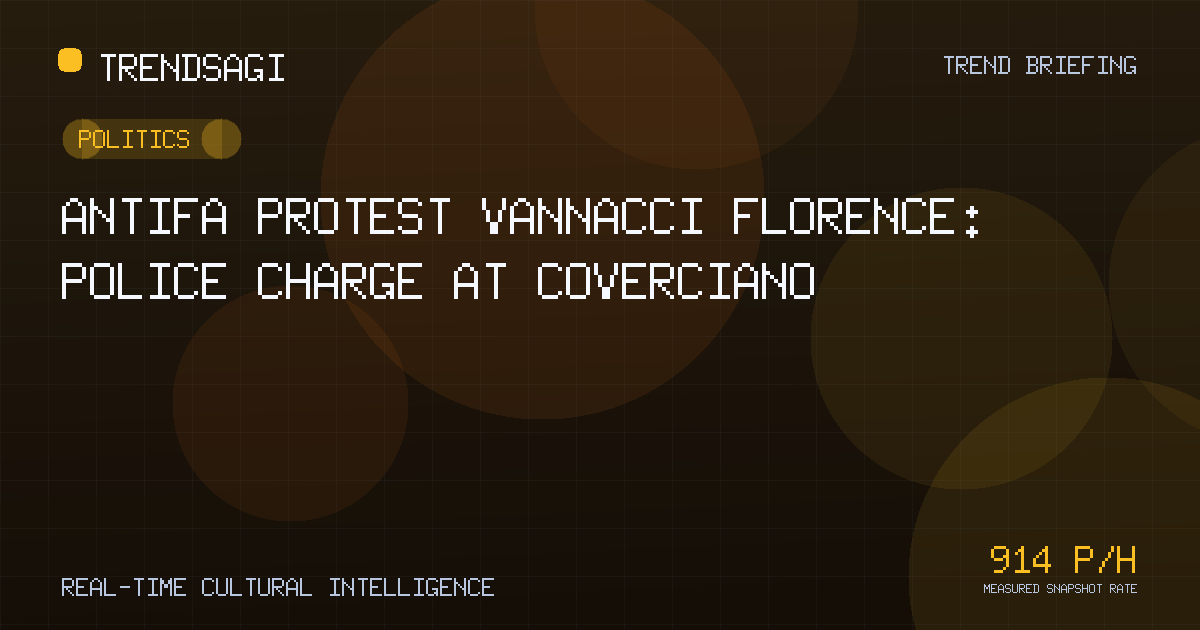
Antifa Protest Vannacci Florence: Police Charge at Coverciano
Antifa protesters clashed with police at Vannacci's Futuro Nazionale office in Florence on Nov 7, 2026. What is verified, what is not, and what to watch.
Automated briefing. Generated from stored signal measurements and source-backed research; it is not manually reviewed. Read the methodology and limitations or the editorial standards.
Metrics in this briefing are a snapshot associated with its publication date and may not reflect current conditions.
What changed
Antifa demonstrators protesting Roberto Vannacci's inauguration of a Futuro Nazionale party office in Florence's Coverciano district were pushed back by police baton charges on November 7, 2026, according to same-day reports from Tgcom24, Il Messaggero and L'Unione Sarda. The outlets describe eggs thrown and insults shouted as Vannacci left the premises. The topic is moving: stored measurements show 791 posts in the latest observation, with a measured rate of 914.2 posts/hour across an exact 902-second window spanning three stored observations, timestamped 2026-11-08T14:31:41Z.
The direct answer to the search query is therefore narrow and verified: a contested party-office opening in Florence, a police charge against Antifa protesters, no confirmed casualty or arrest figures. What is not established is that the Florence clash produced the measured post velocity — the search results do not link one to the other, and that connection remains unconfirmed.
| Observation time | Measured posts/hour | Snapshot volume |
|---|---|---|
| 2026-11-08T14:31:41Z | 914.2 | 791 posts |
Why this topic may be moving
The verified trigger is the November 7 confrontation itself. Multiple Italian outlets reported the same events within hours, which plausibly explains the spike, though the search results do not directly confirm that this caused the measured post velocity. Readers should treat the timing overlap as suggestive, not proven.
A second, weaker thread is European context. A 12punto piece frames a wider "era of bans in Europe" and asks whether the same hand is reaching from Washington to Europe — a debate-level argument, not a report on Florence. The brief also flags German Antideutsche discussion, French riot allegations and a Greek graffiti story in Patras, but explicitly does not verify that any of these are connected to the same online surge. They may be separate flashpoints sharing one loaded word.
The useful takeaway is not that "Antifa" is one coordinated thing surging everywhere at once, but that one verified local confrontation in Florence is being read alongside unrelated European debates — and the data cannot yet tell those apart.
What is verified, and what is not
Verified: the date and place (November 7, 2026, Coverciano, Florence); the occasion (Vannacci inaugurating a Futuro Nazionale office); the presence of Antifa or antifascisti protesters; police baton charges; eggs thrown and insults shouted. These details appear consistently across Tgcom24, Il Messaggero and L'Unione Sarda.
Not verified, and therefore stated here as open questions: any injury, arrest, charge or damage figures; official statements from Vannacci, Futuro Nazionale or Italian police beyond what outlets describe; the identity or affiliation of the Florentine group beyond the label "Antifa"/"antifascisti"; and whether the German, French and Greek stories relate to the same surge.
Why it matters
For readers outside Italy, the ranking coverage is thin on context. Italian reports repeat near-identical wire copy without explaining who Vannacci is or what Futuro Nazionale represents, and the German, French and Greek angles are covered separately with no synthesis of whether "Antifa" is one movement or many. That conflation is the practical risk: a single word is being used to bundle a police charge in Tuscany with ban debates in Berlin, riot allegations in France and graffiti in Patras.
Who should care: editors and analysts tracking political unrest vocabulary; researchers studying how local incidents travel across borders; and general readers trying to work out whether "Antifa trending" means one event or several.
What to watch next
- Follow-up reporting from Florence on injuries, arrests, charges and any police statement — the current gap most likely to close first.
- Whether Vannacci or Futuro Nazionale issue statements, and whether the office opening proceeds or is rescheduled.
- Whether German, French and Greek coverage begins citing Florence, which would suggest genuine cross-border linkage rather than parallel use of a label.
- Whether the measured rate persists or decays in subsequent stored observations; a single window cannot distinguish a sustained surge from a short burst.
- Any official European or national move on banning groups, which would shift the story from incident to policy.
Frequently asked questions
What exactly happened between Antifa protesters and police at Vannacci's Futuro Nazionale office opening in Florence?
According to Tgcom24, Il Messaggero and L'Unione Sarda, Antifa demonstrators gathered to protest Roberto Vannacci's inauguration of a Futuro Nazionale office in the Coverciano district on November 7, 2026. Police pushed the protesters back with baton charges as Vannacci left the premises, with eggs thrown and insults shouted.
Were there injuries, arrests, or damage during the Coverciano clashes?
No verified figures are available. The reporting reviewed describes the charge and the protest but does not supply confirmed counts of injuries, arrests, charges or damage, so any specific number circulating should be treated as unconfirmed.
Who is Roberto Vannacci and what is Futuro Nazionale?
The verified reporting identifies Vannacci as the figure inaugurating a Futuro Nazionale party office in Florence. The brief does not verify further biographical or organisational detail, so readers should consult dedicated profiles rather than infer his role from the clash coverage alone.
What does Antifa mean and how is it organized in Italy and Europe?
"Antifa" is shorthand for antifascist and, as used in this reporting, describes the protesters rather than a named organisation. The verified sources do not establish the identity, structure or affiliation of the Florentine group beyond that label, and the week's German, French and Greek stories are not verified as connected.
Why are European governments discussing banning Antifa and left-wing groups?
A 12punto piece describes an "era of bans in Europe" and asks whether the same hand is reaching from Washington to Europe, framing the question as a policy debate. That is the extent of what the verified material supports; specific legislative proposals are not confirmed here.
Is the Florence event connected to other Antifa activity reported this week in Germany, France, or Greece?
Unconfirmed. German Antideutsche discussion, French riot allegations and a Greek graffiti story in Patras are each covered separately, and the brief states plainly that their relationship to the same online surge is not verified.
Methodology and limitations
The signal rests on three stored observations, the latest at 2026-11-08T14:31:41Z, yielding a measured snapshot rate of 914.2 posts/hour over a 902-second window and a latest snapshot volume of 791 posts. The rate is a measured snapshot rate, not a live figure, forecast, reach, engagement or unique-person count, and the volume is not itself a rate.
What the signal can establish: that discussion volume around this topic was high at the moment of observation. What it cannot establish: why, whether one specific event drove it, or how the posts were distributed across platforms and countries. The search-intent brief's original value — timestamping the surge precisely so a page can show how the term jumped across countries — is a plausible framing, but the country-level spread is not verified by the data provided.
Practical next checks: watch for Florentine follow-up reporting, statements from the involved parties, and whether subsequent observations show persistence or decay.
Sources
- Firenze, tensioni mentre Vannacci lascia la sede di Fn: carica della polizia (Tgcom24) — tgcom24.mediaset.it
- Vannacci, tensione davanti alla nuova sede di Futuro Nazionale a Firenze: manifestanti contestano il generale, la polizia carica (Il Messaggero) — ilmessaggero.it
- Vannacci inaugura la sede del partito, contestazione Antifa e carica della polizia (L'Unione Sarda) — unionesarda.it
- An era of bans in Europe: Is the same hand reaching from Washington to Europe? (12punto) — en.12punto.com.tr
Track This Topic for New Signals
Set alerts for future velocity or sentiment changes around this topic.
Explore Tracking PlansAbout TrendsAGI research
TrendsAGI's automated research pipeline publishes dated signal snapshots, methodology notes, and practical workflows for teams evaluating cultural momentum. Read how signals are scoped, scored, and limited in our research methodology.