908-second window · 3 observations · Measured Nov 5, 2026, 9:19 PM UTC · Provider: go_recent_snapshot_v2
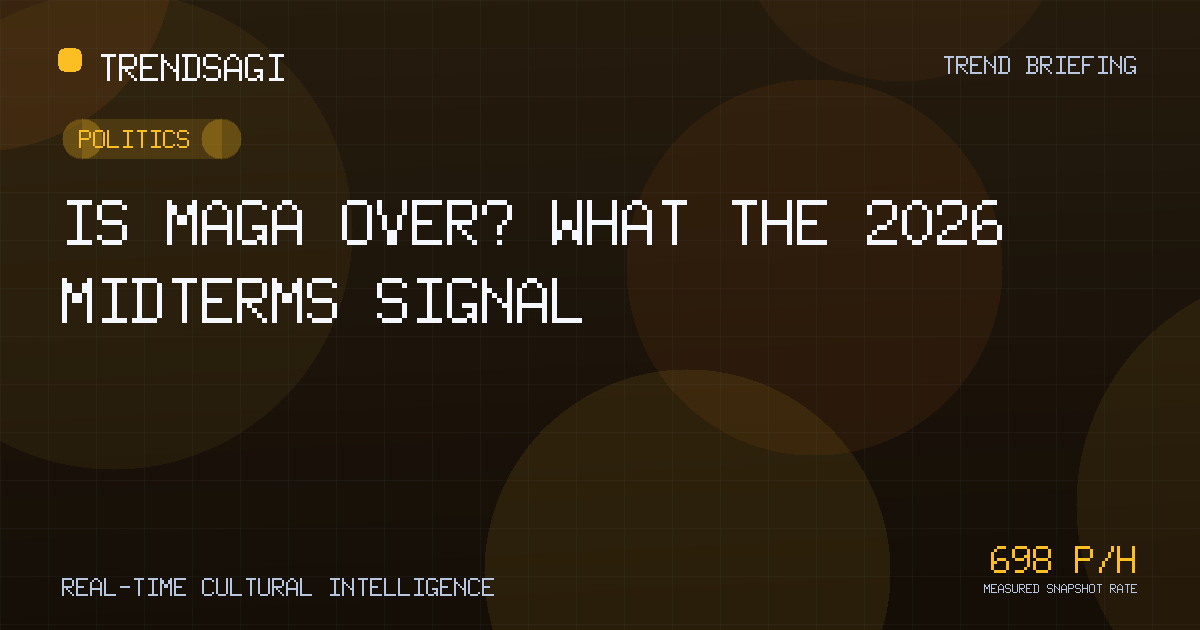
Is MAGA Over? What the 2026 Midterms Signal
Democrats swept both chambers on Nov. 3, 2026, driving the 'is MAGA over' debate. See the measured post rate behind the surge and what to watch next.
Automated briefing. Generated from stored signal measurements and source-backed research; it is not manually reviewed. Read the methodology and limitations or the editorial standards.
Metrics in this briefing are a snapshot associated with its publication date and may not reflect current conditions.
What changed
The question "is MAGA over" is surging because Democrats won both the House and the Senate in the Nov. 3, 2026 midterms — a result that outlets including the Australian Broadcasting Corporation, 한겨레 and The Christian Science Monitor are framing as a repudiation of Donald Trump and his movement. In the immediate aftermath, discussion of the movement's future is running at a measurable 697.7 posts per hour, the snapshot rate TrendsAGI recorded at 2026-11-05T21:19:36Z over a 908-second window built from three stored observations, on a snapshot volume of 378 posts. That figure describes activity at one moment, not a forecast or a running live rate.
The short answer: the midterms clearly cost MAGA its grip on Congress and forced an open argument about its future, but the evidence available here does not establish that the movement is finished. What the numbers do show is a conversation that is still moving fast days after the vote — consistent with dispute rather than consensus.
| Observation time (UTC) | Measured snapshot rate | Snapshot volume |
|---|---|---|
| 2026-11-05T21:19:36Z | 697.7 posts/hour (908-second window, 3 observations) | 378 posts |
Why this topic may be moving
The verified driver is the midterm outcome: a Democratic sweep of both chambers, described across international coverage as a rebuke of Trump and MAGA. That single result opens several lines of debate at once — whether the movement is dead, who inherits it, and what it means for 2028 — and each of those lines feeds the search demand behind "is MAGA over."
What we cannot verify here is the exact turnout mechanics behind the loss, or any single event beyond the midterm aftermath to which the trend label maps. Where commentary asserts that MAGA voters stayed home, treat that as a claim still needing data, not a settled fact.
Why it matters
For anyone tracking U.S. politics, the practical stakes are structural rather than rhetorical. A movement that loses both chambers faces questions about fundraising networks, candidate pipelines, and who speaks for it. The Christian Science Monitor's framing asks whether MAGA has a future after an anti-Trump backlash; UnHerd's coverage centers on JD Vance's inability to escape the movement's shadow — two different bets on the same question of succession.
International audiences are asking the same thing in their own terms: the ABC in Australia and 한겨레 in Korea both ran pieces on whether this is the end of MAGA as it has been known. That cross-border interest is part of why the topic travels beyond U.S. political news cycles.
The midterms settled who controls Congress; they did not settle what MAGA becomes next. The velocity in the days after the vote measures argument, not a verdict.
What to watch next
- Whether the post rate holds or fades. A sustained high snapshot rate across successive observations would indicate an unresolved fight; a sharp drop would suggest the debate is exhausting itself.
- Succession signals. Statements from JD Vance and other figures about the movement's direction are the clearest available indicator of whether a "post-Trump" MAGA is being organized or merely discussed.
- Reaction framing. Watch whether MAGA-aligned figures attribute losses to turnout, messaging, or the candidate at the top — the diagnosis chosen tends to predict the rebuild strategy.
- The Iran war thread. Commentary linking the war to the movement's decline is circulating, but the connection to voter behavior is not established in the verified material here; treat it as a hypothesis to test, not a cause.
- 2028 positioning. Early moves by likely contenders will show whether the movement reconstitutes around a new figure or fragments.
Frequently asked questions
Did the 2026 midterms actually end the MAGA movement?
No verified source establishes that. The midterms cost MAGA control of both chambers and triggered widespread debate about its future, but whether the movement is finished is contested and opinion-based rather than a settled outcome.
Why did MAGA supporters fail to turn out in the midterms?
Specific turnout data behind any drop-off is not verified in the material available here, so a precise explanation cannot be given. Commentary exists, but it should be read as interpretation rather than confirmed cause.
What is JD Vance's role in MAGA's future?
Coverage indexed here, including from UnHerd, frames Vance as unable to escape the movement's shadow — suggesting he is central to any succession question. What that means organizationally is still unclear.
Could MAGA come back in 2028?
That is a live and unresolved question. No verified source rules it out; the debate turns on whether the movement can rebuild around a new leader or a revised message.
What are MAGA figures saying about the losses?
The verified brief does not include specific statements from MAGA figures, so their reactions cannot be summarized reliably here. This is a gap worth checking directly against primary statements.
How does the Iran war factor into MAGA's decline?
Commentary connects the Iran war to the movement's troubles, but no verified turnout or polling link is established in this material. The connection remains unconfirmed.
Methodology and limitations
The velocity figure comes from three stored observations spanning an exact 908-second window ending at 2026-11-05T21:19:36Z, yielding a measured snapshot rate of 697.7 posts per hour against a snapshot volume of 378 posts. It is a point-in-time measurement of posting activity, not a live rate, a forecast, a reach estimate, or a count of unique people. The signal cannot establish why individual users posted, cannot confirm turnout mechanics, and cannot settle whether the movement has ended. Search volume for the query itself is not verified and is not cited. Readers wanting firmer ground should check official election results, primary statements from political figures, and subsequent snapshots to see whether the conversation is accelerating or cooling.
Sources
- Is Donald Trump's MAGA movement over? (Australian Broadcasting Corporation) — abc.net.au
- Is this the end of MAGA as we know it? (한겨레) — hani.co.kr
- Does MAGA have a future? After anti-Trump backlash in midterms, it may not. (The Christian Science Monitor) — csmonitor.com
- JD Vance can't escape MAGA's shadow (UnHerd) — unherd.com
Track This Topic for New Signals
Set alerts for future velocity or sentiment changes around this topic.
Explore Tracking PlansAbout TrendsAGI research
TrendsAGI's automated research pipeline publishes dated signal snapshots, methodology notes, and practical workflows for teams evaluating cultural momentum. Read how signals are scoped, scored, and limited in our research methodology.