893-second window · 3 observations · Measured Nov 4, 2026, 8:00 AM UTC · Provider: go_recent_snapshot_v2
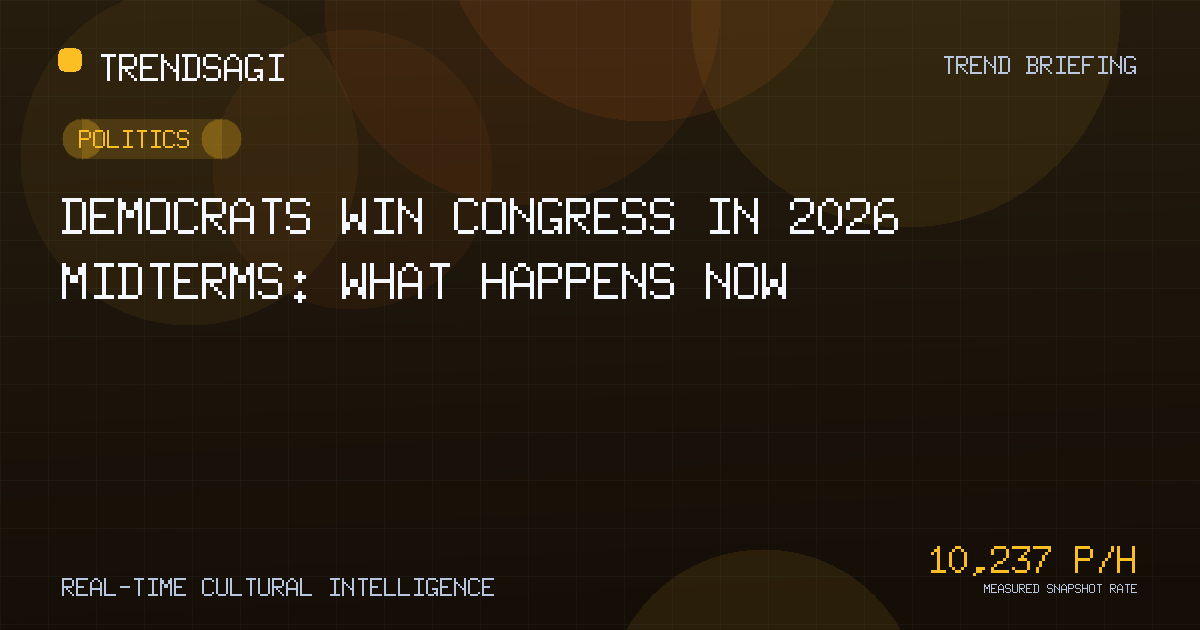
Democrats Win Congress in 2026 Midterms: What Happens Now
Democrats won both chambers of Congress in the 2026 midterms. What changes now for Trump's agenda, appointments, and oversight.
Automated briefing. Generated from stored signal measurements and source-backed research; it is not manually reviewed. Read the methodology and limitations or the editorial standards.
Metrics in this briefing are a snapshot associated with its publication date and may not reflect current conditions.
What changed
Democrats have won control of both chambers of Congress in the 2026 U.S. midterm elections, according to the Australian Broadcasting Corporation, ending Republican control during President Trump's term. The result answers the question driving today's searches — what happens now that Democrats control Congress in 2026 — by flipping the legislative branch while the presidency stays Republican. The Guardian's live election coverage framed the vote as a contest over control of Congress for the remainder of Trump's term, and that control has now changed hands.
TrendsAGI measured a sharp reaction spike around this outcome: a snapshot rate of 10,237 posts per hour across an exact 893-second window ending 2026-11-04T08:00:53Z, based on three stored observations. That figure is a measured snapshot rate at a single point in time, not a live or forecast number, and it describes posting volume — not people, reach, or engagement. The elevated rate is consistent with a post-election reaction surge, but it does not by itself tell us whether the surge is celebration, anxiety, or plain curiosity.
| Observation time | Measured posts/hour (snapshot) | Snapshot volume |
|---|---|---|
| 2026-11-04T08:00:53Z | 10,237 | 5,538 posts |
Why this topic may be moving
The verified trigger is straightforward: the midterms have concluded and results indicate Democrats won the House and the Senate. That is a structural power shift, and it arrives after a Congress the Los Angeles Times described as historically paralyzed facing its voters. The United States Studies Centre's guide frames the midterms as the central mechanism by which voters reshape the federal balance, which explains why a result this clear would generate concentrated public attention.
What the signal cannot establish is the mix of motives behind the volume. We can confirm a measured spike in posting and the reported outcome of the election. We cannot confirm exact final vote counts, seat tallies by chamber, or whether every result was certified at the time of the spike — none of those details were provided in the verified material. Readers should treat specific seat numbers circulating in social posts as unconfirmed until official canvassing and certification are complete.
Why it matters
Unified Democratic control of Congress is the single most consequential change to the federal negotiating landscape since Trump took office. It reframes nearly every near-term decision: appropriations, oversight, judicial and executive appointments, and the legislative calendar itself.
- Legislative agenda. A Democratic majority can set floor schedules and committee agendas, which means bills Trump's administration favors may stall, while Democratic priorities get hearings and votes they previously lacked.
- Oversight and appointments. Senate control carries confirmation power. The chamber's new majority decides how quickly — or whether — nominees advance, and committee chairs decide which investigations proceed.
- Political narrative. A midterm repudiation of the incumbent party typically resets expectations for the next presidential cycle. Coverage from The Guardian and ABC frames this as a pivotal turn in Trump's term, and both the White House and Democratic leaders will be judged on how they handle divided government.
The verified story is a change in who controls Congress. The details that will decide what that change means — seat margins, certification, and Democratic leaders' actual legislative plans — are still being established, and should be reported as provisional until confirmed.
What to watch next
The practical effects follow a predictable sequence. Leadership elections in each chamber come first; committee assignments follow; then the seating of the new Congress and the first scheduling decisions. Watch for these concrete signals:
- Certification updates in close states such as Ohio, Georgia, and North Carolina, where the verified material did not provide final results. Until certification, seat counts should be treated as provisional.
- Leadership announcements from both parties, which will signal how confrontational the new majority intends to be.
- Oversight letters and hearing notices — the earliest tangible evidence of how Democrats intend to use committee power.
- Nomination calendars for judicial and executive appointments, the clearest near-term test of Senate control.
- Approval ratings for Congress and the president, which will shape how far each side is willing to push before the next election.
Readers should also distinguish breaking results from pre-election speculation when sharing posts. The volume spike is real and measurable; individual claims inside it require verification against official sources.
Frequently asked questions
Who won control of the House and Senate in the 2026 midterms?
Democrats won control of both the House of Representatives and the Senate, according to the Australian Broadcasting Corporation, ending Republican control of Congress during Trump's term. Exact seat margins were not provided in the verified material and remain unconfirmed here.
What can Democrats block or pass now that they control Congress?
Control of both chambers lets Democrats set the legislative agenda, schedule votes, and decline to advance bills they oppose. Senate control also gives them authority over confirmation proceedings. Specific Democratic legislative plans were only partially described in the verified material, so those details should be treated as provisional.
How does divided or unified control affect Trump's remaining term?
A Democratic Congress facing a Republican president produces divided government, which typically narrows what either side can pass and shifts activity toward oversight and negotiation. The Guardian framed the midterms as a contest over control of Congress for the remainder of Trump's term; that control now rests with Democrats.
What are the early results in key states like Ohio, Georgia and North Carolina?
The verified material did not provide state-level results for Ohio, Georgia, or North Carolina. Treat specific state tallies circulating online as unconfirmed until official certification.
Why was this Congress historically unproductive before the election?
The Los Angeles Times described the outgoing Congress as historically paralyzed. The verified material does not establish the full set of causes, so any single explanation should be treated as one interpretation rather than a settled finding.
What happens to appointments and oversight now?
Senate control gives Democrats leverage over confirmation of judicial and executive nominees, and committee majorities give them the ability to open investigations and compel testimony. How aggressively they use those tools will become visible through early leadership and committee decisions.
Methodology and limitations
The change figure in this briefing is derived from three stored observations of aggregated posting volume, measured over an exact 893-second window ending at 2026-11-04T08:00:53Z. It is a snapshot rate, not a live or current rate, and it is not a measure of reach, engagement, or unique individuals. The latest snapshot volume was 5,538 posts.
Election-outcome statements are attributed to the publishers named in this article. Exact vote counts, seat tallies by chamber, certification status, and the full detail of Democratic legislative plans were not verified and are described here as unconfirmed. This briefing answers what is known about who now controls Congress and what that control changes; it does not forecast specific legislative outcomes.
Sources
- The Democrats have won control of Congress. What now? (Australian Broadcasting Corporation) — abc.net.au
- US midterm elections 2026 live updates: polls begin to close with control of Congress for remainder of Trump's term at stake (The Guardian) — theguardian.com
- A historically paralyzed Congress faces its voters (Los Angeles Times) — latimes.com
- A guide to the 2026 US midterm elections (United States Studies Centre) — ussc.edu.au
Track This Topic for New Signals
Set alerts for future velocity or sentiment changes around this topic.
Explore Tracking PlansAbout TrendsAGI research
TrendsAGI's automated research pipeline publishes dated signal snapshots, methodology notes, and practical workflows for teams evaluating cultural momentum. Read how signals are scoped, scored, and limited in our research methodology.