1929-second window · 3 observations · Measured Nov 1, 2026, 9:22 PM UTC · Provider: go_recent_snapshot_v2
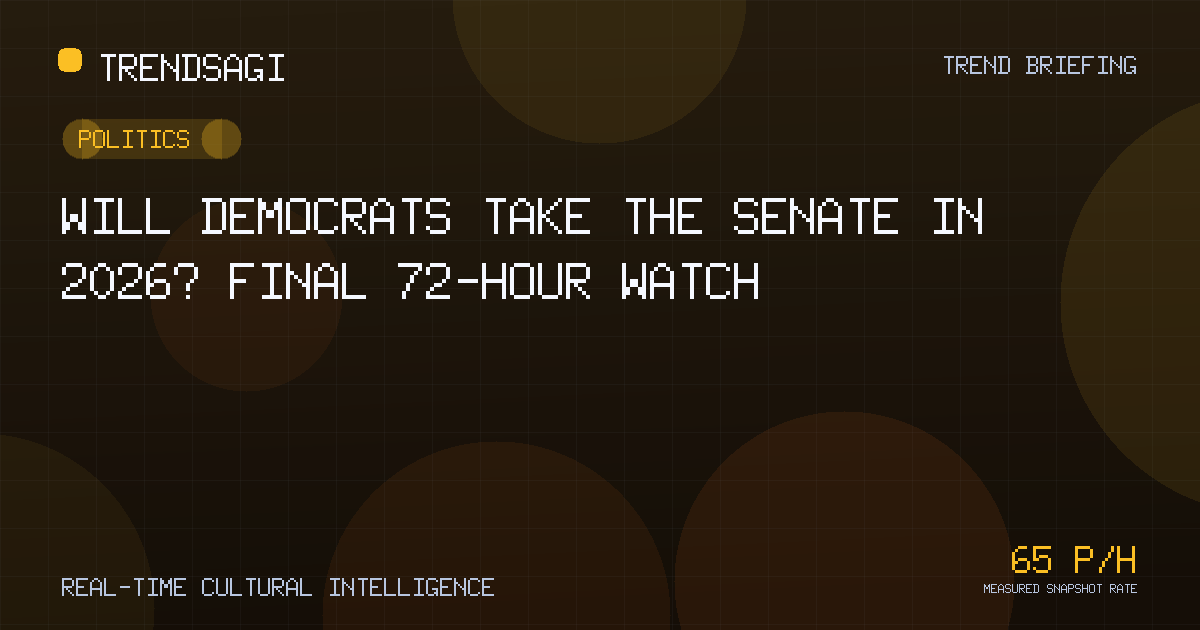
Will Democrats Take the Senate in 2026? Final 72-Hour Watch
Democrats' Senate conversation is accelerating three days before the Nov. 3 midterms. See the measured 65.3 posts/hour signal, key races and what to watch.
Automated briefing. Generated from stored signal measurements and source-backed research; it is not manually reviewed. Read the methodology and limitations or the editorial standards.
Metrics in this briefing are a snapshot associated with its publication date and may not reflect current conditions.
What changed
The Democratic Party conversation is accelerating sharply into the final weekend before the Nov. 3, 2026 midterms. Stored observations show the topic climbing to a measured snapshot rate of 65.3 posts/hour over an exact 1,929-second window ending at 2026-11-01T21:22:40Z, with the latest snapshot volume at 1,125 posts. That is the clearest verified change we can report: volume and velocity are both elevated three days out from election day, even though the results do not establish a single verified trigger for the spike.
The direct answer for searchers asking “will Democrats take the Senate in 2026” is that the outcome is not settled by any verified data in this briefing. What is verifiable is timing and intensity: the spike lands Oct. 31–Nov. 1, 2026, and coverage cited by BBC, UnHerd and tagesschau.de focuses on Democratic prospects for the House and Senate and on the party’s ideological direction. Specific polling averages and seat projections are not verified here, so treat any precise odds you see elsewhere as unconfirmed unless you check the underlying source.
| Observation time (UTC) | Measured posts/hour | Snapshot volume |
|---|---|---|
| 2026-11-01T21:22:40Z | 65.3 | 1,125 posts |
Why this topic may be moving
The timing is the strongest fact we have. Three days before the Nov. 3 midterms, the conversation is being driven by horse-race coverage of Democratic House and Senate prospects and by a parallel argument about what the party should stand for. BBC reporting on the Texas Senate race asks whether a Democratic candidate can turn the tide in a state that has repeatedly disappointed the party. tagesschau.de frames the Democratic campaign as a choice between left, right and the political center. UnHerd argues that anti-Trump backlash is not the same thing as a Democratic revival.
Those three publishers point at the same underlying dynamic without agreeing on the conclusion: the election is close enough that both a Democratic wave and a narrower anti-incumbent surge remain live readings. The stored signal cannot tell you which reading is correct. It can tell you the conversation is moving faster than a normal news day, and that the acceleration is concentrated in the final 72 hours.
The signal is a measure of attention, not a forecast. A rising posts-per-hour count into election day tells you where readers are looking, not how they will vote.
Why it matters
For readers trying to understand whether Democrats can take the Senate, the practical question is which seats decide control and what the final polls show. Coverage is split between national horse-race punditry and ideology debate, so the specific seats Democrats need to flip get less plain explanation than they deserve. Michigan and Texas are covered separately, and no single source in this brief ties them together as a decisive swing map. That gap matters because Senate control usually turns on a handful of races, not on a national average.
This briefing does not verify polling averages, seat projections, or the precise real-world event that triggered the 2026-11-01T21:22:40Z spike. It also cannot confirm that every Nov. 3 reference in coverage is the actual election day. What it can establish is a measured snapshot rate of 65.3 posts/hour at a defined observation time, which is useful as a leading indicator of intensity and not as a prediction.
What to watch next
- Whether the measured rate keeps climbing in the final 48 hours or plateaus, which would suggest the conversation has peaked.
- Plain reporting that names the specific Senate seats Democrats must flip, rather than national polling averages alone.
- Michigan and Texas coverage read together as one swing map, including the El-Sayed Michigan Senate race and Talarico Texas Senate polls where verified sources support it.
- Whether the “blue wave” and “anti-Trump surge” framings survive contact with district-level reporting, or whether both give way to a narrower read.
- Any post-election analysis of the Democratic Party’s direction and what it implies for 2028.
Frequently asked questions
How big is the Democrats’ lead in the House and Senate polls right now?
This briefing does not verify any specific polling average or lead size, so no number can be stated responsibly here. Verified coverage in this brief discusses Democratic prospects without establishing a polling margin. Check the underlying pollster and date before treating any lead as real.
Which Senate races decide control and what do the latest polls show in Michigan and Texas?
Michigan and Texas are the races most prominently discussed in the verified coverage here, with BBC reporting on the Texas Senate race and Democratic hopes of turning the tide. Specific polling numbers for either state are not verified in this brief, so the latest poll figures should be treated as unconfirmed until you read the source directly.
Is this a genuine blue wave or just an anti-Trump surge?
Verified coverage explicitly frames this as an open question. UnHerd argues that anti-Trump backlash is not the same as a Democratic revival, while other coverage treats Democratic prospects as live. The stored signal shows attention rising but cannot settle which reading is correct.
Will a progressive or centrist message help Democrats in swing districts?
tagesschau.de frames the Democratic campaign as a choice between left, right and the center, which reflects a genuine internal debate rather than a settled strategy. No verified source here establishes which message is winning in swing districts, so the honest answer is that it remains contested.
What happens to the Democratic Party’s direction — and 2028 — after Tuesday?
The verified coverage points to an active argument about the party’s ideological direction, and post-election analysis will likely turn on which factions can claim the result. Any specific 2028 implication is speculation at this stage and is not established by the data in this brief.
How does Trump’s approval rating compare to past midterm cycles?
This briefing does not verify any Trump approval rating or a historical comparison, so no figure or ranking can be stated truthfully. That comparison requires a direct, dated polling source.
Methodology and limitations
The change figure is a measured snapshot rate of 65.3 posts/hour, calculated over an exact 1,929-second window using three stored observations and measured at 2026-11-01T21:22:40Z. It is not a live rate, forecast, reach, engagement or unique-person count. The latest snapshot volume is 1,125 posts and should not be read as a rate. The measured rate describes the stored signal only; it does not measure the size of any rally, the accuracy of any poll, or the likelihood of any electoral outcome.
This briefing deliberately omits polling averages, seat projections, search-volume data, the precise real-world event behind the spike, and any traffic or ranking data for competing pages because none of those were verified. Readers who need those figures should go to the original pollsters and election analysts. The value here is narrower and more honest: a timestamped read on how fast the Democratic Party conversation is moving in the final 72 hours, plus a guide to the questions that will actually decide Senate control.
Sources
Track This Topic for New Signals
Set alerts for future velocity or sentiment changes around this topic.
Explore Tracking PlansAbout TrendsAGI research
TrendsAGI's automated research pipeline publishes dated signal snapshots, methodology notes, and practical workflows for teams evaluating cultural momentum. Read how signals are scoped, scored, and limited in our research methodology.