889-second window · 3 observations · Measured Oct 27, 2026, 4:20 PM UTC · Provider: go_recent_snapshot_v2
James Comey Charged a Third Time: The 2016 Leak Case Explained
Comey was charged a third time over an alleged 2016 leak of national defense info. What the filing says, how it compares to the two prior cases, and what's
Automated briefing. Generated from stored signal measurements and source-backed research; it is not manually reviewed. Read the methodology and limitations.
Metrics in this briefing are a snapshot associated with its publication date and may not reflect current conditions.
What changed
Federal prosecutors have moved to charge former FBI Director James Comey for a third time, alleging that in 2016 he leaked national defense information to the media. The complaint was unsealed around Oct. 25–26, 2026, and Comey publicly denied the charges in an Instagram video, according to BBC and Deutschlandfunk. This follows two earlier federal prosecutions that did not result in convictions.
Interest is not moving in a vacuum. TrendsAGI's stored observations measured about 2,660 posts per hour across an exact 889-second window ending at the 2026-10-27T16:20:31Z snapshot, which carried 1,090 posts. That is a measured snapshot rate, not a live or forecast figure. The spike appears driven by real-time social reaction that began around the complaint's unsealing and Comey's video response — timing that static wire reports do not capture.
| Observation time | Measured posts/hour | Snapshot volume |
|---|---|---|
| 2026-10-27T16:20:31Z | 2,660.8 | 1,090 posts |
Why this topic may be moving
The verified reason for the surge is straightforward: a third federal case against a former FBI director is unusual, and it landed alongside a public denial from Comey himself. BBC reported the third set of federal charges, and Deutschlandfunk reported that the U.S. Justice Department has charged Comey for a third time. Those two facts — a new filing plus a personal video rebuttal — give social conversation both a news hook and a quotable reaction to circulate.
The search behavior the brief identifies centers on confusion rather than curiosity about a single detail. People are asking what exactly this case alleges, why this is the third prosecution, how it compares with the earlier two, and whether the charges are legally serious or politically motivated. Much of the ranking coverage is wire-style and thin on the underlying conduct, so the questions outrun the answers available.
Why it matters
A third prosecution of the same former official raises structural questions beyond the individual case: how the Justice Department builds and re-builds a case, what procedural weaknesses can sink one, and whether appointment or venue issues that undid earlier efforts could recur here. For readers following the story, the practical value is separating three things that are easily blurred — the substance of the new allegation, the history of the prior cases, and the public response from Comey and his legal team.
It also matters for disambiguation. Searches around "Comey" are pulling together James Comey and Maurene Comey, who is the subject of a separate ruling on her dismissal. Verified sources in this brief do not establish any connection between the two matters, and readers should treat suggestions of one as unconfirmed.
The most useful reading of this moment: a fresh filing and a video denial generated measurable social velocity, but the substance of the two counts, the strength of the evidence, and any link to the earlier cases remain described only in outline in the coverage available.
What the signal can and cannot establish
What it can establish: that a snapshotted burst of posting activity coincided with the complaint's unsealing and Comey's response, and that the volume reached 1,090 posts at the measured observation time. What it cannot establish: that the spike reflects any single audience, that it predicts sustained interest, or that the charges themselves are strong or weak. The measured rate is a timestamped observation, not a measure of reach, engagement, or unique people.
What to watch next
- Whether the reported dismissal motion is granted, denied, or scheduled for argument, and whether the legal arguments resemble those in the prior cases.
- Any clarification from English-language reporting on the identity of the alleged 2016 leak recipient; Dutch coverage cited a specific outlet, but that is not confirmed in the English sources listed.
- Whether prosecutors disclose more of the underlying alleged conduct than the two vaguely described counts.
- Whether procedural questions around appointment or venue resurface.
- Whether social volume holds, fades, or re-spikes around a court date or a statement from Comey's lawyers.
Frequently asked questions
What exactly is Comey accused of in the third case?
Prosecutors allege that Comey leaked national defense information to the media in 2016, per BBC and Deutschlandfunk. The complaint was unsealed around Oct. 25–26, 2026. Detailed descriptions of the alleged conduct and evidence are thin in the coverage available.
What are the two counts and what penalties do they carry?
Reports described two counts drawn from a three-page filing, but the exact statutory penalties are not verified in the sources available here. Treat specific sentencing figures circulating online as unconfirmed until a charging document or court record is cited.
Why is this the third time the DOJ has charged him, and what happened to the first two cases?
This is the third federal prosecution of Comey, according to BBC and Deutschlandfunk. The first two did not result in conviction; the available reporting mentions them only briefly, so the precise reasons each failed are not established in the verified material.
When did the alleged 2016 leak occur and to whom?
The alleged leak is dated to 2016. The recipient is not confirmed in the listed English-language sources; Dutch coverage cited a specific news outlet, but that detail should be treated as unconfirmed pending English reporting.
How has Comey responded, and what are his lawyers arguing?
Comey publicly denied the charges in an Instagram video, per the verified brief. Specific arguments from his legal team beyond the reported dismissal motion are not established in the sources available.
Is there a connection between this case and the separate ruling on Maurene Comey's dismissal?
No connection is verified in the material available. The two matters involve different people and different proceedings, and readers should not assume linkage without reporting that establishes it.
Methodology and limitations
The activity figure comes from three stored observations of public posting volume, measured across an exact 889-second window and expressed as a snapshot rate at 2026-10-27T16:20:31Z. It describes observed posting activity at that moment, not audience size or future interest. Legal details are attributed to BBC and Deutschlandfunk as published; items the brief flags as unverified — exact penalties, the alleged recipient, any link to the Maurene Comey ruling, and details of the earlier dismissals — are presented as unresolved rather than asserted. Where the public explanation for the surge is incomplete, this briefing says so instead of filling the gap.
Sources
- Ex-FBI chief James Comey faces federal charges for third time (BBC) — bbc.co.uk
- US-Justizministerium klagt Ex-FBI-Chef Comey zum dritten Mal an (Deutschlandfunk) — deutschlandfunk.de
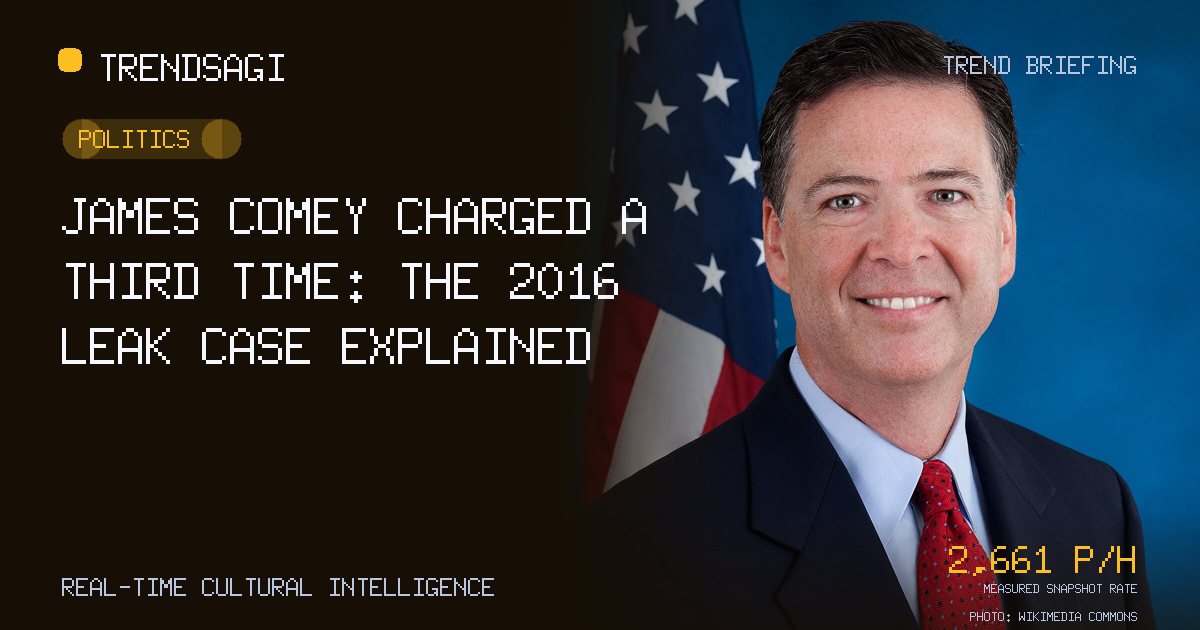
Image: James Comey by Federal Bureau of Investigation, Public domain, via Wikimedia Commons.
Track This Topic for New Signals
Set alerts for future velocity or sentiment changes around this topic.
Explore Tracking PlansAbout TrendsAGI research
TrendsAGI's automated research pipeline publishes dated signal snapshots, methodology notes, and practical workflows for teams evaluating cultural momentum. Read how signals are scoped, scored, and limited in our research methodology.