899-second window · 3 observations · Measured Oct 18, 2026, 1:42 AM UTC · Provider: go_recent_snapshot_v2
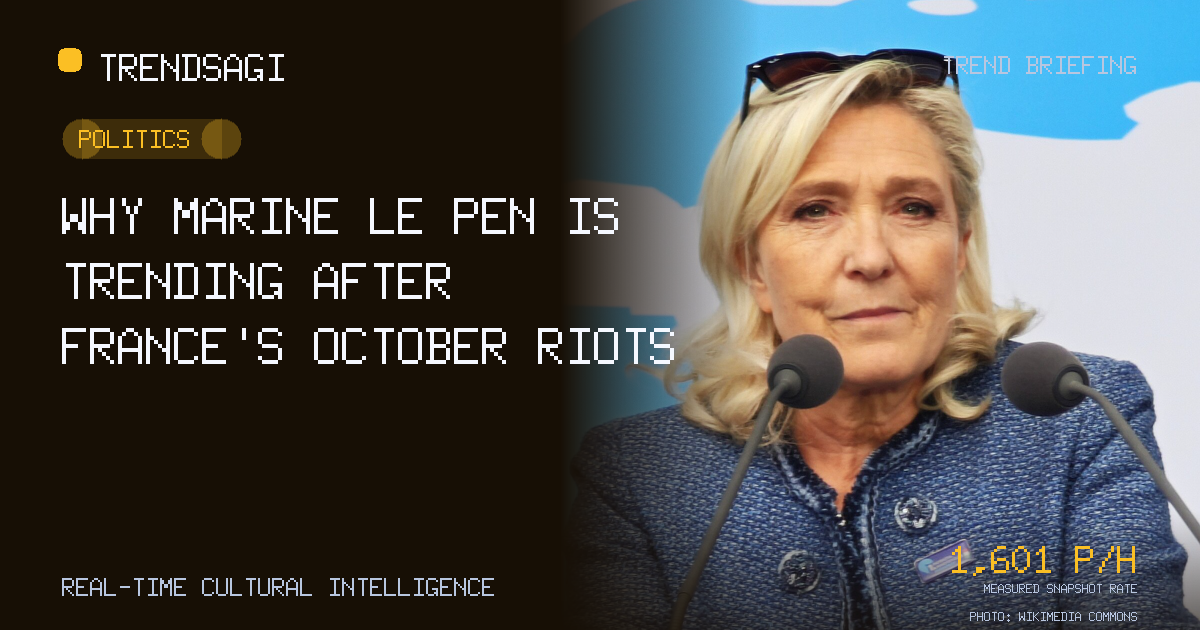
Why Marine Le Pen Is Trending After France's October Riots
Marine Le Pen discussion surged after 17 Oct 2026 French riots. Snapshot rate hit 1601 posts/hour as users linked unrest to her 2027 frontrunner status.
Automated briefing. Generated from stored signal measurements and source-backed research; it is not manually reviewed. Read the methodology and limitations.
Metrics in this briefing are a snapshot associated with its publication date and may not reflect current conditions.
What changed
Discussion of Marine Le Pen accelerated sharply after nationwide protests and riots across France on 17 October 2026. TrendsAGI measured a snapshot rate of 1601.1 posts per hour over a 899-second window ending at 2026-10-18T01:42:06Z, with a latest snapshot volume of 1000 posts. Social conversation linked the unrest over living costs, education and public services directly to her position as the clear frontrunner for the 2027 presidential election.
| Observation time (UTC) | Measured posts/hour | Snapshot volume |
|---|---|---|
| 2026-10-18T01:42:06Z | 1601.1 | 1000 |
Why this topic may be moving
On 17 October hundreds of thousands of demonstrators marched against soaring prices, underfunded schools and strained public services. Peaceful rallies in many cities were overtaken by violence: buildings set alight, shops looted, and clashes with police that led to more than 1,000 arrests according to government figures reported by multiple outlets. Interior Ministry estimates put turnout near 550,000; unions claimed higher.
Marine Le Pen, leader of the National Rally and the consistent polling leader for the April–May 2027 presidential contest, responded by condemning the violence. She accused far-left activists linked to Jean-Luc Mélenchon of hijacking legitimate cost-of-living grievances and turning them into disorder. In posts and statements she framed the unrest as evidence of the failure of the current government and positioned her party as the force that would restore order while addressing purchasing-power concerns.
The timing amplified existing momentum. Le Pen launched her fourth presidential bid in July 2026 after a Paris appeals court upheld her embezzlement conviction but shortened the ban on holding office, clearing her to run. She has since presented a fiscal plan promising roughly €140 billion in net savings and used a Brussels trip to criticise the EU budget timetable and question continued French aid to Ukraine. President Emmanuel Macron, speaking after an EU summit, told her (without naming her) to “stay humble,” according to Le Monde.
The measured social spike does not prove the riots will shift the next opinion polls, but it shows that large numbers of users immediately connected the street violence to Le Pen’s electoral prospects and to the broader sense that the political centre is exhausted.
Why it matters
France faces a presidential election in six months with Macron term-limited. Polls for months have placed Le Pen first in the opening round and competitive or ahead in most run-off scenarios. Widespread discontent over living standards and public services is precisely the terrain on which her National Rally has sought to expand beyond its traditional base. When protest turns into riot, both left and right interpret the images as validation of their diagnosis—collapse of order versus failure of the system—yet the quantitative social focus has landed disproportionately on Le Pen as the candidate best placed to capitalise.
Markets, European partners and French institutions are already pricing in the possibility of a National Rally presidency. Her recent statements on EU budget contributions, Ukraine support and a domestic debt-brake referendum add concrete policy stakes to the social-media surge.
What to watch next
- Whether the next wave of national opinion polls (expected in the coming weeks) registers any measurable movement in first-round or run-off intentions after the 17 October events.
- Progress of Le Pen’s further appeal to the Cour de Cassation; the highest court is expected to examine priority constitutional questions in December, with a final ruling potentially arriving before the April 2027 first round.
- Government responses to the underlying grievances—teacher recruitment, school infrastructure, energy and food prices—and whether they blunt or reinforce the narrative of systemic failure.
- Any escalation or de-escalation of street actions in the weeks ahead, and how National Rally and La France Insoumise message the images.
Frequently asked questions
Why is Marine Le Pen trending right now?
Nationwide protests and riots on 17 October 2026 over living costs and public services produced a sharp rise in social discussion that explicitly linked the unrest to her status as 2027 frontrunner. TrendsAGI recorded a measured rate of 1601.1 posts per hour in a short observation window early on 18 October.
Is Marine Le Pen still allowed to run in 2027?
Yes. A Paris appeals court in July 2026 upheld her embezzlement conviction but reduced the ineligibility period so that the remaining ban had already been served. She announced her candidacy the same day and has filed a further appeal to the Cour de Cassation, which suspends enforcement of the sentence while it is pending.
How do the October 2026 French protests affect her chances?
It is too early for reliable polling evidence. Social conversation has framed the disorder as confirmation of her critique of the status quo, while she has blamed the far left for the violence. Whether that narrative moves actual voting intentions remains unconfirmed.
What are the latest polls for the 2027 French election?
Multiple surveys through mid-October continue to place Le Pen first in the opening round, typically above 30 percent, with Jean-Luc Mélenchon and former prime minister Édouard Philippe among the strongest potential second-round opponents. Exact figures vary by pollster and hypothetical match-ups.
What did Le Pen say about Ukraine and the EU budget?
During a mid-October visit to Brussels she criticised the accelerated timetable for the EU’s next multi-year budget as an attempt to lock in decisions before the French election and indicated that a National Rally government would reduce French financial support for Ukraine within months. Macron publicly rejected the approach.
What is the status of her embezzlement conviction and appeal?
The July 2026 appeals court confirmed guilt, imposed a three-year sentence (one year under electronic monitoring, two suspended) and a fine, but shortened the electoral ban. Le Pen has appealed to the Cour de Cassation; that further appeal currently suspends the practical effects of the sentence, allowing her to campaign freely.
Methodology and limitations
The posts-per-hour figure is a measured snapshot rate derived from three stored observations spanning exactly 899 seconds and ending at the stated timestamp. It is not a live rate, a forecast, an engagement metric or a count of unique users. Snapshot volume records the size of the most recent observation window. The data establish that conversation volume rose sharply in the hours after the 17 October events and that many posts connected those events to Le Pen’s candidacy. They cannot establish causation for future poll movements, the durability of the spike, or the precise share of supportive versus critical commentary. Readers should treat the signal as an early quantitative indicator of attention, not as a predictor of electoral outcomes.
Sources
- Macron tells Le Pen to 'stay humble' ahead of French vote (Le Monde) — lemonde.fr
- Marine Le Pen (Wikipedia) — en.wikipedia.org
Image: Marine Le Pen by Elekes Andor, CC BY 4.0, via Wikimedia Commons.
Track This Topic for New Signals
Set alerts for future velocity or sentiment changes around this topic.
Explore Tracking PlansAbout TrendsAGI research
TrendsAGI's automated research pipeline publishes dated signal snapshots, methodology notes, and practical workflows for teams evaluating cultural momentum. Read how signals are scoped, scored, and limited in our research methodology.