2704-second window · 3 observations · Measured Nov 2, 2026, 8:01 AM UTC · Provider: go_recent_snapshot_v2
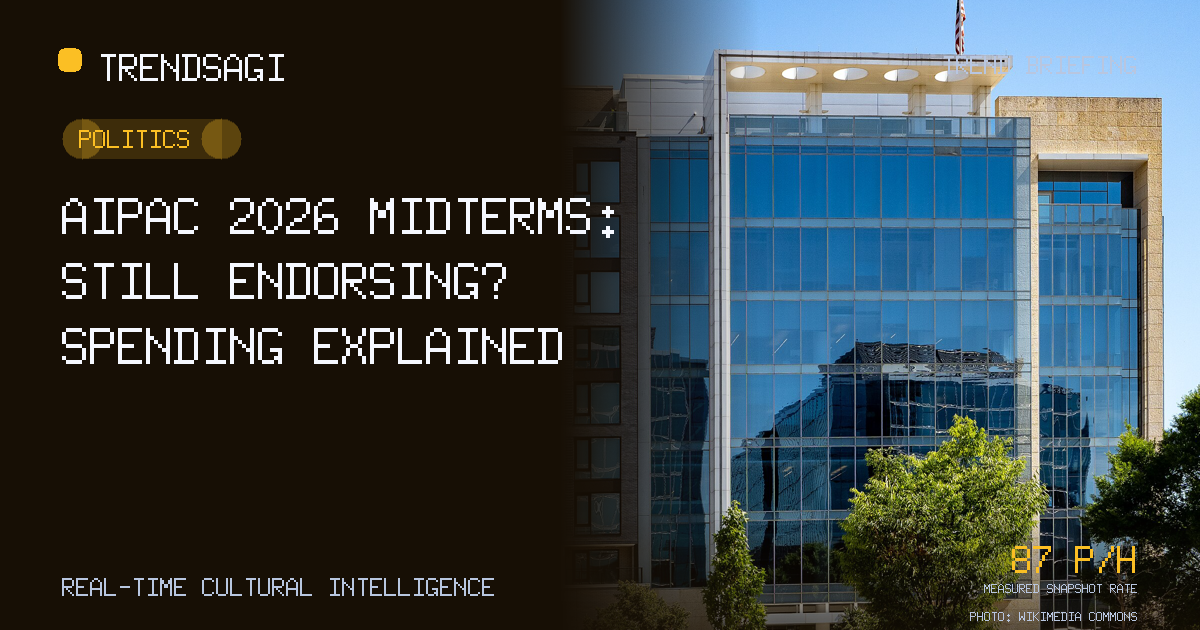
AIPAC 2026 Midterms: Still Endorsing? Spending Explained
AIPAC reportedly stopped public endorsements and direct donations but still spends via super PACs in 2026 races like Maine. TrendsAGI measured 86.6 posts/hour
Automated briefing. Generated from stored signal measurements and source-backed research; it is not manually reviewed. Read the methodology and limitations or the editorial standards.
Metrics in this briefing are a snapshot associated with its publication date and may not reflect current conditions.
What changed
Attention around AIPAC is accelerating as reporting on the 2026 US midterms gains traction. The question driving searches — is AIPAC still endorsing candidates in 2026? — follows reports that AIPAC announced it would stop publicly endorsing and directly donating to candidates, while it reportedly continues to channel large sums through super PACs and pop-up groups into races such as Maine's Senate contest. TrendsAGI measured a snapshot rate of 86.6 posts/hour at 2026-11-02T08:01:15Z, calculated from 3 stored observations over a 2,704-second window, with a latest snapshot volume of 363 posts. That measured figure describes the pace of attention at that stored moment; it is not a live rate, a forecast, or a count of unique people.
| Observation time (UTC) | Measured posts/hour | Snapshot volume |
|---|---|---|
| 2026-11-02T08:01:15Z | 86.6 | 363 posts |
Why this topic may be moving
Coverage clusters around the November 2026 midterms. The Intercept reports that AIPAC is not retreating and is already shaping the next Congress, while NOS reports that the pro-Israel group has stopped openly backing political candidates, citing "challenges." Together these describe a split picture: a public step back from endorsements and direct donations, alongside continued spending through other vehicles.
The supplied search-intent analysis does not explain why the label is spiking at this specific hour. The measured rate confirms attention is elevated at the stored observation time, but it cannot establish the trigger. Treat any single-cause explanation circulating online as unconfirmed.
Why it matters
For voters in competitive races, the distinction between direct endorsements and indirect spending is practical, not semantic. If a group stops endorsing but keeps funding ads and organizing through PACs, the visible signal changes while the financial footprint may not. Readers tracking the Maine Senate race, or any race where AIPAC-linked money is reported, need the mechanism explained plainly.
For reporters and analysts, the gap is a consolidated, dated account: what AIPAC said it would stop, what reporting says it is still doing, and where the money is reportedly going. Current coverage is fragmented across English and non-English outlets and across individual races.
What AIPAC says it will stop doing and what it is reportedly still funding are two different questions. Following the money means following the vehicles, not just the endorsements.
What to watch next
- Implementation status: whether the announced halt on public endorsements and direct donations holds, shifts, or is partly reversed. The supplied brief does not verify this.
- Super PAC and pop-up activity: new filings or reporting on pass-through groups and which races they target.
- Maine Senate race: continued reporting on spending tied to Susan Collins's contest.
- Counter-groups: whether newer organizations challenging AIPAC's influence show measurable effects. The brief does not verify any effect size.
- Attention concentration: whether the elevated rate persists or concentrates around specific races and moments.
Practical next checks: compare original reporting from The Intercept and NOS against later coverage for changes in the endorsement policy; look for dated campaign-finance filings rather than aggregated totals; and track whether the same race names recur across outlets.
Frequently asked questions
Did AIPAC really stop endorsing and donating to candidates, and when?
Reporting cited in the brief says AIPAC announced it would stop publicly endorsing and directly donating to candidates. The brief does not provide a precise date, so the exact timing is not verified here.
If it stopped direct donations, how is it still spending in the 2026 midterms?
According to reporting summarized in the brief, AIPAC still channels large sums through super PACs and pop-up groups into races such as Maine's Senate contest. The brief does not verify total dollar figures.
What are AIPAC's 'pop-up' or pass-through PACs and how do they work?
They are described in reporting as intermediary groups used to move money into specific races. The brief notes their mechanics are only described in passing, so a full plain-language explanation is not verified by the supplied material.
How much has AIPAC spent on Susan Collins and the Maine Senate race?
Reporting referenced in the brief ties AIPAC-linked spending to the Maine Senate contest, but the brief does not provide a verified dollar figure. Treat specific amounts as unconfirmed until sourced to a dated filing or report.
Which candidates and states received the most AIPAC-linked money this cycle?
The brief identifies Maine's Senate race as a reported example but does not supply a consolidated, sourced tally by candidate or state. Any ranking should be treated as unverified.
Are newer groups challenging AIPAC's influence having any measurable effect?
The brief lists this as an open question that current coverage poses but does not answer. No measurable effect is verified in the supplied material.
Methodology and limitations
The 86.6 posts/hour figure is a measured snapshot rate computed from 3 stored observations over an exact 2,704-second window and reported at 2026-11-02T08:01:15Z. The latest snapshot volume of 363 posts is a point-in-time count, not a rate. Neither figure measures reach, engagement, unique people, or future activity.
The signal is stored under the category Politics, with no stored description. The supplied search-intent brief does not verify the cause of the spike at that specific hour, specific total dollar figures for AIPAC-linked spending across all races, whether the announced policy change is fully implemented, search volume or keyword popularity, or election outcomes and voter impact. Those items are either left out or marked unconfirmed above. External facts are attributed to The Intercept and NOS as publishers; readers should check the original reports for full context and updates.
Sources
- AIPAC Isn't Retreating. Here's How It's Already Shaping the Next Congress. (The Intercept) — theintercept.com
- Pro-Israëlische AIPAC stopt openlijke steun politieke kandidaten om 'uitdagingen' (NOS) — nos.nl
Image: AIPAC by ajay_suresh, CC BY 2.0, via Wikimedia Commons.
Track This Topic for New Signals
Set alerts for future velocity or sentiment changes around this topic.
Explore Tracking PlansAbout TrendsAGI research
TrendsAGI's automated research pipeline publishes dated signal snapshots, methodology notes, and practical workflows for teams evaluating cultural momentum. Read how signals are scoped, scored, and limited in our research methodology.