15-minute window · 3 observations · Measured Oct 31, 2026, 12:48 PM UTC · Provider: go_recent_snapshot_v2
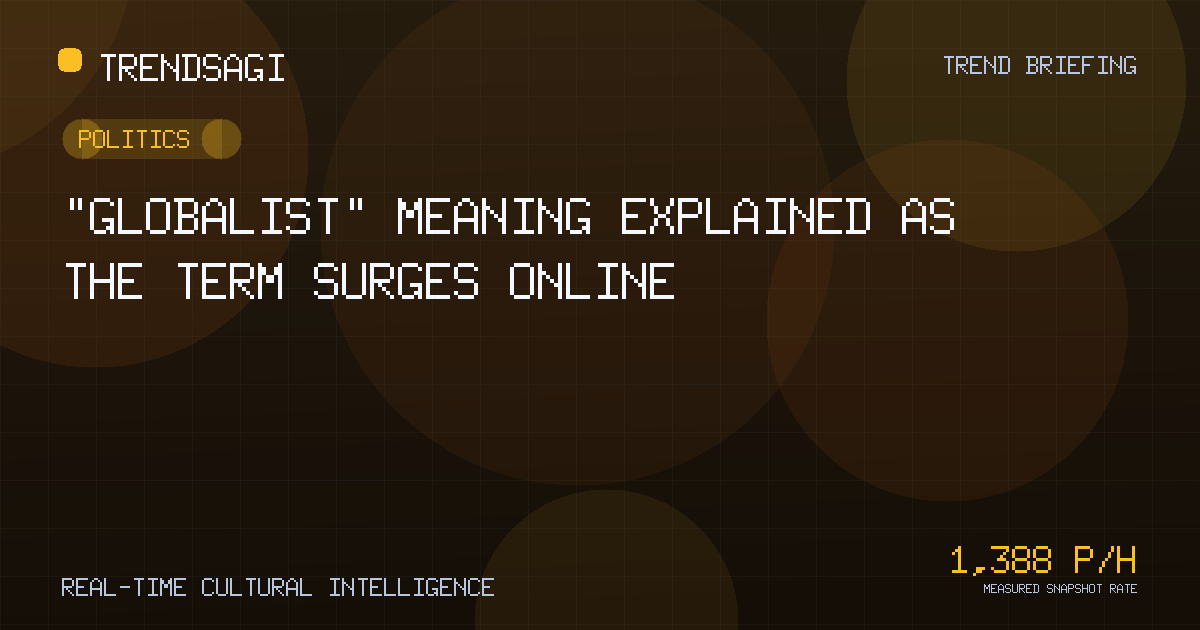
"Globalist" Meaning Explained as the Term Surges Online
TrendsAGI measured 1,388.3 posts/hour as "globalist" spikes. A neutral explainer on the term's meaning, origin and its conspiratorial uses.
Automated briefing. Generated from stored signal measurements and source-backed research; it is not manually reviewed. Read the methodology and limitations or the editorial standards.
Metrics in this briefing are a snapshot associated with its publication date and may not reflect current conditions.
What changed
Use of the political label "globalist" is spiking. TrendsAGI measured a snapshot rate of 1,388.3 posts per hour over an exact 900-second window ending 2026-10-31T12:48:35Z, with 888 posts in the latest snapshot. The measured rate is the only confirmed signal that the term is moving now: the search results reviewed for this briefing do not establish a single real-world event that triggered the increase. Instead, "globalist" appears as a recurring geopolitical and culture-war framing term across Serbian, Spanish, English and social posts in late October 2026, clustered around a purported globalist-versus-sovereigntist struggle, commentary on European riots, COP31 climate politics and preparedness warnings.
Snapshot at a glance
| Observation time | Measured posts/hour | Snapshot volume |
|---|---|---|
| 2026-10-31T12:48:35Z | 1,388.3 | 888 posts |
The rate figure is a measured snapshot rate over three stored observations, not a live or current rate, a forecast, a reach or engagement metric, or a count of unique people. Treat it as a velocity reading for a defined 15-minute window.
Why this topic may be moving
The honest answer is that the cause is still unclear. The search-intent brief states plainly that the ranking pages do not establish one verified triggering event. What the brief does document is a cluster of commentary. The Star News Network published a commentary piece arguing that Europe's riots are "the bill coming due for socialism and globalism." totalnews.com published a piece titled "The Climate Agenda of Globalists Resurfaces Strongly." TikTok carries a neutral explainer of the word's modern meaning. These are opinion and definitional pieces circulating together, not a reported event with a date, place and verified facts.
That matters for interpretation. A term can spike because something happened, or because commentators are reusing a frame that is already emotionally loaded. In this case the evidence supports the second reading so far: the term is being applied across several unrelated storylines at once, which is what a framing word does rather than what a discrete news event does. Whether the usage is a coordinated campaign or organic discussion is not established by the available results, and this briefing does not claim otherwise.
Why it matters
"Globalist" is a contested label, and contested labels shape how people read the news. When the same word is attached to riots, climate summits, banking warnings and trade policy, readers can lose the line between a description of internationalist policy and a pejorative shorthand for a hidden agenda. That line is exactly what most searchers are trying to find.
Several gaps in the currently ranking pages make this harder:
- No reviewed result gives the term's etymology or historical origin; the TikTok explainer offers only a rough modern definition.
- None of the results examines the term's conspiratorial and antisemitic connotations, which is a central question for searchers.
- No single source sets out the specific late-October 2026 drivers — European riots commentary, COP31 in Antalya and the "33 nations prepare" claim — in one place.
- The preparedness and "banking reset" claim in one ranking result is presented without verification, and no reviewed page fact-checks it.
- Most results are opinion or advocacy and do not separate policy internationalism from pejorative usage.
The label is doing more work than the reporting: the term is moving across several storylines at once, but the available sources do not show a single verified event underneath that movement.
How to read the term in the wild
A practical distinction helps. In neutral usage, "globalist" can describe a person or policy favoring international institutions, treaties, open trade or coordinated global action. In pejorative usage, it often implies a small elite directing events from behind the scenes, and it can carry antisemitic insinuation when it names financiers or a supposed global network rather than describing a stated policy position. Readers should watch for the tell: does the sentence name an actual policy, institution or decision, or does it assert a hidden plan without evidence?
On the globalist-versus-sovereigntist framing, real policy debates do exist — over climate commitments such as COP31, trade rules, and the scope of international institutions. The framing becomes conspiratorial when it replaces those specifics with a claim of concealed coordination.
What to watch next
- Whether the measured posting rate holds, rises or falls across the next stored windows, which would show whether this is a short burst or a sustained narrative push.
- Which sub-themes co-occur in the same window — riots commentary, COP31, preparedness warnings — and whether one begins to dominate.
- Whether any outlet publishes a reportable, verifiable event with named officials and dates, rather than commentary.
- Whether the "33 nations prepare" and "banking reset" claims receive independent verification or remain unconfirmed.
- Whether Serbian, Spanish and English commentary converge on the same talking points, which would bear on the coordination question without settling it.
Frequently asked questions
What does "globalist" actually mean, and where did the term come from?
In ordinary usage it describes someone who favors international cooperation, institutions or open trade. The reviewed sources offer only a rough modern definition and do not supply a reliable etymology, so the term's historical origin remains unverified in this briefing.
Who uses the word globalist, and who is it usually aimed at?
It is used across the political spectrum, but in current commentary it is most often aimed at policymakers, international institutions, financiers and climate-agenda advocates. The reviewed results do not provide a systematic survey of who uses it.
Is "globalist" a neutral description of internationalist policy or a conspiracy-coded label?
It can be either. It functions as a neutral description when it names a stated policy or institution, and as a pejorative or conspiracy-coded label when it implies a concealed elite agenda without evidence.
Why is the term spiking in late October 2026 — what events are people reacting to?
No single verified event is established by the reviewed results. The brief documents a cluster of commentary around European riots, COP31 climate politics and preparedness warnings, plus a measured snapshot rate of 1,388.3 posts per hour at 2026-10-31T12:48:35Z.
How does the globalist-vs-sovereigntist framing map onto real policy debates like climate summits and trade?
Genuine debates exist over climate commitments, trade rules and the authority of international bodies. The framing is informative when it engages those specifics and conspiratorial when it substitutes a claim of hidden coordination for them.
How can I tell a serious use of the term from an antisemitic or conspiratorial dog whistle?
Look for named policies, institutions or decisions on one side, and for unnamed elites, financiers or a secret plan on the other. Claims of hidden control without verifiable evidence are the warning sign; antisemitic insinuation often appears when the supposed network is coded rather than described.
Methodology and limitations
The velocity figure comes from TrendsAGI's stored observations: three snapshots, with the latest at 2026-10-31T12:48:35Z, yielding 1,388.3 posts per hour measured over an exact 900-second window. It is a snapshot rate, not a live measurement, and it is a count of posts, not people. The snapshot volume of 888 posts refers to that latest observation.
This briefing cannot establish a single triggering event, cannot confirm the "33 nations prepare" or "banking reset" narratives, and cannot determine whether usage is coordinated or organic. No traffic, ranking or keyword-volume data were provided. The external commentary cited is attributed to its publishers and should be read as opinion unless independently verified.
Sources
Track This Topic for New Signals
Set alerts for future velocity or sentiment changes around this topic.
Explore Tracking PlansAbout TrendsAGI research
TrendsAGI's automated research pipeline publishes dated signal snapshots, methodology notes, and practical workflows for teams evaluating cultural momentum. Read how signals are scoped, scored, and limited in our research methodology.