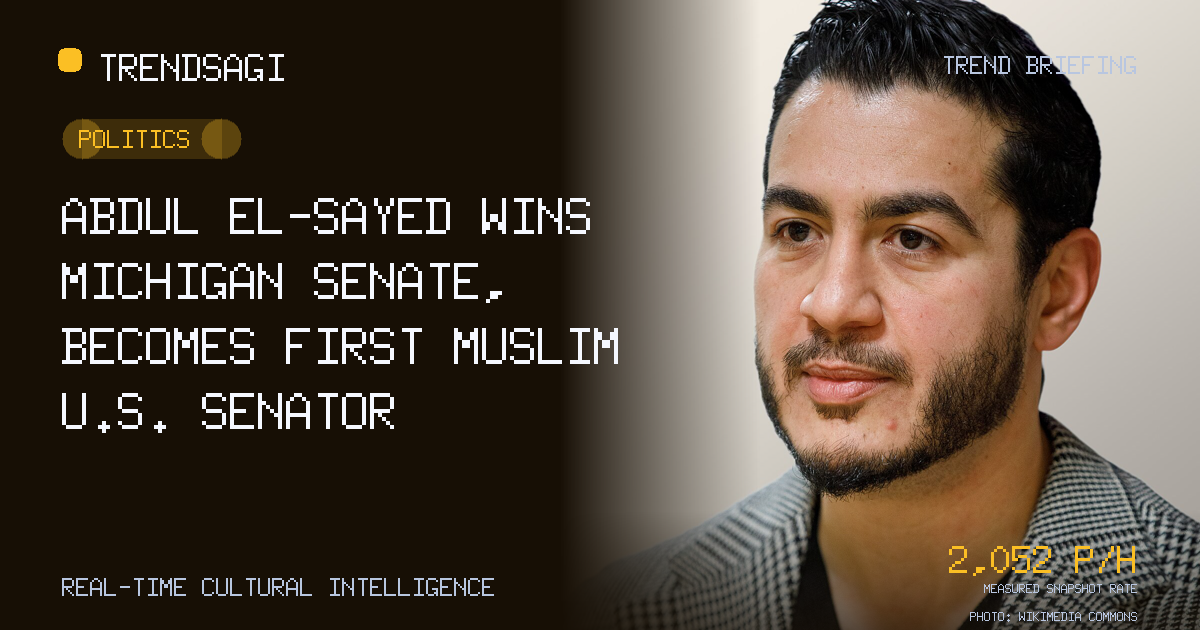
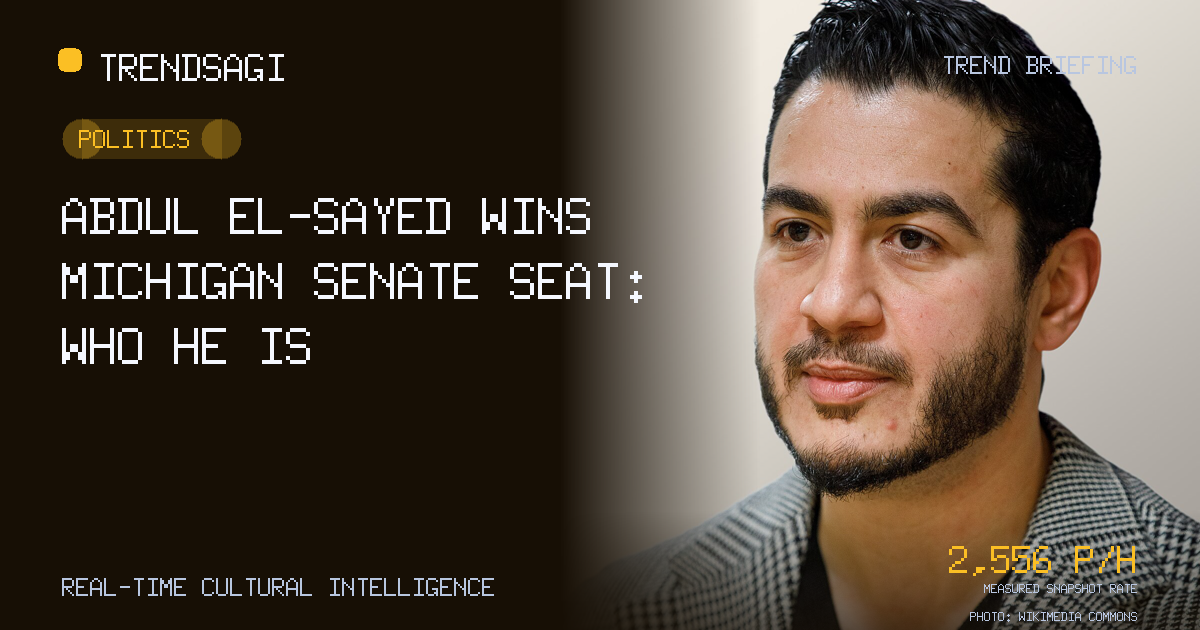
903-second window · 3 observations · Measured Nov 4, 2026, 7:46 PM UTC · Provider: go_recent_snapshot_v2
What Did Trump Say About the Muslim Brotherhood?
Trump attacked Abdul El-Sayed over alleged Muslim Brotherhood ties before the 2026 midterms. What is verified, what is not, and why searches are spiking.
Automated briefing. Generated from stored signal measurements and source-backed research; it is not manually reviewed. Read the methodology and limitations or the editorial standards.
Metrics in this briefing are a snapshot associated with its publication date and may not reflect current conditions.
What changed
President Donald Trump made remarks about the Muslim Brotherhood while campaigning for Republican Senate candidates ahead of the November 3, 2026 US midterms, specifically attacking Michigan Democrat Abdul El-Sayed over alleged family ties to the group. That verified campaign context is why search interest in "what did Trump say about the Muslim Brotherhood" is moving. The topic is not moving because of a court ruling, a new designation, or a documented organizational development — none of those are established in the available record. The recorded signal is a measured snapshot rate of 949.0 posts/hour over an exact 903-second window, using 3 stored observations, measured at 2026-11-04T19:46:12Z, with a latest snapshot volume of 580 posts. That figure describes how fast the stored observation set changed at measurement time; it is not a live rate, a forecast, a reach estimate, or a count of unique people.
| Observation time (UTC) | Measured posts/hour | Snapshot volume |
|---|---|---|
| 2026-11-04T19:46:12Z | 949.0 (measured snapshot rate, 903-second window, 3 stored observations) | 580 posts |
Why this topic may be moving
The verified driver is political rhetoric, not a new legal or intelligence finding. Trump raised the Muslim Brotherhood while stumping for Republican Senate candidates in the final stretch before the November 3 midterms, and he tied the group to Abdul El-Sayed through alleged family connections. That combination — a presidential-level claim, a named candidate, and an election deadline — is the kind of package that reliably pulls searches toward basic questions: what was actually said, who El-Sayed is, and what the Brotherhood actually is. The search-intent brief notes that ranking pages lean toward opinion and advocacy rather than neutral explanation, which leaves the plain who/what/when questions underserved.
What the record does not establish is equally important. No verified source in the brief provides a direct, official statement from Abdul El-Sayed or his family responding to the claims. The specific date and year of Egypt's declaration of the Brotherhood as a terrorist organization is not fully contextualized in the available snippets. And the midterm outcome reported by one opinion outlet is not confirmed by a primary news source in the results. Where the cause of the surge beyond the campaign remarks is unclear, it should be described as unclear.
Why it matters
This is a case where a campaign claim about a designated or banned organization can travel faster than the underlying facts. The Muslim Brotherhood is a real organization with a long history, and it is banned or restricted in several countries; that makes the label sound authoritative even when the specific evidentiary link to an individual is thin or unverified. Readers who encounter the claim in a feed have a practical reason to separate three things: what a politician said, what public records show, and what the group actually is.
There is also a policy dimension. The Washington Examiner frames the El-Sayed question as an uncomfortable truth worth confronting; the National Post runs an opinion column describing the Brotherhood as a "cancer" at the heart of Canada; JINSA publishes an explainer on what the group is and why it threatens the United States. Those are different genres — opinion, opinion, and advocacy-adjacent analysis — and none of them functions as a neutral fact-check of the El-Sayed allegation. The gap matters because the Canadian angle in particular is covered only by a single opinion column in the available results, with no balanced explainer on the group's legal status and activities there.
The useful question is not whether the Brotherhood is controversial — it plainly is — but whether the specific claim about a specific candidate is supported by public records. On the available evidence, that link remains asserted rather than demonstrated.
What is actually known, by question
Trump's remarks came during campaign appearances for Republican Senate candidates before the November 3, 2026 midterms, and centered on alleged family ties between El-Sayed and the Muslim Brotherhood. That much is verified by the search-intent brief. Beyond that, the brief does not supply a verbatim transcript, so any reconstruction of exact wording should be treated cautiously.
The Muslim Brotherhood is an Islamist movement and organization with roots in Egypt, and it is banned or restricted in a number of countries, including Egypt. The brief notes that the Egypt history and ban are mentioned in ranking coverage but not contextualized with dates and current status in one accessible place — a real gap for readers arriving mid-spike.
On El-Sayed specifically, no verified evidence in the brief substantiates the family-tie claim. No official response from him or his family appears in the results. That is not proof the claim is false; it is a statement about what the record currently shows, and readers should hold the distinction.
What to watch next
- Any direct, on-the-record statement from Abdul El-Sayed or his family addressing the claim.
- Primary-source reporting, rather than opinion columns, on the midterm results and any post-election follow-through on the Brotherhood remarks.
- Official statements from the Egyptian government or from Western governments on the group's legal status, which would give the debate a firmer factual anchor.
- Whether the measured snapshot rate decays as the election news cycle turns over — a rapid rise and rapid fall is characteristic of campaign-driven attention.
Practical next checks for a careful reader: look for a transcript or clip of the actual remarks; distinguish opinion columns from reported pieces; and treat any claim about a candidate's family as unverified until a primary source addresses it.
Frequently asked questions
What exactly did Trump say about the Muslim Brotherhood and Abdul El-Sayed?
Trump made remarks about the Muslim Brotherhood while campaigning for Republican Senate candidates ahead of the November 3, 2026 midterms, attacking Michigan Democrat Abdul El-Sayed over alleged family ties to the group. The verified record confirms the campaign context and the thrust of the attack; it does not supply a full verbatim transcript.
What is the Muslim Brotherhood and why is it banned in some countries?
The Muslim Brotherhood is an Islamist movement and organization with roots in Egypt, and it is banned or restricted in several countries, including Egypt. In the available coverage, the Egypt ban is mentioned but not fully contextualized with dates and current status in a single accessible explainer.
Is there verified evidence that Abdul El-Sayed or his family are linked to the Muslim Brotherhood?
No verified evidence in the available record substantiates the family-tie claim, and no direct official response from El-Sayed or his family appears in the results. The claim is asserted in political rhetoric; treat it as unconfirmed until a primary source addresses it.
How does the Muslim Brotherhood operate in Canada and other Western countries?
This is one of the weaker-covered angles: the Canadian dimension appears mainly in a National Post opinion column describing the group as a "cancer" at the heart of Canada, with no balanced explainer on legal status and activities in the available results. Readers should treat the Canadian claims as opinion rather than established fact pending further reporting.
Why did the Muslim Brotherhood topic spike around the 2026 US midterms?
The topic is spiking because Trump made remarks about the group while campaigning for Republican Senate candidates before the November 3, 2026 midterms, specifically attacking El-Sayed over alleged family ties. The combination of a presidential-level claim, a named candidate, and an election deadline is the verified driver.
Methodology and limitations
The measured figure in this briefing — 949.0 posts/hour — is a snapshot rate calculated over an exact 903-second window using 3 stored observations, measured at 2026-11-04T19:46:12Z. It describes the rate of change in the stored observation set at that moment. It is not a live or current rate, and it should not be read as a forecast, a reach estimate, an engagement measure, or a count of unique people. The latest snapshot volume was 580 posts.
The signal can establish that attention to this topic was moving quickly at measurement time and that the volume of stored posts was non-trivial. It cannot establish why any individual searcher looked, what they concluded, or whether the underlying political claim is true. It also cannot corroborate the measurement methodology behind the rate, since no search result in the brief independently confirms it. Where the available record is silent — on El-Sayed's response, on the precise year of Egypt's designation, on the confirmed midterm outcome, and on unverified claims of external support for the group — this briefing says so rather than filling the gap.
Sources
- If it quacks like a duck: The uncomfortable truth about Abdul el Sayed (Washington Examiner) — washingtonexaminer.com
- Michael Higgins: The Muslim Brotherhood is a 'cancer' at the heart of Canada (National Post) — nationalpost.com
- The Muslim Brotherhood: What It Is and Why It Threatens the United States - JINSA — jinsa.org
Track This Topic for New Signals
Set alerts for future velocity or sentiment changes around this topic.
Explore Tracking PlansAbout TrendsAGI research
TrendsAGI's automated research pipeline publishes dated signal snapshots, methodology notes, and practical workflows for teams evaluating cultural momentum. Read how signals are scoped, scored, and limited in our research methodology.