15-minute window · 3 observations · Measured Nov 4, 2026, 7:31 PM UTC · Provider: go_recent_snapshot_v2
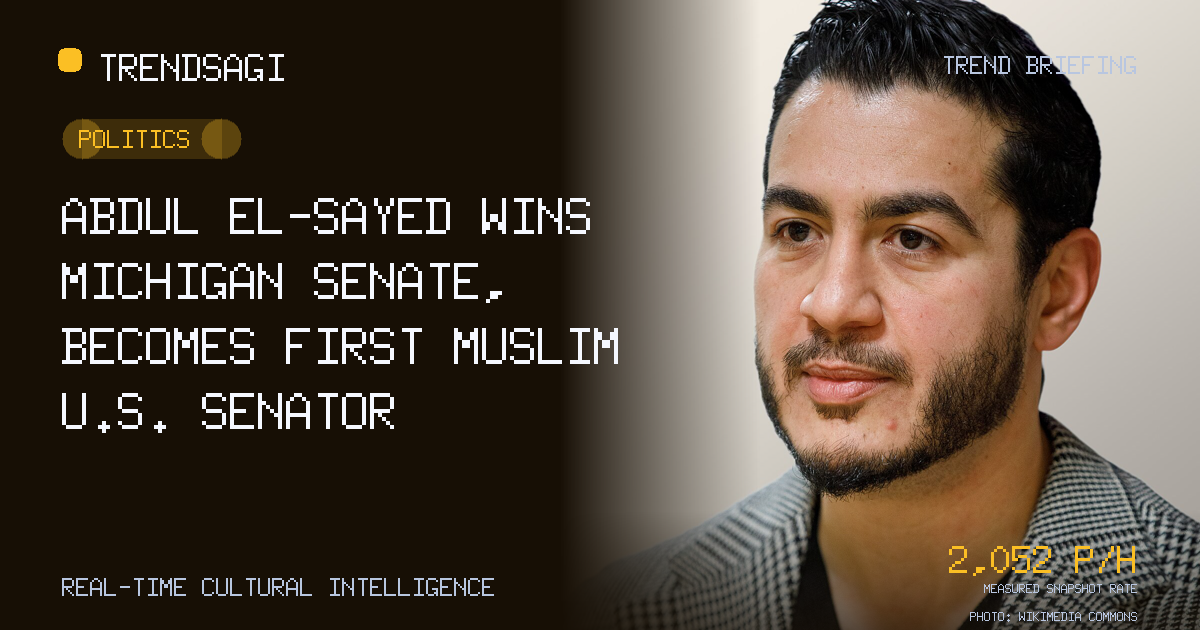
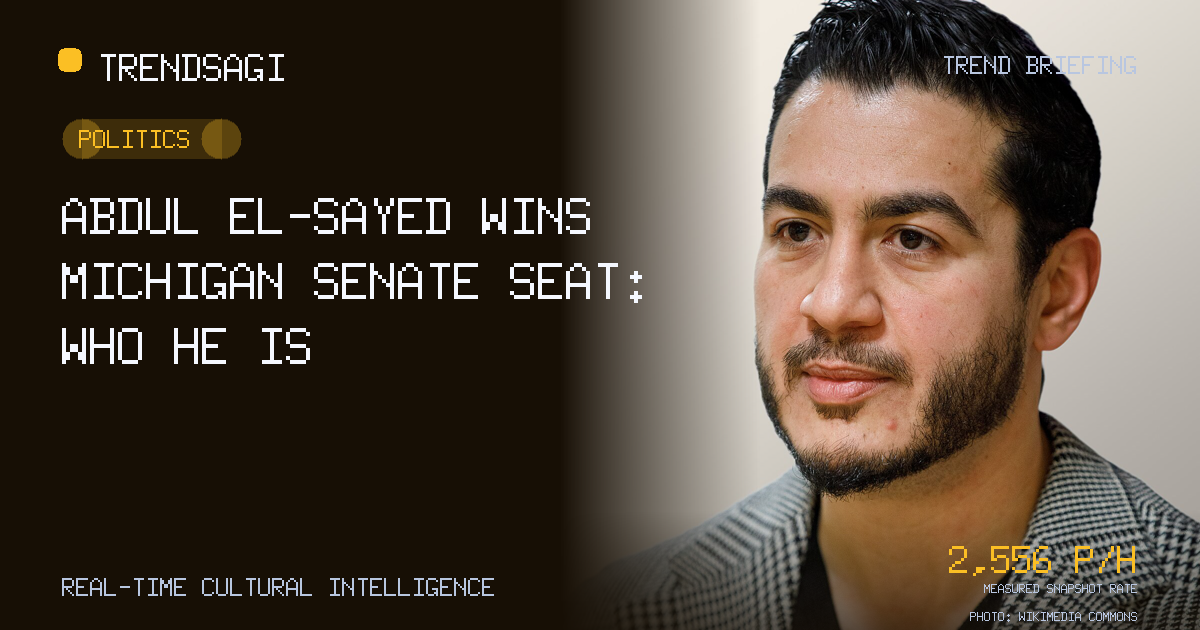
Abdul El-Sayed Wins Michigan Senate Seat: Who He Is
Abdul El-Sayed won Michigan's Senate race, a reported first for a Muslim senator. See what drove the spike, what's verified, and what's still unclear.
Automated briefing. Generated from stored signal measurements and source-backed research; it is not manually reviewed. Read the methodology and limitations or the editorial standards.
Metrics in this briefing are a snapshot associated with its publication date and may not reflect current conditions.
What changed
Abdul El-Sayed won Michigan's US Senate race in the November 3, 2026 midterms, defeating Republican Mike Rogers, and is being described by outlets including Anadolu Ajansı as the first Muslim elected to the US Senate. The win set off a rapid burst of public attention: TrendsAGI measured a snapshot rate of 2,556.2 posts per hour over an exact 900-second window at 2026-11-04T19:31:07Z, with a latest snapshot volume of 1,180 posts. That measurement captures how hard the story moved at one point in time — it is not a live rate, a forecast, or a reach or engagement figure.
| Observation time (UTC) | Measured snapshot rate | Snapshot volume |
|---|---|---|
| 2026-11-04T19:31:07Z | 2,556.2 posts/hour | 1,180 posts |
Why this topic may be moving
The verified driver is the victory itself. According to the search-intent brief built from live search results, the surge in posts coincides with El-Sayed's historic win, a viral victory speech, and a heated Election Day exchange with a Sky News reporter. Those are the three threads most searchers are pulling on.
Two of those threads are documented by named publishers. Anadolu Ajansı published a profile asking and answering who El-Sayed is, framed around the first-Muslim milestone. HuffPost UK reported that a Sky News reporter was grabbed by a US politician during a heated exchange — the reporter clash that is circulating alongside the results.
Who is Abdul El-Sayed, and why the milestone matters
Searchers asking "who is Abdul El-Sayed" want a concise profile that connects the person to the win. Outlets covering the result identify him as the newly elected Democratic senator from Michigan and frame the victory as a first for Muslim Americans in the chamber. The profile coverage from Anadolu Ajansı is the clearest published source for that framing.
What the brief does not establish is a primary election-authority citation for the first-Muslim claim. The milestone is attributed to the outlets reporting it rather than to an official record, so readers should treat it as the widely reported framing rather than a certified historical fact.
What drove the spike, and what didn't
The measured rate tells you when attention peaked, not why each post was written. Three distinct moments are entangled in the same news cycle:
- The result. A Senate seat flipping in a midterm year is inherently high-volume news.
- The speech. Remarks aimed at Trump and JD Vance went viral, pulling in audiences beyond Michigan.
- The confrontation. A heated Election Day exchange with a Sky News reporter added a second, visually shareable moment.
The signal cannot separate those strands. It can show that the topic moved at 2,556.2 posts per hour in the measured window; it cannot tell you which viral clip produced which share of the volume.
The reliable takeaway is narrower than the noise: a Senate win and a reported first-Muslim milestone are the load-bearing facts, while the viral speech, the reporter clash, and the insults are the accelerants that pushed the story past its political base.
Why it matters
For readers outside Michigan, this is a story about representation and about how a single down-ballot result becomes a national conversation. For anyone tracking political media, it is a case study in how a result, a speech, and a confrontation can merge into one trend within hours.
The people who should care most: Michigan voters checking what their new senator stands for; Muslim American readers following a reported first; policy watchers focused on healthcare, affordability, and military aid; and newsroom and communications teams trying to understand which moments actually moved the numbers.
What to watch next
- Whether the measured rate decays quickly or holds, which would suggest sustained interest rather than a single-day spike.
- Publication of certified vote totals or official results, which would firm up the margin the brief currently leaves unconfirmed.
- Fuller reporting on the Sky News exchange, including what he was asked and why he refused to answer.
- Any formal response from Senate colleagues or party leadership to the milestone.
- Whether platform coverage consolidates around his policy platform rather than the viral moments.
Frequently asked questions
Who is Abdul El-Sayed and what was he before running for Senate?
He is the Democrat newly elected to Michigan's US Senate seat in the November 3, 2026 midterms. Outlets profiling him tie his candidacy to the reported first-Muslim milestone in the chamber; the brief does not verify his prior roles in detail, so check the Anadolu Ajansı profile for his background.
Did he actually win Michigan's Senate race, and by what margin?
Yes — the verified brief states he defeated Republican Mike Rogers. The exact margin and total votes are not confirmed in the brief, so treat any specific figure you see as unverified until official results are published.
Why is he called the first Muslim elected to the US Senate?
Outlets including Anadolu Ajansı describe his win that way. The brief does not cite a primary election authority for the claim, so it should be understood as the reported framing rather than a certified record.
What exactly did he say in his victory speech about Trump and JD Vance?
The speech remarks aimed at Trump and JD Vance are verified as a driver of attention, but the full text and exact wording are not confirmed in the brief. Avoid quoting specific lines unless you can trace them to a primary recording or transcript.
What happened in his exchange with the Sky News reporter?
HuffPost UK reported that a Sky News reporter was grabbed by a US politician during a heated exchange on Election Day. The brief confirms the clash as a verified driver of the surge but notes that the fuller context — what he was asked and why he refused — is thin in existing coverage.
What are his main policy positions on healthcare, affordability, and military aid to Israel?
Coverage of his platform is scattered, and the brief does not verify specific positions in detail. Readers should look for a consolidated platform source rather than inferring positions from the viral moments.
Methodology and limitations
The rate cited here is a measured snapshot rate: 2,556.2 posts per hour over an exact 900-second window, using three stored observations and measured at 2026-11-04T19:31:07Z, with a latest snapshot volume of 1,180 posts. It is not a live or current rate, a forecast, a reach or engagement metric, or a count of unique people.
What this signal can establish: that the topic moved quickly at a specific measured moment and roughly how large the observed volume was. What it cannot establish: the cause of the movement, the vote margin, the exact wording of the speech, the primary-source basis for the first-Muslim claim, or the accuracy of insult quotes attributed to Trump that are reported by one outlet and not independently confirmed here. Facts about the win and the milestone are attributed to the publishers named above.
Sources
- PROFILE - Who is Abdul El-Sayed, the first Muslim elected to US Senate? (Anadolu Ajansı) — mobil.aa.com.tr
- Sky News Reporter Grabbed By US Politician During Heated Exchange (HuffPost UK) — huffingtonpost.co.uk
Image: Abdul El-Sayed by Kenneth C. Zirkel, CC BY-SA 4.0, via Wikimedia Commons. The thumbnail adapts this photo with a title overlay and is shared under the same licence.
Track This Topic for New Signals
Set alerts for future velocity or sentiment changes around this topic.
Explore Tracking PlansAbout TrendsAGI research
TrendsAGI's automated research pipeline publishes dated signal snapshots, methodology notes, and practical workflows for teams evaluating cultural momentum. Read how signals are scoped, scored, and limited in our research methodology.