807-second window · 2 observations · Measured Nov 4, 2026, 2:18 PM UTC · Provider: go_recent_snapshot_v2
What "Woke 2" Means After the Midterms: A 2026 Glossary
Woke is spiking after the US midterms. What "woke 2" means, the meme wave Newsweek reported, and a 2026 glossary of the term's shifting meanings.
Automated briefing. Generated from stored signal measurements and source-backed research; it is not manually reviewed. Read the methodology and limitations or the editorial standards.
Metrics in this briefing are a snapshot associated with its publication date and may not reflect current conditions.
What changed
"Woke" is trending again right after the US midterm elections, and the search phrase driving it is "what does woke 2 mean after the midterms". The short answer: "Woke 2" is not an official definition or a new movement — it is a meme label, popularized in jokes catalogued by Newsweek after Democratic victories on Nov 4, used to describe a hypothetical second-generation version of "woke" politics. At the same time, commentary from The Irish Times and Slate frames the moment as a post-election reckoning with "Woke 1.0," while Fox News reports Joe Rogan's late-October/early-November remarks that "woke" ideology is replacing religion on the left. The stored signal shows a real-time surge around this cluster, not merely a scheduled opinion column.
The measured snapshot rate was 2,519.8 posts per hour over an exact 807-second window, based on two stored observations taken at 2026-11-04T14:18:18Z, with a latest snapshot volume of 4,800 posts. That is a measured snapshot rate, not a live rate, forecast, or reach figure — but it is enough to confirm that something organic and fast-moving is happening around the term.
| Observation time (UTC) | Measured posts/hour | Snapshot volume |
|---|---|---|
| 2026-11-04T14:18:18Z | 2,519.8 | 4,800 posts |
Why this topic may be moving
The verified reason the term is spiking is the aftermath of the US midterm elections. Newsweek reports an avalanche of "woke 2" jokes and memes following Democratic victories on Nov 4. The Irish Times carries Kathy Sheridan's column on Peadar Tóibín claiming to be "bursting the woke bubble." Slate's post-election analysis frames the cycle as a male-dominated election with unresolved questions about 2028. Fox News reports Joe Rogan's Nov 1–2 comments about "woke" ideology replacing God and entering Christianity. Those are secondary and commentary drivers; the search-intent brief confirms that no single triggering event beyond the midterms is verified.
A short 2026 glossary: what each camp means
The word "woke" now carries at least four live meanings, and the confusion around "woke 2" comes from people using different ones in the same conversation.
- Original AAVE sense: being awake to racial injustice and systemic inequality — a term of awareness, not accusation.
- Right-wing pejorative: a broad label for progressive cultural overreach, used by critics including Rogan in the Fox-reported comments.
- "Woke 1.0" post-mortem: the Irish Times and Slate commentary treat "woke" as a finished or exhausted phase that the midterms have now put under review.
- "Woke 2" meme: a joke format — catalogued by Newsweek — that imagines a sequel to "woke," usually as satire of how quickly the label multiplies.
The useful takeaway: "Woke 2" is a meme, not a manifesto. It spreads because the midterms gave people a fresh occasion to argue about what "woke" ever meant.
Why it matters
For readers, the practical value is a neutral map: when someone says "woke" in 2026, the word alone tells you little. The political meaning has drifted from its AAVE origin into a pejorative and now into meme shorthand, and the midterm timing has made that drift visible in real time. For editors and analysts, the signal shows that a culturally loaded term can surge on the back of election results and joke formats rather than a single policy event — which makes it harder to attribute to one cause. Non-US usage, such as Tóibín's Irish framing, also shows the term traveling beyond American politics.
What to watch next
- Whether the "woke 2" meme sustains past the week or fades once post-election commentary settles.
- Whether the term's usage clusters around US midterm results or spreads into Irish and UK political commentary.
- Whether the Rogan remarks generate a distinct secondary spike or remain a background driver.
- Whether "Woke 1.0" post-mortem framing becomes the dominant neutral definition in mainstream coverage.
Frequently asked questions
What does "woke" mean in 2026, and how has the meaning shifted?
It still carries its original AAVE sense of being alert to racial injustice, but it is now also widely used as a pejorative for progressive cultural politics and, most recently, as meme shorthand. The shift is from a term of awareness to a label applied by critics and joked about online.
What are the "woke 2" jokes and memes and where did they start?
They are jokes that imagine a sequel to "woke" politics, catalogued by Newsweek in an avalanche of memes after Democratic midterm victories on Nov 4. The search-intent brief notes that no page clearly explains the meme's specific formats or origin beyond the headline, so the exact starting point remains unconfirmed.
Why is "woke" spiking right after the US midterm elections?
Newsweek ties the surge to post-election meme activity after Democratic victories, while The Irish Times and Slate frame it as a reckoning with "Woke 1.0." Joe Rogan's Nov 1–2 comments add a secondary driver, but the brief does not confirm a single triggering event beyond the midterms.
Did the midterm results show "woke" politics winning or losing?
The verified sources do not quantify a win or loss for "woke" politics. Slate's analysis discusses the election cycle and 2028 without declaring a verdict on "woke," and The Irish Times column questions whether anyone cares about "bursting the woke bubble."
What did Joe Rogan actually say about woke ideology and Christianity?
Fox News reports Rogan warning that "woke" ideology is replacing God on the left and entering into Christianity in comments around Nov 1–2. The brief notes that no full-context summary is available, so the remarks should be treated as reported clips rather than a complete transcript.
What does Peadar Tóibín mean by "bursting the woke bubble"?
The Irish Times column by Kathy Sheridan discusses Tóibín's claim that he is "bursting the woke bubble," framing it as a political gesture in Irish commentary. The brief does not provide a full definition of his usage beyond the column's framing.
Methodology and limitations
The rate figure comes from two stored observations over an 807-second window ending at 2026-11-04T14:18:18Z, yielding a measured snapshot rate of 2,519.8 posts per hour and a latest volume of 4,800 posts. The signal cannot establish a single triggering event, search volume, ranking positions, traffic, or whether the spike is primarily US-based or global. It also cannot confirm whether Rogan's comments directly drove the velocity or whether any official encyclopedia status exists beyond the general "Woke" article. Readers should treat the meme and commentary explanations as reported by the named publishers, not as independently verified definitions.
Sources
- Democratic victory sparks avalanche of "woke 2" jokes, memes (Newsweek) — newsweek.com
- Kathy Sheridan: Peadar Tóibín says he's bursting the "woke bubble". Does anyone care? (The Irish Times) — staging.irishtimes.com
- Joe Rogan warns 'woke' ideology is replacing God on the left and entering into Christianity (Fox News) — foxnews.com
- It's Been a Very Male Election Cycle. There's Still Room for Hope About 2028. (Slate Magazine) — slate.com
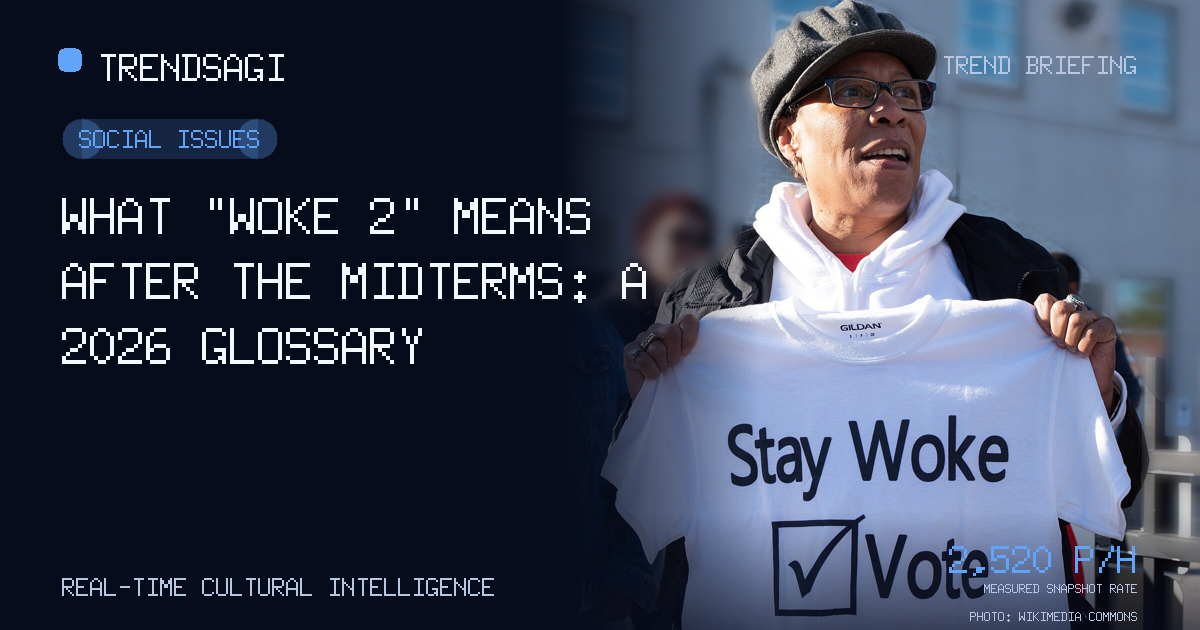
Image: Woke by Marcia Fudge, Public domain, via Wikimedia Commons.
Track This Topic for New Signals
Set alerts for future velocity or sentiment changes around this topic.
Explore Tracking PlansAbout TrendsAGI research
TrendsAGI's automated research pipeline publishes dated signal snapshots, methodology notes, and practical workflows for teams evaluating cultural momentum. Read how signals are scoped, scored, and limited in our research methodology.