2726-second window · 3 observations · Measured Nov 7, 2026, 5:06 PM UTC · Provider: go_recent_snapshot_v2
Why Is Jensen Huang in the News? Spy Memo and Billionaire Drop
Jensen Huang is in the news for a billionaire-ranking drop after a chip selloff and a reported US memo alleging a spy link. Here's what's confirmed and what
Automated briefing. Generated from stored signal measurements and source-backed research; it is not manually reviewed. Read the methodology and limitations or the editorial standards.
Metrics in this briefing are a snapshot associated with its publication date and may not reflect current conditions.
What changed
Jensen Huang is in the news for two separate stories that broke within a day of each other. According to Business Insider, the Nvidia CEO dropped out of the Bloomberg Billionaires Index top 10 after a chip-stock selloff following Democratic midterm wins. Separately, the Financial Times, as relayed by Kurdistan24, reported a US memo linking Huang to a woman US intelligence allegedly believes was recruited to spy for China, and three House Republican committee chairs requested a closed-door briefing with him on November 18. TrendsAGI measured a snapshot rate of 208.7 posts per hour over a 2,726-second window at 2026-11-07T17:06:12Z, with a latest snapshot volume of 371 posts, indicating the discussion is accelerating in real time.
| Observation time (UTC) | Measured posts/hour | Snapshot volume |
|---|---|---|
| 2026-11-07T17:06:12Z | 208.7 | 371 posts |
Why this topic may be moving
Two distinct threads are driving fresh coverage. The first is wealth and markets: reports say Huang fell out of the world's top 10 billionaires as chip stocks sold off after the midterm elections, a storyline that ties a high-profile CEO's net worth directly to political and market shifts. The second is a national-security allegation: the Financial Times, via Kurdistan24, reported that a US memo connects Huang to a woman US intelligence allegedly believes was recruited to spy for China. Three House Republican committee chairs then asked Huang for a closed-door briefing on November 18, according to a report carried by Flipboard (The Next Web). The overlap of a market story and an espionage-linked claim within 48 hours explains the surge in searches and social posts.
Importantly, the two threads are being reported separately. The billionaire-ranking drop is attributed to a stock selloff, not to the spy allegation. Readers should be careful not to merge them into a single cause-and-effect narrative.
TrendsAGI's measured rate of 208.7 posts per hour is a snapshot rate from a fixed observation window, not a live or forecast figure. It shows that discussion was moving quickly at the moment of measurement, but it does not establish why individual users posted or which sub-claim drove each post.
Why it matters
This story sits at the intersection of three things readers care about: the personal wealth of a central AI-chip figure, US-China technology tensions, and congressional oversight. CEOs in the semiconductor sector are increasingly treated as front-line actors in the US-China chip contest, as CEOWORLD magazine framed it. A closed-door House briefing request is a concrete step that could produce new information — or new questions — in the coming weeks.
For investors and market watchers, the story is a reminder that executive reputation and stock performance can interact, even when the underlying claims are unconfirmed. For policy watchers, the briefing request signals that lawmakers want direct answers about the reported memo and the relationship it describes. For general readers, the key value is separating confirmed facts from unverified allegations.
The confirmed facts are narrow: a reported ranking drop after a selloff, a reported memo, and a requested briefing. The espionage-linked relationship claim remains an unverified allegation from unnamed sources.
What to watch next
- The November 18 closed-door briefing: Whether Huang attends, what committee chairs say afterward, and whether any transcript or summary is released.
- Nvidia's official statements: Watch for a full, exact company response rather than secondhand summaries.
- The Financial Times report and the memo: Whether the memo's authenticity or contents are independently confirmed, and whether US intelligence or law enforcement comments.
- Chip-stock movements: Whether the AI selloff continues or reverses, which would affect Huang's net-worth position.
- Social velocity: TrendsAGI's measured rate can be rechecked at later observation windows to see whether the burst is sustained or fades after the briefing.
Frequently asked questions
Why did Jensen Huang drop out of the world's top 10 billionaires?
According to Business Insider, Huang dropped out of the Bloomberg Billionaires Index top 10 amid an AI and chip-stock selloff that followed Democratic midterm wins. The ranking change reflects a decline in the value of his Nvidia-linked holdings, not a reported change in share count.
What exactly does the US memo allege about Jensen Huang and Alice Huang?
The Financial Times, as relayed by Kurdistan24, reported that a US memo links Huang to a woman US intelligence allegedly believes was recruited to spy for China. The brief does not verify the memo's contents or authenticity, and the relationship and spying claims remain unconfirmed allegations from unnamed sources.
Who is Alice Huang (Huang Le) and what is Megaspeed?
Alice Huang, also referred to as Huang Le, is the woman named in the reported memo. Megaspeed is a company connected to the story. Beyond these one-line descriptions, the brief does not provide verified details, so readers should treat further biographical claims as unconfirmed.
What has Nvidia said in response to the spy-link reports?
Nvidia's response has been summarized inconsistently across outlets, and the brief does not provide the full, exact official statement. Readers should look for Nvidia's complete wording directly from the company or a source that quotes it in full rather than relying on paraphrases.
What is the November 18 closed-door House briefing about and who requested it?
Three House Republican committee chairs requested a closed-door briefing with Huang on November 18, according to a report carried by Flipboard (The Next Web). The briefing is expected to address the reported spy-link allegations, though the brief does not verify the full agenda.
Are the spy allegations confirmed or still unverified claims?
The spy allegations are unverified claims. The brief states that US intelligence allegedly believes the woman was recruited to spy for China, based on unnamed sources, and that the memo's contents and authenticity are not confirmed.
Methodology and limitations
TrendsAGI's signal is a measured snapshot of post volume and rate over a fixed window, not a live feed, forecast, reach, engagement, or unique-person count. The 208.7 posts/hour figure was measured at 2026-11-07T17:06:12Z over a 2,726-second window using three stored observations, with a latest snapshot volume of 371 posts. The signal can establish that discussion was moving quickly at that moment; it cannot establish the truth of any allegation, the contents of the memo, whether a relationship occurred, or whether spying took place. External facts are attributed to the publishers named above, and unverified claims are labeled as such. The separate Kazakhstan and Higgsfield investment story is not verified as connected to the spy controversy and should not be conflated with it.
Sources
- Nvidia’s Jensen Huang Drops Out of World’s Top 10 Billionaires List Amid AI Selloff (Business Insider) — markets.businessinsider.com
- Nvidia CEO Jensen Huang has one question to answer for Republicans... (The Times of India) — timesofindia.indiatimes.com
- Billionaire Jensen Huang’s Case Shows CEOs Are Now Front-Line Targets in the U.S.-China Chip Contest (CEOWORLD magazine) — ceoworld.biz
- House chairs ask Nvidia’s Jensen Huang to explain reported spy link (Flipboard (The Next Web)) — flipboard.com
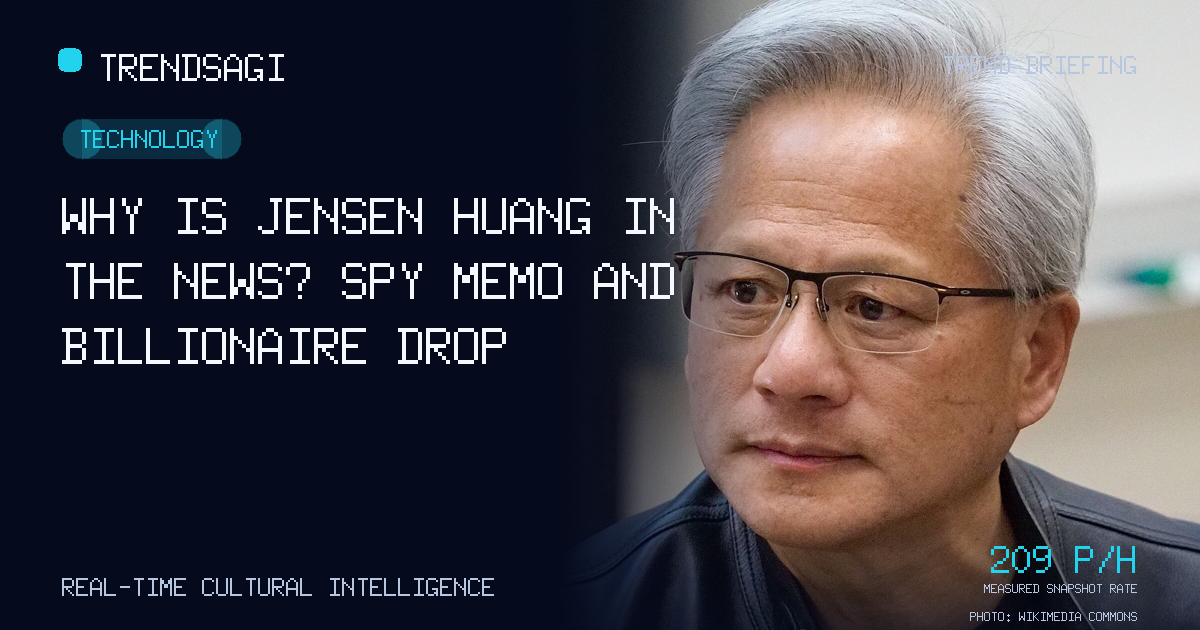
Image: Jensen Huang by Anderseidesvik, CC BY-SA 4.0, via Wikimedia Commons. The thumbnail adapts this photo with a title overlay and is shared under the same licence.
Track This Topic for New Signals
Set alerts for future velocity or sentiment changes around this topic.
Explore Tracking PlansAbout TrendsAGI research
TrendsAGI's automated research pipeline publishes dated signal snapshots, methodology notes, and practical workflows for teams evaluating cultural momentum. Read how signals are scoped, scored, and limited in our research methodology.