1008-second window · 3 observations · Measured Nov 7, 2026, 5:06 PM UTC · Provider: go_recent_snapshot_v2
Why Berkshire Hathaway Stock Is Surging in the AI Selloff
Berkshire stock is rising as investors flee AI names, per Fortune. TrendsAGI measured 403.7 posts/hour of discussion at 2026-11-07T17:06:13Z.
Automated briefing. Generated from stored signal measurements and source-backed research; it is not manually reviewed. Read the methodology and limitations or the editorial standards.
Metrics in this briefing are a snapshot associated with its publication date and may not reflect current conditions.
What changed
Attention on Berkshire Hathaway is accelerating as investors try to explain why the stock is rising while the S&P 500 and AI-linked tech shares fall. TrendsAGI measured 403.7 posts per hour across a 1,008-second window using three stored observations, with the latest snapshot at 2026-11-07T17:06:13Z showing 196 posts. That is a measured snapshot rate of discussion velocity, not a forecast and not a count of unique people. The most plausible verified driver, per Fortune, is a rotation into Berkshire as a haven while investors flee an AI-driven selloff — even as Berkshire's own portfolio takes a hit amid reshuffling.
| Metric | Value |
|---|---|
| Observation time | 2026-11-07T17:06:13Z |
| Measured posts/hour | 403.7 |
| Latest snapshot volume | 196 posts |
Why this topic may be moving
The verified record is narrow but clear on direction: Fortune frames Berkshire as a haven again as investors leave AI-heavy names, while noting its own portfolio is absorbing losses during reshuffling. That combination — safe-haven demand alongside weakness inside the portfolio — is exactly the kind of contradiction that drives search interest, because readers want to know whether the rally is about Berkshire's business or about everyone else's problems.
What the stored signal cannot tell us is the mechanism. The snapshot volume and measured rate show that discussion is building; they say nothing about whether the buyers are institutional, retail, or index-driven, and nothing about price. The search-intent brief explicitly leaves the exact intraday percentage move and closing price unconfirmed, so any specific number circulating today should be treated as unverified until a primary market source confirms it.
Surrounding coverage adds context worth separating from confirmed fact. Recaps of Q3 2026 have centered on a profit decline, a large buyback, and softness at Geico, but the brief notes these are often reported in isolation rather than connected. The plain-English link that readers are looking for — a large cash reserve, an accelerated repurchase, and a portfolio that is exposed to both AI enthusiasm and the old economy — is precisely the part that paywalled outlets tend to truncate.
The safe-haven logic, in plain terms
Three threads are commonly woven together when people ask why Berkshire is outperforming:
- Cash as optionality. A very large cash and short-term holdings position means Berkshire does not have to raise capital at bad prices. When credit gets tighter or valuations compress, cash-funded buyers set terms rather than accept them.
- Buybacks as a signal. A multibillion-dollar repurchase program tells the market that management sees its own shares as reasonably valued. The brief flags an open question about whether buybacks have fully halted or merely slowed — that distinction matters and is not settled.
- Insurance as a ballast. Float from underwriting gives Berkshire investable capital that is not tied to debt service, which is why the no-debt funding story resonates during a selloff. Geico's weaker results are the counterweight: the ballast is not frictionless.
The useful takeaway for readers is not that Berkshire is immune to an AI selloff, but that its structure — cash, float, and buybacks rather than leverage — changes what a selloff does to it compared with debt-funded AI builders.
Why it matters
For individual investors, this story sits at the intersection of two live questions: is the AI trade narrowing, and what earns a place in a portfolio when it does? Berkshire is being used as a shorthand answer, which is why search interest is spreading faster than a standard earnings recap would suggest. The measured 403.7 posts per hour captures the spread of the question, not the answer.
For anyone following the post-Buffett transition, the succession narrative is doing real work in the coverage. Readers arriving cold may not know the stock's path since the CEO transition was announced, and the brief flags a drop of roughly 15% followed by a full recovery as background that most recaps assume rather than explain. Treat that timeline as context reported elsewhere, not as something established by the stored signal.
The same caution applies to Greg Abel's AI posture. Questions about his AI investment strategy and how much has been committed are legitimate and widely asked, but the brief marks the precise size and completion status of those commitments as unconfirmed beyond what each individual source states. Reporters and analysts should cite per-source figures rather than aggregate them into a single total.
What to watch next
- Confirmation of the trading day's numbers. The exact move and closing price should be confirmed by primary exchange or company sources before being repeated.
- Buyback status. Whether repurchases continue at the recent pace, slow, or stop entirely is the single clearest signal about how management views its own valuation.
- Geico commentary. Any update on underwriting margins and claims trends will indicate whether the insurance engine is stabilizing.
- Portfolio reshuffling disclosures. Position changes explain the reported hit to the investment book and will clarify how much of the Q3 decline was mark-to-market rather than operational.
- Velocity re-measurement. A fresh TrendsAGI observation would show whether the discussion rate is building or fading; one snapshot cannot establish a trend.
Frequently asked questions
Why is Berkshire Hathaway stock going up while the S&P 500 and tech stocks fall?
Fortune attributes the strength to investors treating Berkshire as a haven as they flee an AI-driven selloff. The brief does not verify the day's exact price move, so the honest answer is that the rotation narrative is verified while the precise numbers are not.
What did Berkshire's Q3 2026 earnings show, including the profit decline and Geico weakness?
Coverage summarized in the search brief points to a lower quarterly profit, softer results at Geico, and a large buyback. The brief does not verify a specific cause beyond changes in the value of investments, so avoid asserting a single driver.
How much stock did Berkshire buy back, and did buybacks stop recently?
Reporting referenced in the brief centers on a buyback of roughly $9.6 billion. Whether repurchases have fully halted or merely slowed is explicitly unconfirmed, so present it as an open question rather than a settled fact.
What is Greg Abel's AI investment strategy and how much has he committed?
Readers are actively asking this, but the brief marks the precise size and completion status of reported AI commitments as unverified beyond what each individual source states. Cite per-source figures and avoid a consolidated total.
Why does Berkshire's cash reserve and no-debt funding make it an AI-era safe haven?
Cash and insurance float let Berkshire fund investments without issuing debt, so it is not forced to raise money at unfavorable terms. That structural difference is the substance behind the safe-haven framing, even though the size of any given AI commitment remains unconfirmed.
How has Berkshire stock performed since Buffett announced he would step down?
The brief references a decline of about 15% followed by a full recovery, which is useful context for readers arriving cold. Treat those figures as reported context rather than as something the stored signal establishes.
Methodology and limitations
This briefing draws on one canonical stored signal and a search-intent brief. The 403.7 posts-per-hour figure is a measured rate computed from three stored observations across an exact 1,008-second window, captured at 2026-11-07T17:06:13Z; the 196 figure is the latest snapshot volume, not a rate. Neither number is a live measurement, a forecast, a reach estimate, an engagement figure, or a count of unique people, and the platform measurement is not independently verifiable in search results.
External claims are attributed to the publisher named where the brief verifies them. Where the brief marks something unconfirmed — the day's exact price move, the precise size of AI commitments, the buyback halt question, and any cause of the profit decline beyond investment-value changes — it is presented as unresolved rather than assumed. Readers should confirm market data and company disclosures directly before acting.
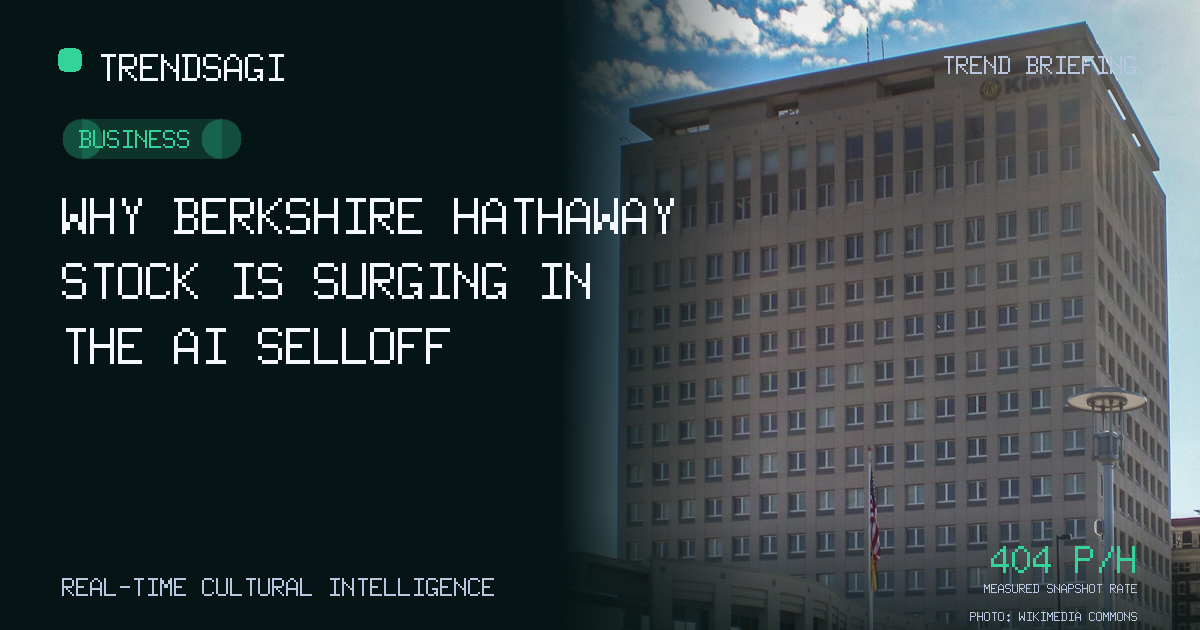
Image: Berkshire Hathaway by JonClee86, CC BY-SA 3.0, via Wikimedia Commons. The thumbnail adapts this photo with a title overlay and is shared under the same licence.
Track This Topic for New Signals
Set alerts for future velocity or sentiment changes around this topic.
Explore Tracking PlansAbout TrendsAGI research
TrendsAGI's automated research pipeline publishes dated signal snapshots, methodology notes, and practical workflows for teams evaluating cultural momentum. Read how signals are scoped, scored, and limited in our research methodology.