1709-second window · 3 observations · Measured Nov 5, 2026, 1:33 AM UTC · Provider: go_recent_snapshot_v2
Why Affordability Became the Defining Issue of the 2026 Midterms
Affordability became a defining 2026 midterm issue as voters cited cost of living; social conversation measured 111.6 posts/hour at the snapshot.
Automated briefing. Generated from stored signal measurements and source-backed research; it is not manually reviewed. Read the methodology and limitations or the editorial standards.
Metrics in this briefing are a snapshot associated with its publication date and may not reflect current conditions.
What changed
Affordability became a defining issue of the 2026 US midterms. Voters named cost of living a top concern in exit polls, and both parties leaned into economic populism as post-election coverage crystallized around housing, rent, groceries, health care, and even AI data centers as affordability flashpoints. The topic is moving for that political reason: it is now the frame through which voters and officials discuss prices, not one isolated news event. The measured social-conversation rate at the stored snapshot was 111.6 posts/hour over an exact 1,709-second window using 3 stored observations, taken at 2026-11-05T01:33:36Z, alongside a snapshot volume of 1,000 posts.
| Observation time | Measured posts/hour | Snapshot volume |
|---|---|---|
| 2026-11-05T01:33:36Z | 111.6 | 1,000 posts |
Why this topic may be moving
The verified reason for the attention is political. Affordability surfaced as a defining midterm issue, with exit polls showing voters ranked cost of living among their top worries and both parties emphasizing economic populism. Coverage after the election pulled housing, rent, groceries, health care, and AI data centers into one affordability storyline rather than treating them as separate beats. That is why the label is suddenly everywhere: it is the common language voters and campaigns are using for a cluster of price pressures.
Note what this does not establish. The available brief does not confirm a single triggering event behind the label, nor does it provide exact exit-poll percentages beyond a general Fortune summary. It also does not verify the precise drivers of the measured rate spike beyond general midterm and post-election context. Treat the political explanation as the verified frame, not as a complete causal account of every post.
The useful takeaway is that affordability is functioning as the midterms' common language for a cluster of price pressures — housing, rent, groceries, health care, and data-center costs — rather than as a single isolated event.
Why it matters
For readers, this is an explainer moment. Searchers want to know why the word is everywhere, whether the economy is genuinely bad when headline data looks resilient, and what, if anything, is being proposed. The cost-of-living politics of 2026 now shape how housing, food, rent, insurance, and energy debates are framed.
Different groups experience the squeeze differently. Renters watching rental affordability decline, owners facing insurance and upkeep costs, and essential workers priced out of metros all hear "affordability" differently. That gap is a large part of why the topic travels so widely across social platforms.
What to watch next
- Which sub-issues spike fastest. Watch whether housing, rent, groceries, health care, or AI data centers dominate the next measured windows. The stored data cannot rank them yet; future observations can.
- Political follow-through. Whether parties convert populist messaging into specific proposals, and how experts assess them. The brief confirms positions, not detailed legislation or effectiveness.
- Rental-affordability research. Studies such as the MBA rental-affordability model, reported by Scotsman Guide, and related rental research are worth tracking as they connect to the election moment.
- The data-center angle. Fortune's reporting on how the AI buildout became an affordability issue is a novel thread worth watching as a broader cost-of-living driver.
- Fresh measurements. New snapshots will show whether the measured rate is sustained, easing, or accelerating. Treat any single reading as a snapshot, not a forecast.
Frequently asked questions
Why did affordability become the defining issue in the 2026 midterms?
Because voters named cost of living a top concern in exit polls and both parties leaned into economic populism, making affordability the shared frame for the election's economic debate.
What specific costs — housing, groceries, rent, insurance, energy — are driving the affordability squeeze?
Post-election coverage crystallized around housing, rent, groceries, health care, and AI data centers as affordability flashpoints. The brief confirms those categories but does not provide a single verified breakdown of each cost's contribution.
Why does the economy feel bad when headline data looks resilient?
The gap between headline resilience and lived experience is a real question, but this brief does not verify a specific explanation. It confirms that voters named cost of living a top concern; it does not supply data proving the economy is worse or better than headline figures suggest.
What did voters actually say about cost of living in exit polls?
Voters named cost of living a top concern in exit polls, according to the verified brief. Exact AP exit-poll figures beyond a general Fortune summary are not confirmed here.
How did the AI data center buildout get tied to affordability?
Fortune reported on how the AI buildout became the midterms' affordability issue, with data centers treated as a cost-of-living flashpoint in post-election coverage. The brief does not verify the full mechanism, so readers should treat this as a reported thread rather than a settled causal finding.
What policies are being proposed to improve affordability, and do experts think they would work?
The brief confirms that both parties leaned into economic populism and that positions are being discussed, but it does not verify specific legislation or expert effectiveness assessments. That remains an open question to track.
Methodology and limitations
The measured rate of 111.6 posts/hour comes from 3 stored observations over an exact 1,709-second window, read at 2026-11-05T01:33:36Z, with a snapshot volume of 1,000 posts. That figure is a measured snapshot rate, not a live or current rate, forecast, reach, engagement, or unique-person count, and snapshot volume is not a rate.
The signal can establish that affordability conversation is accelerating around the midterm context and that the label is active on social platforms. It cannot establish a single underlying news event behind the label, exact exit-poll percentages beyond the Fortune summary, precise drivers of the rate spike, Google search volume, or the effectiveness of any policy proposal. Searchers should use this as a framing explainer and check primary data and verified reporting before drawing firm conclusions.
Sources
- 'People really effing hate data centers': How the AI buildout became the midterms' affordability issue (Fortune) — fortune.com
- Government to Blame for Higher Prices (Foundation for Economic Education) — fee.org
- MBA unveils new model to study decline in rental affordability (Scotsman Guide) — scotsmanguide.com
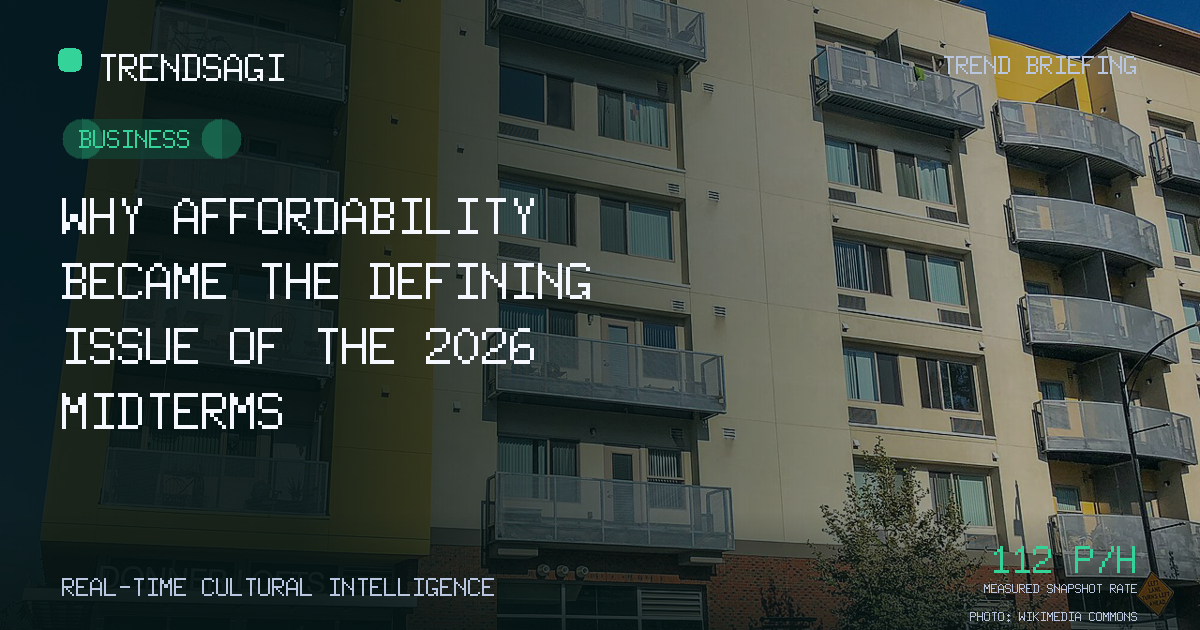
Image: Affordable housing by country by Will Buckner, CC BY 2.0, via Wikimedia Commons.
Track This Topic for New Signals
Set alerts for future velocity or sentiment changes around this topic.
Explore Tracking PlansAbout TrendsAGI research
TrendsAGI's automated research pipeline publishes dated signal snapshots, methodology notes, and practical workflows for teams evaluating cultural momentum. Read how signals are scoped, scored, and limited in our research methodology.