1822-second window · 2 observations · Measured Nov 11, 2026, 11:59 AM UTC · Provider: go_recent_snapshot_v2
What to Say Instead of 'Thank You for Your Service'
Veterans Day drove a measured 1,612.5 posts/hour around 'thank you for your service.' What to say instead, how veterans respond, and ways to actually help.
Automated briefing. Generated from stored signal measurements and source-backed research; it is not manually reviewed. Read the methodology and limitations or the editorial standards.
Metrics in this briefing are a snapshot associated with its publication date and may not reflect current conditions.
What changed
The short answer for anyone searching today: "thank you for your service" is a well-meant but often hollow opener, and a more meaningful alternative is specific, practical gratitude — ask about their job or branch, name what you appreciate, and follow up with a concrete act such as writing letters, volunteering, or supporting a veterans organization. On Veterans Day (Nov. 11, 2026), the phrase returned to the center of public conversation: TrendsAGI's stored signal for the topic "thank you for your service" measured 2,057 posts in its latest snapshot, observed at 2026-11-11T11:59:08Z.
The same stored observations put the measured snapshot rate at 1,612.5 posts per hour across an exact 1,822-second window spanning two stored observations. That figure is a measured snapshot rate taken at one moment on Nov. 11 — a pulse, not a live counter, a forecast, or a count of people. The clearest verified driver is the calendar: search results analyzed for this topic are dated Nov. 7–11, 2026 and tie the phrase directly to Veterans Day commentary, including an opinion piece in Times of San Diego on filling the gap after saying "thank you for your service," an editorial thanking veterans in TribLIVE.com, a column in Times Leader, and a City of DuPont roundup of ways to thank veterans in The Cascadian. No single viral post or event is established by those results, and the cause beyond the holiday tie-in remains unclear.
| Observation time | 2026-11-11T11:59:08Z |
|---|---|
| Measured snapshot rate | 1,612.5 posts/hour (1822-second window, 2 stored observations) |
| Latest snapshot volume | 2,057 posts |
| Stored category | Current Events & News |
Why this topic may be moving
The verified explanation is seasonal, not mysterious. Nov. 11 is the one day each year when the phrase is said and debated at scale, and the pages currently ranking were all published in the days immediately before or on the holiday. That pattern — commentary clustered around a single date — is consistent with a holiday-driven spike rather than a breaking news event.
What the signal cannot tell us is why any individual post was written, whether a particular veteran's essay or a viral thread set the tone, or how the conversation split between gratitude, discomfort, and critique. Those would require reading the posts themselves, which the stored signal does not do.
The useful takeaway from this spike isn't that people are talking — it's that the conversation has moved past the phrase itself toward what should come after it. The practical question readers are bringing to search engines is not "is it polite?" but "what actually helps?"
Why it matters
Holiday spikes around this phrase are annual, but the search intent around them has become practical. Readers want etiquette, meaning, and a next step. Opinion columns in Times of San Diego, TribLIVE.com, and Times Leader all gesture at the same idea — that a quick thank-you can leave a gap — but editorials rarely hand readers a list. That gap is where a veteran-centered guide earns its place.
Several of those columns also invoke the "military-civilian gap," the distance in experience and understanding between those who served and the majority who did not. The brief behind this article notes that the gap is asserted by syndicated commentary but is rarely quantified with sourced figures, so treat any specific size or trend claim about it as unconfirmed unless a named source provides the numbers.
- Who should care: workplaces planning Veterans Day messaging, schools and community groups running recognition events, journalists covering the holiday, and veterans deciding how to respond when the phrase lands awkwardly.
- What to do with the number: use it as a timing signal. It says when public attention peaks, which is when practical guidance and volunteer calls are most likely to be seen.
- What not to do: don't treat the volume as evidence of sentiment, reach, or support for any policy.
What to watch next
Because the phrase is anchored to a date, the most informative watch signals are about decay and follow-through rather than escalation.
- Post-holiday drop-off: how quickly the measured rate falls after Nov. 11 tells you whether this is purely ceremonial attention or something with staying power.
- Shift in search phrasing: movement from "thank you for your service meaning" toward "how to respond to thank you for your service" would suggest veterans themselves are driving the conversation.
- Action-oriented queries: rising interest in volunteering, letters to veterans, and organizations would confirm the practical turn the ranking pages only partly serve.
- Memorial Day comparison: the same phrase recurs in May; comparing the two spikes would separate holiday effects from genuine baseline interest.
- Origin claims: if a widely shared post asserts the phrase began in a specific war or era, that claim needs an independent source before repeating it — the current results do not establish its origin.
Frequently asked questions
Why do we say 'thank you for your service' and where did the phrase come from?
It functions as a short, socially safe way to acknowledge military service without knowing the details of someone's role or experience. The results reviewed for this topic do not establish where or when the phrase originated, so any specific wartime origin story should be treated as unconfirmed.
How do veterans actually feel when strangers say it to them?
Responses vary widely, and the commentary reviewed notes that the phrase can feel awkward — sometimes because it invites a veteran to speak for experiences a stranger cannot see, sometimes because it can read as a scripted gesture. There is no single veteran view, and no survey data verifying a distribution appears in the sources reviewed here.
What can I say or do instead that is more meaningful than a quick thank-you?
Be specific and follow up. Ask what they did or which branch, thank them for something concrete, and then act: write letters, volunteer with a veterans organization, or support a local program — the kinds of steps the City of DuPont roundup in The Cascadian describes. Specificity plus action beats a passing phrase.
What is the 'military-civilian gap' and why is it widening?
It refers to the experiential distance between the small share of Americans who have served and the majority who have not. Several syndicated columns invoke it, but the pages reviewed do not provide sourced figures on its size or trend, so claims that it is widening should be attributed with caution.
How can I volunteer or write letters to thank veterans this year?
Practical options include contacting a local veterans service organization, joining community recognition events, and writing letters through established programs. The Cascadian's coverage of DuPont's city-level suggestions is one verified example of a community publishing concrete ways to participate.
What is the history of Veterans Day and how did it replace Armistice Day?
Veterans Day falls on Nov. 11, the date associated with the 1918 armistice, and the sources reviewed link the date directly to the holiday but provide only limited historical detail beyond that. The comparisons between Veterans Day, Armistice Day, and Remembrance Day that appear in ranking pages are brief, so readers wanting depth should consult a dedicated history source.
Methodology and limitations
This briefing draws on a stored signal for the topic labeled "thank you for your service," observed at 2026-11-11T11:59:08Z, with a latest snapshot volume of 2,057 posts and a measured snapshot rate of 1,612.5 posts per hour calculated over an exact 1,822-second window using two stored observations. The rate describes that window only; it is not a live rate, a forecast, an engagement measure, or a count of unique people.
Context about why the phrase is moving comes from a search-intent brief summarizing pages published Nov. 7–11, 2026 by Times of San Diego, TribLIVE.com, Times Leader, and The Cascadian. External statements are attributed to those publishers in the prose above. The brief does not verify that any single post or event drove the spike, does not establish the phrase's origin, and does not quantify the military-civilian gap. Where those questions are unanswerable, this article says so rather than guessing.
Sources
- Opinion: On Veterans Day, how to fill the gap after saying "thank you for your service" (Times of San Diego) — timesofsandiego.com
- Editorial: Thanking veterans for their service (TribLIVE.com)
- Beyond Byline: We can never thank our veterans enough (Times Leader) — timesleader.com
- City of DuPont Shares Ways to Thank Veterans (The Cascadian) — thecascadian.com
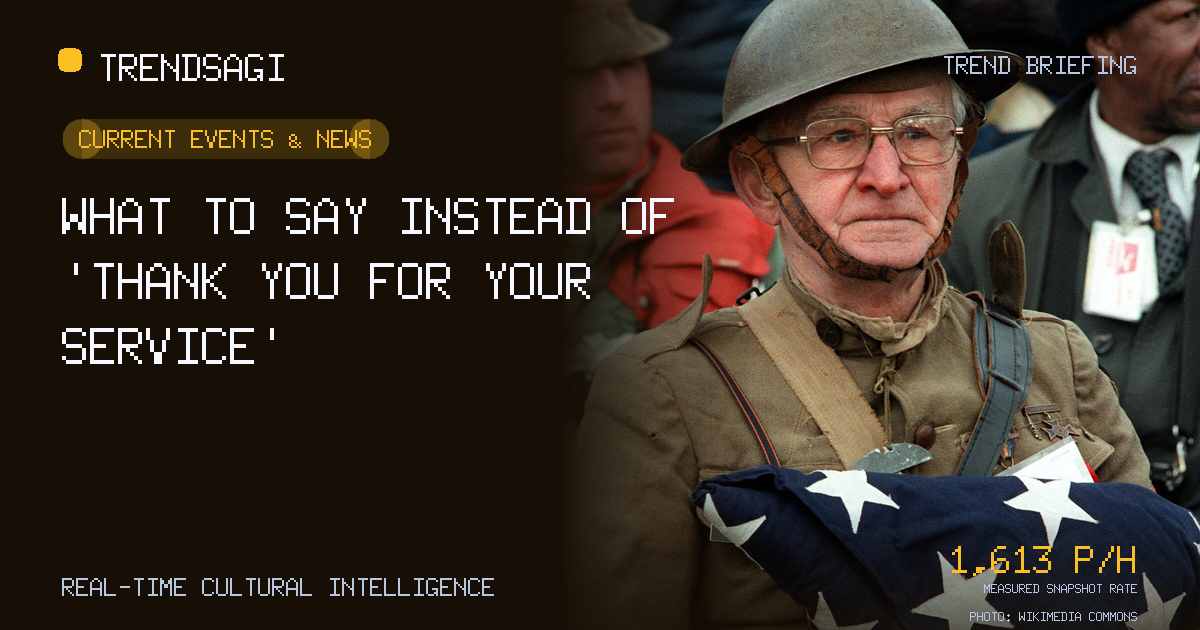
Image: Veterans Day by Department of Defense. Defense Audiovisual Agency; Scene Camera Operator: Mickey Sanborn, Public domain, via Wikimedia Commons.
Included in the TrendsAGI Trend Signal Index
This briefing recorded 1,612.5 posts/hour over 1822-second window from 2 observations. The index publishes the archive-wide percentiles and the gate every rate has to clear.
Trend velocity statisticsTrack This Topic for New Signals
Set alerts for future velocity or sentiment changes around this topic.
Explore Tracking PlansAbout TrendsAGI research
TrendsAGI's automated research pipeline publishes dated signal snapshots, methodology notes, and practical workflows for teams evaluating cultural momentum. Read how signals are scoped, scored, and limited in our research methodology.