899-second window · 3 observations · Measured Nov 8, 2026, 11:01 AM UTC · Provider: go_recent_snapshot_v2
Why 'We Will Remember Them' Is Trending for Remembrance 2026
Measured at 532.4 posts/hour on 8 Nov 2026, 'We Will Remember Them' is spiking around Remembrance Sunday. Here's the phrase's origin, the 2026 timings and the
Automated briefing. Generated from stored signal measurements and source-backed research; it is not manually reviewed. Read the methodology and limitations or the editorial standards.
Metrics in this briefing are a snapshot associated with its publication date and may not reflect current conditions.
What changed
"We Will Remember Them" is spiking as a search and social phrase in the hours around Remembrance Sunday 2026. TrendsAGI's stored signal shows 282 posts in the latest snapshot taken at 11:01:30Z on 8 November 2026, a measured rate of 532.4 posts per hour across an exact 899-second window built from three stored observations. That is fast movement for a phrase tied to a fixed annual commemoration, and it means the term is being carried by this week's news cycle as well as by the calendar.
What readers want is a straight answer: the words are the closing line of the Ode of Remembrance, drawn from Laurence Binyon's 1914 poem "For the Fallen," and they are recited at Remembrance events. Separately, a documentary titled "We Will Remember Them" linked to Nigel Farage is in the news, which is adding a second, contested reason for the phrase to circulate. Which of those two drivers accounts for the larger share of the spike is not confirmed.
| Observation time | Measured posts/hour | Snapshot volume |
|---|---|---|
| 2026-11-08T11:01:30Z | 532.4 | 282 posts |
Why this topic may be moving
Two things are happening at once, and the available evidence does not let us separate them cleanly.
- The calendar. The phrase is the standard refrain of Remembrance commemorations, so it resurfaces every November. Snapshots taken on the morning of 8 November sit inside that recurring pattern.
- The news. Coverage of Farage's same-titled film has been framed around his remarks about Hitler and about politicians attending the Cenotaph, according to the outlets in the search results. That gives the phrase a topical, argumentative edge beyond the ceremony itself.
The stored category places this in current events and news, which fits both explanations. No single source in the results establishes the split between commemoration-driven and film-driven interest, and no source confirms that the hashtag refers specifically to the documentary rather than to the wider commemorations. Treat that as an open question rather than a settled cause.
The reliable reading is that Remembrance provides the recurring baseline and the Farage film supplies this week's amplifier — but the measured signal alone cannot tell you which is doing more of the work.
The phrase itself: origin and full wording
Readers arriving on this phrase are usually looking for the words and where they come from. The line "We will remember them" is the response recited after the Ode of Remembrance, which is the fourth stanza of Laurence Binyon's "For the Fallen," published in The Times in September 1914 after the early battles of the First World War. The stanza is commonly rendered:
They shall grow not old, as we that are left grow old:
Aged shall not weary them, nor the years condemn.
At the going down of the sun and in the morning
We will remember them.
At commemorations the reciter reads the stanza and the assembled respond with the final line. Note that a full verbatim text of the Ode did not appear in the sources reviewed for this briefing, so the wording above should be checked against an authoritative text such as the Royal British Legion before being reproduced elsewhere.
Remembrance Sunday 2026: date and timings
Remembrance Sunday falls on the second Sunday in November, which in 2026 is 8 November — the date of this snapshot. The two-minute silence is observed at the 11th hour of the 11th day of the 11th month, marking the 1918 Armistice.
Two cautions matter here. First, no source reviewed explicitly confirms the 2026 date or the silence time, so the date above is derived from the standing rule rather than confirmed in this week's coverage. Second, the silence is traditionally observed on Armistice Day itself (11 November) and again on Remembrance Sunday, so check the specific schedule published by the Royal British Legion and local councils for service times, which vary by location.
Why it matters
This is a case where a spike in a phrase with deep civic meaning arrives tangled with a political story. Readers searching the phrase may want the poem, may want the ceremony details, or may want to understand the Farage documentary — and the ranking pages, mostly opinion columns and a partisan film write-up, tend to assume which one you meant.
The practical cost of that confusion is real. Someone looking for the Ode's wording can land in a partisan argument; someone looking for the film can land on a poem explainer. A single neutral explainer that separates the two, as this one does, is more useful than either.
Who should care: people preparing for or attending Remembrance events, teachers and community organisers who need the correct wording, journalists covering the Farage film, and anyone trying to read the social conversation without mistaking a commemorative surge for a purely political one.
What to watch next
- Whether the measured rate holds past the 11th-hour commemorations on 8 November, or drops sharply once the ceremony ends. A fast decay points to a ceremony-driven pattern; a longer tail points to the news story.
- Whether the phrase continues to climb after Armistice Day on 11 November, which would suggest sustained interest in the film rather than the ceremony.
- Whether coverage shifts from Farage's remarks to the film's content. The current coverage, per the search results, is dominated by his Hitler and Cenotaph comments rather than what the documentary shows.
- Whether official Remembrance accounts and organisers adopt the hashtag, which would clarify its primary meaning.
- Whether any outlet publishes a clear statement on where the film can be watched. Release and streaming details are not established in the sources reviewed.
Practical next checks for anyone reporting or citing this: verify the Ode's wording against the Royal British Legion; confirm local service times with the relevant council; and, if referencing the film, cite the specific outlet for each remark rather than summarising them collectively.
Frequently asked questions
Why is 'We We Will Remember Them' trending right now?
The phrase is spiking in the hours around Remembrance Sunday 2026, which falls on 8 November, and is being amplified by coverage of a Nigel Farage documentary of the same name. The split between the two drivers is not confirmed.
Where does the phrase 'We will remember them' come from and what are the full words?
It is the closing line of the Ode of Remembrance, the fourth stanza of Laurence Binyon's 1914 poem "For the Fallen," recited at Remembrance services with the audience responding with that line.
When is Remembrance Sunday 2026 and what time is the two-minute silence?
Remembrance Sunday 2026 falls on 8 November, the second Sunday of the month. The two-minute silence is observed at 11am on the 11th day of the 11th month; confirm local service timings with organisers.
What is Nigel Farage's 'We Will Remember Them' film about and why is it being discussed?
The search results describe it as a documentary of that title discussed mainly through Farage's remarks about Hitler and about politicians attending the Cenotaph. What the film itself shows, and where it can be watched, is not established in the sources reviewed.
What did Farage say about politicians attending the Cenotaph?
Coverage in the search results frames his remarks around politicians attending the Cenotaph, but this briefing has not verified the exact wording, so the specific quotes should be checked against the original reporting before being repeated.
Is the trend about the Remembrance commemorations or the Farage documentary?
Both are plausible and neither is confirmed as the dominant driver. The phrase recurs every November for the commemorations, and this week's film coverage provides a second, concurrent reason for the surge.
Methodology and limitations
The measured figure of 532.4 posts per hour is a snapshot rate calculated over an exact 899-second window from three stored observations, last taken at 2026-11-08T11:01:30Z. It is not a live rate, a forecast, or a measure of reach, engagement, or unique people. The volume figure of 282 refers to posts counted in that single snapshot, not to the rate.
Limitations: the cause of the spike cannot be attributed with confidence from this signal alone, and the relative weight of the commemorations versus the film is unknown. The hashtag's specific referent is unconfirmed. Viewership, release, and streaming details for the film are absent from the sources reviewed. The full text of the Ode was not quoted in those sources, and the 2026 Remembrance Sunday date and silence time were not explicitly confirmed there. Any figure or quotation repeated elsewhere should be traced to a primary source.
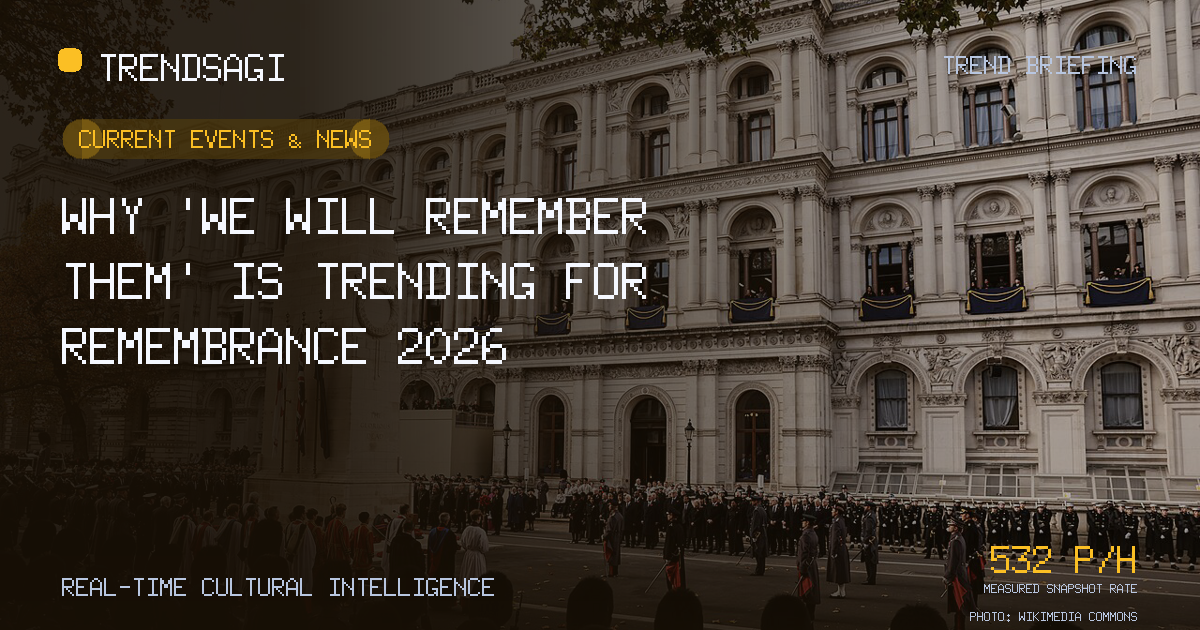
Image: Remembrance Sunday by UK Government, CC BY 4.0, via Wikimedia Commons.
Track This Topic for New Signals
Set alerts for future velocity or sentiment changes around this topic.
Explore Tracking PlansAbout TrendsAGI research
TrendsAGI's automated research pipeline publishes dated signal snapshots, methodology notes, and practical workflows for teams evaluating cultural momentum. Read how signals are scoped, scored, and limited in our research methodology.