14-minute window · 3 observations · Measured Nov 5, 2026, 8:33 PM UTC · Provider: go_recent_snapshot_v2
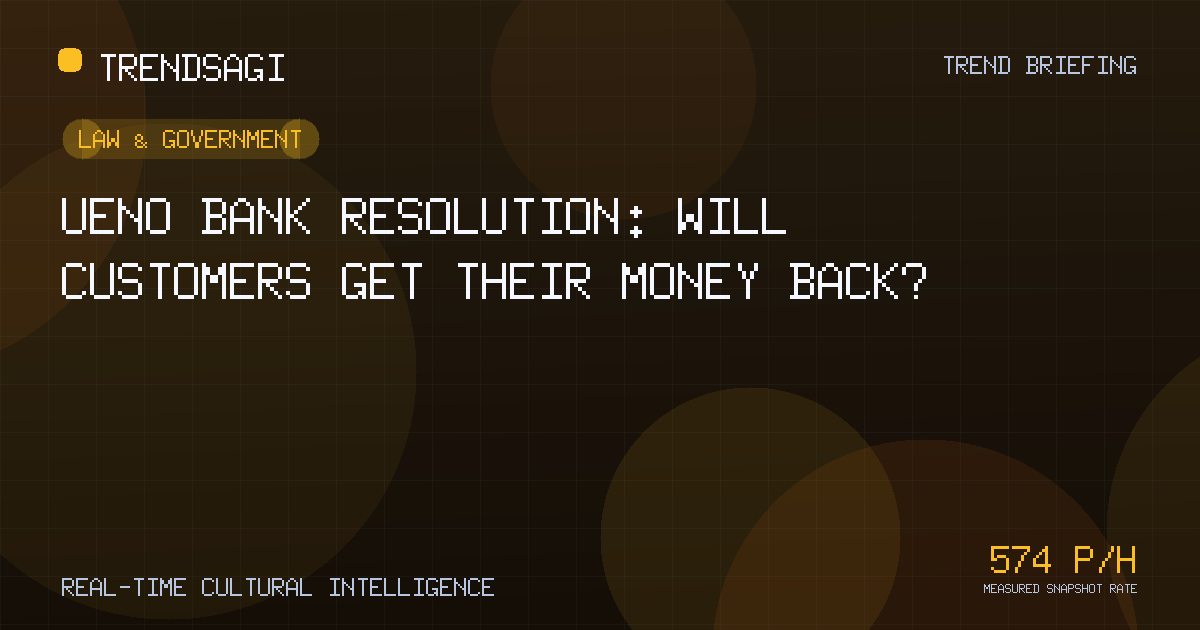
Ueno Bank Resolution: Will Customers Get Their Money Back?
Ueno Bank entered resolution on Nov. 2, 2026, locking out customers. Here's what's verified about deposits, payouts, and Peña's resignation.
Automated briefing. Generated from stored signal measurements and source-backed research; it is not manually reviewed. Read the methodology and limitations or the editorial standards.
Metrics in this briefing are a snapshot associated with its publication date and may not reflect current conditions.
What changed
Paraguay's central bank placed Ueno Bank, a fast-growing digital lender tied to President Santiago Peña, into resolution proceedings on Nov. 2, 2026, according to the Payment Risk Association News. The action came after the bank's capital ratio fell far below requirements, locking roughly 2.9–3 million customers out of their accounts. The story escalated from a bank seizure into a political crisis: mass protests in Asunción, an opposition impeachment bid, and Peña's resignation on Nov. 5, 2026 — the same day the topic spiked.
On the question searchers are asking most — will Ueno Bank customers get their money back — the verified record so far confirms the resolution was triggered but does not confirm a payout amount, a deposit-insurance coverage ceiling, or a timeline for returning funds. Treat any specific figure circulating online as unconfirmed until the central bank publishes terms.
TrendsAGI measured this topic at 574.1 posts per hour over an 840-second window ending 2026-11-05T20:33:29Z, using 3 stored observations. That is a measured snapshot rate, not a live rate or a forecast. It matters because the pace indicates the story has moved well beyond a single news cycle and is now tracking a presidential resignation, not just a bank failure.
| Observation time (UTC) | Measured posts/hour | Snapshot volume |
|---|---|---|
| 2026-11-05T20:33:29Z | 574.1 | 637 posts |
Why this topic may be moving
The verified sequence explains the acceleration. EFE Noticias reports that Paraguay's president resigned after the Ueno Bank closure. CNBC TV18 reports thousands protesting and demanding their money back. NOS reports Peña stepped down after mass protests over the bank blockade. Each of those is a separate headline cycle — bank resolution, street protest, resignation — stacked within four days.
What the brief does not verify is the underlying cause of the capital shortfall, whether financial statements were restated, or what threshold the reported 15.01% capital ratio was measured against. One ranking page describes 15.01% as below a required 12%, which is internally inconsistent. Until resolved, the reason the bank became insolvent remains unclear from verified sources.
Why it matters
For customers, this is a deposits question before it is a politics question. Ueno operated as a branchless digital lender, so a resolution raises practical issues a traditional bank wind-down does not: what happens to the app, to account data, to outstanding loans, and to first-time banking customers who may have no branch to walk into.
For the wider system, the unanswered question is contagion. No verified source in the brief addresses whether other Paraguayan banks face similar pressure or what stability measures the central bank has taken beyond this resolution.
For readers following the politics, Peña's resignation is confirmed, but whether an impeachment process continues, and who succeeds him, is not established in the verified material.
The verified facts support a clear sequence — resolution on Nov. 2, protests, resignation on Nov. 5 — but not a clear answer on deposits. The fastest-moving question is political; the most consequential one is still open.
What to watch next
- Central bank payout terms: Any published statement on insured amounts, coverage ceilings, and disbursement dates is the single most important signal for customers.
- Treatment of accounts and loans: Whether a bridge institution, asset purchaser, or liquidation vehicle takes over the book, and what that means for the app and customer data.
- Capital-ratio reconciliation: A corrected figure and the actual regulatory threshold, which would resolve the current confusion.
- Succession and impeachment: Confirmation of an interim or successor government, and whether the opposition bid proceeds.
- Contagion indicators: Deposit movement or supervisory action at other Paraguayan lenders.
- Rate direction: A sustained decline in the measured rate would suggest the story is settling into a slow-moving legal process; a further rise would point to new developments.
Frequently asked questions
What exactly happened to Ueno Bank and when did the central bank intervene?
Paraguay's central bank placed Ueno Bank into resolution proceedings on Nov. 2, 2026, after its capital ratio fell far below regulatory requirements, according to the Payment Risk Association News. Customers were locked out of their accounts as a result.
Will Ueno Bank customers get their deposits back, and how long will it take?
This is not yet verified. The resolution process has been confirmed, but no source in the verified material specifies a coverage limit, payout amount, or timeline. Customers should watch for an official central bank announcement rather than relying on figures circulating online.
Why did the bank's capital ratio fall below the minimum, and were the financial statements adjusted?
The verified material does not establish why the ratio fell or whether statements were restated. One ranking page describes a 15.01% ratio as below a 12% requirement, which is internally inconsistent and unresolved.
How is President Santiago Peña linked to Ueno Bank, and why did he resign?
Ueno Bank is described as a digital lender tied to Peña. EFE Noticias and NOS report he resigned on Nov. 5, 2026, following mass protests over the bank blockade. The precise nature and extent of his ties to the bank is not detailed in the verified material.
What happens next politically — is there still an impeachment process or a successor government?
An opposition impeachment bid followed the bank action, but whether it continues after Peña's resignation is unconfirmed, and no successor or interim president is identified in the verified sources.
Could this spread to other Paraguayan banks or the wider financial system?
There is no verified evidence in the brief of contagion to other Paraguayan banks. The central bank's broader stability measures beyond this resolution are not described.
Methodology and limitations
This briefing is built on a stored signal captured at 2026-11-05T20:33:29Z, with a snapshot volume of 637 posts and a measured rate of 574.1 posts per hour across an 840-second window using 3 stored observations. The rate describes that measurement window only; it is not a live figure, a projection, or a count of unique people. Context comes from the verified search-intent brief and the named publishers — EFE Noticias, Payment Risk Association News, CNBC TV18, and NOS — as summarised there; the underlying resolution documents were not independently reviewed for this piece. Where the brief marks a detail unconfirmed — affected-customer counts, insurance coverage, the capital threshold, impeachment status, and succession — it is presented here as open.
Sources
- President of Paraguay resigns after Ueno Bank closure (EFE Noticias) — efe.com
- The central bank of Paraguay initiates resolution proceedings for digital lender Ueno Bank (Payment Risk Association News) — news.paymentrisk.org
- Paraguay bank crisis: Why thousands are protesting and demanding their money back (CNBC TV18) — cnbctv18.com
- Paraguayaanse president Peña stapt op na massale protesten om bankblokkade (NOS) — nos.nl
Track This Topic for New Signals
Set alerts for future velocity or sentiment changes around this topic.
Explore Tracking PlansAbout TrendsAGI research
TrendsAGI's automated research pipeline publishes dated signal snapshots, methodology notes, and practical workflows for teams evaluating cultural momentum. Read how signals are scoped, scored, and limited in our research methodology.