1817-second window · 3 observations · Measured Oct 10, 2026, 4:52 PM UTC · Provider: go_recent_snapshot_v2
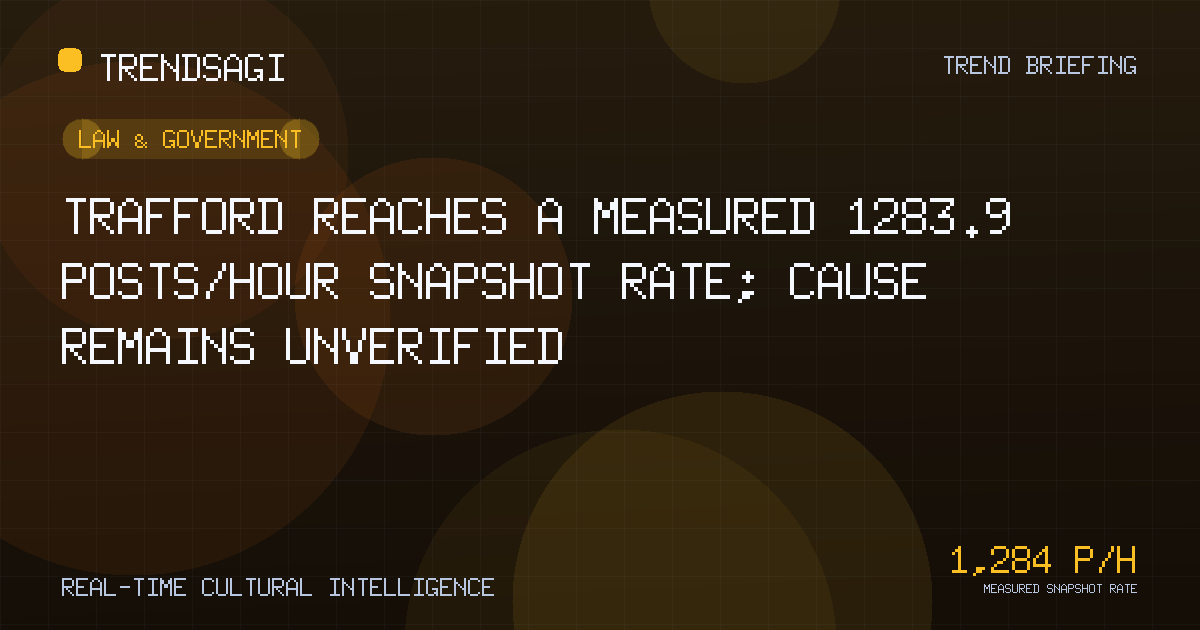
Trafford reaches a measured 1283.9 posts/hour snapshot rate; cause remains unverified
Trafford recorded a measured 1283.9 posts/hour snapshot rate; the cause is unverified, with practical checks for those monitoring it.
Automated briefing. Generated from stored signal measurements and source-backed research; it is not manually reviewed. Read the methodology and limitations.
Metrics in this briefing are a snapshot associated with its publication date and may not reflect current conditions.
What changed
Trafford is showing a concentrated burst of online activity in the latest stored observation, but the available signal does not establish why. The snapshot contains 1000 posts; that is a count of collected items, not a rate, reach figure, or measure of unique people. The defensible conclusion is concentrated attention around an ambiguous label, not proof of a particular government action or public reaction.
The measured change rate was 1283.9 posts/hour over an exact 1817-second window using 3 stored observations, measured at 2026-10-10T16:52:34Z. This is a measured snapshot rate, not a live or current rate, forecast, reach, engagement figure, or unique-person count. It quantifies posting activity during the observed window; by itself, it does not show whether the burst will persist or what produced it.
| Metric | Stored value |
|---|---|
| Observation time | 2026-10-10T16:52:34Z |
| Measured snapshot rate | 1283.9 posts/hour |
| Snapshot volume | 1000 posts |
| Measurement window | 1817 seconds |
| Stored observations | 3 |
Why this topic may be moving
The stored record contains no post-level description and no verified public trigger. That makes the cause unclear, rather than allowing a likely explanation to be presented as fact. A place label may be attached to discussion of several subjects, and the stored category alone does not identify the institution, decision, proceeding, or policy involved.
Different underlying stories could create the same pattern: an official announcement, a public meeting, a reported controversy, a legal or regulatory development, or repeated use of the label without a single shared event. These are possibilities, not verified explanations. In particular, the Law & Government classification is evidence of how the signal was categorized, not evidence that every post concerns local government or that policy has changed.
A defensible causal account would need a specific event, a credible publication or official record confirming it, timing that precedes the burst, and post content that repeatedly connects that event to “Trafford.” The current record does not establish those links. Any named trigger added now would be speculation.
A high posting rate can show where attention is accumulating, but it cannot by itself show what happened, who agrees, or whether the activity reflects meaningful public response.
Why it matters
The immediate value is triage: this signal identifies a place-label worth checking, while withholding a substantive conclusion that the evidence cannot support. That distinction matters when a fast-moving label can shape coverage, planning, or perceptions of a community.
- Local-government and communications teams should determine which Trafford body or issue generated the posts and whether an official notice, agenda, statement, or service update predates the activity.
- Residents and service users should look for verified operational impact—such as a confirmed decision, service change, consultation, or disruption—rather than infer impact from posting volume alone.
- Journalists and policy researchers should inspect original posts and source documents before using the signal to characterize public sentiment, institutional activity, or local opinion.
- Trust, safety, and analytics teams should check for repetition, copied claims, coordinated posting, or spam, because any of those could distort interpretation without necessarily erasing the underlying burst.
What the signal can and cannot establish
The signal is useful for deciding where to investigate, not for answering the underlying substantive question.
- It establishes observed collection activity: the observation time, the 1000-post snapshot volume, and the supplied measured change rate describe how much labeled content was captured during the defined observation.
- It establishes a rate for the defined window: the supplied 1283.9 posts/hour applies to the stated observations and measurement period.
- It does not establish the topic: no post text is supplied, so the specific claim, event, institution, and policy area remain unresolved.
- It does not establish audience or consensus: volume and rate do not show unique authors, location, sentiment, agreement, or whether people changed behavior.
- It does not establish authenticity or causation: repeated or automated content may be present, and correlation between a label and activity is not proof of the event that caused it.
What to watch next
The next useful step is to turn the aggregate signal into a verified event trail and test whether the burst persists.
- Subsequent windows: compare later observations using the same collection method and window. Persistence would support a sustained conversation; a sharp reversal would be more consistent with a short event-driven spike.
- Content clusters: inspect representative original posts for repeated phrases, named institutions, policy areas, locations, and claims. Separate distinct conversations that share only the word “Trafford.”
- Official chronology: check whether a relevant authority published a notice, agenda, decision, statement, or service update before the cluster. Confirm the document and its publisher rather than relying on screenshots or summaries.
- Independent corroboration: look for credible outlets reporting the same event and for primary records supporting their claims. Repetition of an unsourced post is not independent confirmation.
- Account and language patterns: examine whether accounts repeat identical wording, post in unusually tight sequences, or amplify a single source. Treat those as warning signs requiring validation, not automatic proof of automated activity.
- Response and spread: watch for an official response and for migration into closely related topics or categories. That would help distinguish a local information cycle from broader attention.
Methodology and limitations
The reported rate was supplied from 3 stored observations across an exact 1817-second window; it has not been treated as a live estimate. The 1000-post figure is reported separately as snapshot volume. Neither figure has been converted into reach, audience, engagement, or sentiment.
No post-level sampling, geographic filtering, account deduplication, bot detection, or representativeness test is provided. Individual observation values and a normal baseline are also absent, so the signal cannot show the shape, relative unusualness, or duration of a longer trend. The category label and absent post description limit semantic confidence.
No external event is presented as the cause because no such trigger is verified in the stored material. Accordingly, this briefing identifies the movement, explains the limits of the evidence, and specifies checks that can turn the signal into a reliable story if the underlying activity persists.
Track This Topic for New Signals
Set alerts for future velocity or sentiment changes around this topic.
Explore Tracking PlansAbout TrendsAGI research
TrendsAGI's automated research pipeline publishes dated signal snapshots, methodology notes, and practical workflows for teams evaluating cultural momentum. Read how signals are scoped, scored, and limited in our research methodology.