908-second window · 3 observations · Measured Oct 11, 2026, 3:41 PM UTC · Provider: go_recent_snapshot_v2
Zelenskyy Offers Elections for 60-Day Ceasefire After Trump Clash
Zelenskyy offers elections for a 60-day Russia ceasefire after Trump criticism; Trump then claims an energy ceasefire Ukraine says is news but will support if
Automated briefing. Generated from stored signal measurements and source-backed research; it is not manually reviewed. Read the methodology and limitations.
Metrics in this briefing are a snapshot associated with its publication date and may not reflect current conditions.
What changed
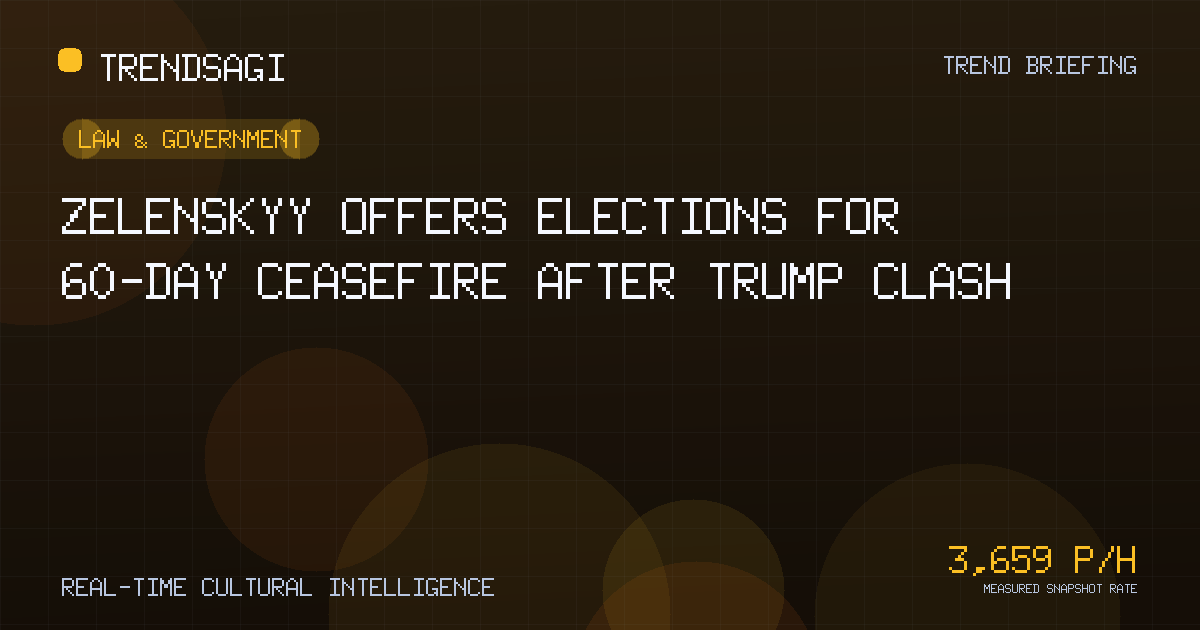
Ukrainian President Volodymyr Zelenskyy is drawing intense attention after a rapid public exchange with US President Donald Trump over energy infrastructure strikes and leadership. Trump criticized Zelenskyy on Saturday for Ukrainian attacks on Russian oil refineries, linked them to higher diesel prices, and said it was time for Ukraine to get a new president. In a Sunday ABC interview, Zelenskyy responded by offering to organize elections if Russia agrees to a 60-day total ceasefire. Hours later Trump announced an immediate “energy ceasefire” that both sides had supposedly agreed to; Zelenskyy said the claim was news to him but that Ukraine would support it if Russia does the same. TrendsAGI measured a snapshot rate of 3659 posts per hour over a 908-second window ending at the 2026-10-11T15:41:32Z observation, with a latest snapshot volume of 2769 posts.
| Observation time (UTC) | Measured posts/hour | Snapshot volume |
|---|---|---|
| 2026-10-11T15:41:32Z | 3659 | 2769 |
Why this topic may be moving
The sequence unfolded in less than a day. On Saturday Trump publicly faulted Zelenskyy for continuing strikes on Russian refineries after the United States temporarily eased sanctions to allow more Russian diesel into global markets. Trump stated it was time for Ukraine to get a new president. Zelenskyy answered on ABC’s This Week by stressing that Ukrainians alone choose their leader and by conditioning any elections on a full 60-day ceasefire from Russia. He also repeated Ukraine’s readiness for a reciprocal halt to energy-infrastructure attacks.
Trump then posted on Truth Social that an energy ceasefire was in effect immediately and that both parties had agreed. According to BBC News and Axios reporting carried by multiple outlets, Zelenskyy later said the announcement was news to him, yet confirmed Ukraine supports such a step provided Russia does too and that Kyiv awaits details from the American side. Al Jazeera and Reuters noted that Russia had not issued an immediate public confirmation.
The social spike quantifies how quickly a diplomatic exchange can move from bilateral criticism to competing ceasefire claims within hours, giving readers a real-time intensity reading that traditional reporting alone cannot supply.
Why it matters
The episode sits at the intersection of battlefield tactics, energy markets, and political legitimacy. Ukrainian strikes on Russian refineries have reduced diesel output and raised prices, a pressure point Trump has highlighted while pursuing limited sanctions relief. Zelenskyy’s election offer addresses repeated external calls for new leadership while underscoring the practical and legal barriers: Ukrainian law bars elections under martial law, and security conditions for voting remain absent without a genuine pause in fighting.
Readers following energy prices, US–Ukraine relations, or the broader war should note that an energy-only truce is narrower than the 60-day total ceasefire Zelenskyy proposed. Prior similar energy-truce claims earlier in the autumn did not hold; Russian strikes on Ukrainian energy sites and Ukrainian responses continued. The absence of confirmed Russian assent leaves the current claim unverified on one side.
What to watch next
- Any formal statement from the Russian government or military confirming or rejecting the energy ceasefire.
- Whether Ukrainian or Russian strikes on energy targets continue in the hours and days after the announcement.
- Clarification from the US side on the terms, duration, and verification mechanisms of any energy arrangement.
- Legal and logistical assessments inside Ukraine of how a 60-day ceasefire could enable elections under current martial-law rules.
- Further comments from Zelenskyy or Trump that link the energy pause to broader ceasefire or negotiation tracks.
Frequently asked questions
What exactly did Trump say about Zelenskyy needing to be replaced?
On Saturday Trump told reporters it was time for Ukraine to get a new president, stating that Zelenskyy could have settled the war many times and chooses not to. He tied the criticism to Ukrainian strikes on Russian refineries that he said were driving up diesel prices.
Did Zelenskyy agree to the energy ceasefire Trump announced?
Zelenskyy said the announcement was news to him but that Ukraine supports an energy ceasefire and will accept it if Russia also agrees. He posted that Kyiv awaits details from the American side and fully backs de-escalation steps.
Under what conditions would Ukraine hold elections according to Zelenskyy?
In the ABC interview Zelenskyy said Ukraine would organize elections if Russia provides a 60-day total ceasefire. He emphasized that the choice of leader belongs to the Ukrainian people and that security infrastructure is required for voting.
Has Russia confirmed or commented on the energy ceasefire?
As of the latest reporting from Reuters, BBC News, and Al Jazeera, Russia has not issued a public confirmation or detailed comment on Trump’s announcement.
Why did Trump criticize Ukrainian strikes on Russian refineries?
Trump argued the strikes were creating a global diesel-supply problem and raising prices. The remarks followed a US decision to ease certain sanctions to permit more Russian diesel into markets.
What is the difference between the energy ceasefire and a full 60-day ceasefire?
An energy ceasefire would limit attacks on energy infrastructure such as refineries, power plants, and related systems. Zelenskyy’s 60-day proposal calls for a complete halt to hostilities across the board so that elections could be organized under safer conditions.
Methodology and limitations
TrendsAGI’s measured snapshot rate of 3659 posts per hour captures short-window social volume around the Zelenskyy mentions and does not represent unique users, engagement, reach, or a continuing live rate. The figure is derived from three stored observations spanning an exact 908-second window ending at the listed timestamp. The signal can establish the intensity and timing of public reaction to the Trump–Zelenskyy exchange; it cannot confirm the existence, terms, or observance of any ceasefire, nor can it substitute for official diplomatic or battlefield reporting. Practical next checks include monitoring official Russian channels for confirmation, tracking strike reports from both sides, and watching for any joint US–Ukraine or US–Russia statements that add operational detail. Readers should treat unconfirmed claims of mutual agreement as provisional until both parties publicly acknowledge the same terms.
Sources
Track This Topic for New Signals
Set alerts for future velocity or sentiment changes around this topic.
Explore Tracking PlansAbout TrendsAGI research
TrendsAGI's automated research pipeline publishes dated signal snapshots, methodology notes, and practical workflows for teams evaluating cultural momentum. Read how signals are scoped, scored, and limited in our research methodology.