906-second window · 3 observations · Measured Nov 8, 2026, 2:35 PM UTC · Provider: go_recent_snapshot_v2
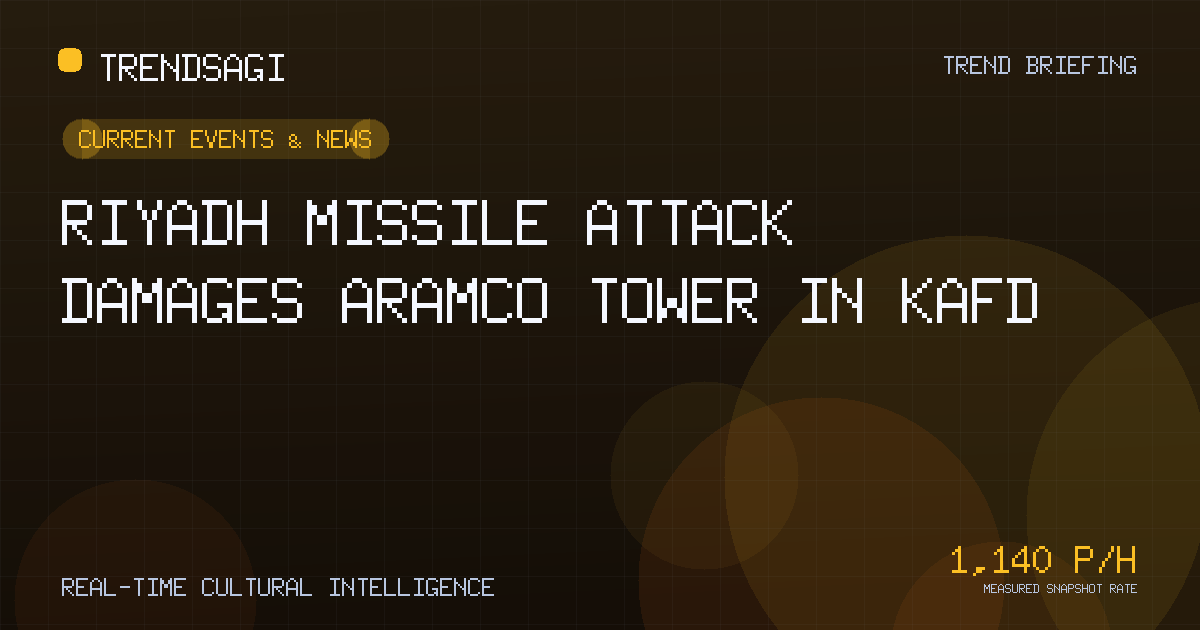
Riyadh Missile Attack Damages Aramco Tower in KAFD
A missile strike damaged an Aramco building in Riyadh's KAFD on 7-8 November 2026; here is what is confirmed, what is not, and how fast attention is spreading.
Automated briefing. Generated from stored signal measurements and source-backed research; it is not manually reviewed. Read the methodology and limitations or the editorial standards.
Metrics in this briefing are a snapshot associated with its publication date and may not reflect current conditions.
What changed
A missile strike damaged an Aramco building in Riyadh's King Abdullah Financial District (KAFD) on 7–8 November 2026, according to multiple outlets including CNN, Yahoo News Malaysia (AFP) and Reuters coverage carried by vijesti.me. The Saudi-led coalition said it intercepted ballistic missiles fired by Yemen's Houthis, and the Houthis claimed responsibility for attacks on Riyadh sites. The attack drove a sharp, measurable surge of attention: TrendsAGI recorded a measured snapshot rate of about 1,140 posts per hour across a 906-second observation window, with the latest snapshot at 600 posts, captured at 2026-11-08T14:35:22Z.
What changed, in numbers
| Observation time | Measured posts/hour | Snapshot volume |
|---|---|---|
| 2026-11-08T14:35:22Z | 1,140.1 | 600 posts |
Two things are moving at different speeds. Public discussion is moving fast; confirmed detail is moving slowly. That gap is the story readers should keep in view: a high measured snapshot rate tells you how quickly a claim is being shared, not whether the claim is true.
Why this topic may be moving
The verified driver is straightforward: a missile strike reportedly hit an Aramco-owned building in Riyadh's main financial district, a coalition said it intercepted Houthi ballistic missiles, and the Houthis said they were behind attacks on Riyadh sites. An attack on a building tied to Saudi Arabia's state oil company, in the capital's flagship business zone, is the kind of event that draws immediate search and social interest because it touches security, energy and business continuity at once.
What the reporting does not yet settle is the detail searchers most want. Damage specifics beyond shattered windows and facade damage remain loosely described, casualty figures are not confirmed in the sources reviewed, and the count of projectiles fired versus intercepted is reported with some inconsistency. Where those numbers are missing, this briefing says so rather than filling the gap.
The surge in posts measures attention, not confirmation. Until casualty figures, damage assessments and the exact count of intercepted projectiles are officially confirmed, treat the fastest-spreading details as claims still in circulation.
Why it matters
Three audiences should pay attention for different reasons.
- People in or travelling to Riyadh want to know whether the targeting is widening and whether the airport and financial district are recurring targets. Reports describe repeated targeting of Riyadh since October, but the brief does not verify the timeline or specifics of earlier strikes on the airport, so treat that as an open question rather than established sequence.
- Energy and markets watchers want to know whether Aramco operations are affected. No confirmed impact on oil production or markets appears in the verified reporting reviewed here. The building damage is confirmed; operational consequences are not.
- Analysts and journalists need to separate the social-media amplification curve from the official record. The measured rate is useful precisely because it shows how fast unverified claims travel alongside confirmed ones.
What to watch next
- Official casualty statements. No confirmed injury or fatality figures appear across the reports. A civil defence or health ministry statement would resolve the biggest open question.
- Damage assessment language. Watch for a shift from witness descriptions of shattered windows and facade damage to an engineering or official structural assessment.
- Interception accounting. Look for a single authoritative count of missiles fired versus intercepted, since current reporting is loose on this.
- Houthi statements. CNN Arabic reported an initial Houthi comment on the Aramco building targeting. The full text of any claim of multiple operations is not verified here, so watch for the complete statement rather than summaries.
- Aramco continuity signals. Any company or market statement on operations would be the first real test of business impact.
- Whether the measured rate decays. A falling snapshot rate with rising confirmation is a healthier sign than a rising rate with no new official facts.
Frequently asked questions
What exactly was hit in Riyadh's financial district and how badly?
A building owned by Saudi oil giant Aramco in Riyadh's King Abdullah Financial District was damaged in the missile attack, per CNN and Reuters coverage carried by vijesti.me. Reported damage centers on shattered windows and facade damage; the precise extent of structural damage is not confirmed.
Did the Houthis claim responsibility, and what did Yahya Saree say?
The Houthis claimed responsibility for attacks on Riyadh sites, and CNN Arabic reported an initial Houthi comment on the targeting of the Aramco building. The full text of Yahya Saree's statement and any claimed list of operations are not verified in the reporting reviewed here.
Were there any casualties or injuries?
No confirmed casualty or injury figures appear across the reports reviewed. This remains unconfirmed and is the key fact to watch for.
How many missiles were fired and were they intercepted?
The Saudi-led coalition said it intercepted ballistic missiles fired by the Houthis. Reporting is inconsistent on how many projectiles were fired versus intercepted, so the exact counts should be treated as unsettled.
Does this affect Aramco operations or oil markets?
No confirmed impact on Aramco oil production or oil markets appears in the verified reporting. The damage to the building is confirmed; operational and market effects are not.
Is Riyadh safe amid the Houthi attacks?
Riyadh and its airport have reportedly been targeted repeatedly since October, but this briefing cannot verify the timeline or details of earlier strikes on the airport. Anyone making travel or safety decisions should rely on official advisories rather than social posts.
Methodology and limitations
The change figure is a measured snapshot rate: about 1,140.1 posts per hour over an exact 906-second window, calculated from three stored observations and fixed at 2026-11-08T14:35:22Z. It is not a live rate, a forecast, a reach estimate, an engagement measure or a count of unique people. The latest snapshot volume was 600 posts.
The signal itself can establish that discussion of this topic accelerated sharply around the observed time. It cannot establish why individual posts were written, whether their content is accurate, or how many distinct people are involved. All factual claims about the strike come from published reporting attributed to CNN, Yahoo News Malaysia (AFP), CNN Arabic and vijesti.me (Reuters). Items this briefing could not verify — casualty numbers, precise structural damage, independent confirmation of the social-media video beyond CNN's verification, the full text of Houthi statements, market impact, and the details of prior October strikes on Riyadh airport — are flagged as unconfirmed or excluded.
Sources
- Building owned by Saudi oil giant damaged in missile attack on Riyadh's financial district (CNN) — edition.cnn.com
- Riyadh financial district targeted, Aramco tower damaged: witnesses (Yahoo News Malaysia (AFP)) — consent.yahoo.com
- أول تعليق من الحوثيين على استهداف مبنى لأرامكو في الرياض (CNN Arabic) — arabic.cnn.com
- Reuters: Riyadh tower damaged, hit by missile (vijesti.me (Reuters)) — en.vijesti.me
Track This Topic for New Signals
Set alerts for future velocity or sentiment changes around this topic.
Explore Tracking PlansAbout TrendsAGI research
TrendsAGI's automated research pipeline publishes dated signal snapshots, methodology notes, and practical workflows for teams evaluating cultural momentum. Read how signals are scoped, scored, and limited in our research methodology.