901-second window · 3 observations · Measured Nov 1, 2026, 2:45 PM UTC · Provider: go_recent_snapshot_v2
"Polish" Trends Explained: Poland Crisis vs. Viral Meme
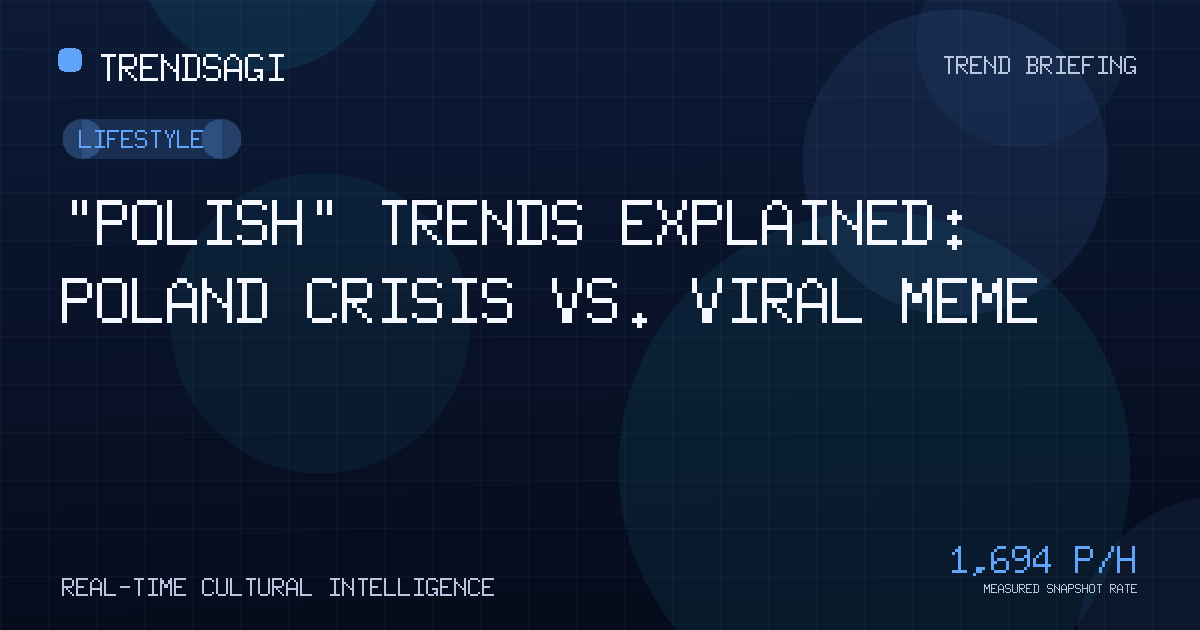
A measured 1,694 posts/hour snapshot shows "Polish" is trending. Explainer separates Poland's crisis, the Ukrainian-expulsion meme, and car polishing.
Automated briefing. Generated from stored signal measurements and source-backed research; it is not manually reviewed. Read the methodology and limitations or the editorial standards.
Metrics in this briefing are a snapshot associated with its publication date and may not reflect current conditions.
What changed
"Polish" is trending because searchers are casting a wide net over an ambiguous label that currently points at three unrelated things: Poland's constitutional crisis, a viral Russian-language street-interview meme in which young Poles suggested expelling Ukrainians, and, confusingly, auto-detailing "car polishing" content that still ranks for some queries. No verified source establishes that any one of these is the driver of the spike. What is measurable is that the interest is real and time-stamped: a stored snapshot at 2026-11-01T14:45:34Z shows 1,090 posts on the topic, with a measured snapshot rate of 1,694 posts/hour over an exact 901-second window using 3 stored observations.
| Observation time | Measured posts/hour | Snapshot volume |
|---|---|---|
| 2026-11-01T14:45:34Z | 1,694 | 1,090 posts |
The rate is a measured snapshot figure, not a live or forecast rate and not an audience-reach estimate. It tells you how fast conversation was accumulating around the moment of measurement, not how many people read it.
Why this topic may be moving
The honest answer is that the available evidence does not establish a single cause. The search intent brief found the label "Polish" splitting across at least three content clusters, and ranking pages are poorly matched to what searchers actually want.
- Politics: The Japan Times published a piece titled "Five things to know about Poland's constitutional crisis," and Sputnik Arabic reported that Dmitry Medvedev described the situation in Poland as a "constitutional coup" supported by neo-Nazi supporters.
- The meme: NEWS.ru and Life.ru both covered a Russian-language story about a street-interview clip in which young Poles suggested deporting Ukrainians. NEWS.ru's headline says young Poles "blew up" the internet with the suggestion; Life.ru frames a young Pole's answer to a street poll as a meme.
- Noise: Auto-detailing "car polishing" wikis and software localization docs pollute some queries, which means "Polish" is naming a chore and a country at the same time.
Because these three clusters are unrelated, a spike in the bare label "Polish" cannot be attributed with confidence to any single story. The volume is verified; the cause is not.
A trend label can be loud without being specific. Here "Polish" is carrying at least three unrelated stories at once, so the useful move is to separate them rather than pick one and call it the cause.
Why it matters
For readers encountering the spike, the practical damage is confusion. Someone searching "Polish" may land on a car-waxing guide when they wanted to understand a constitutional fight, or on a meme clip when they wanted a news explainer. Russian-language outlets — NEWS.ru and Life.ru among them — repeat the street-interview meme without original sourcing or identifying the interviewer or outlet, so a single street clip can be mistaken for public opinion.
On the political side, The Japan Times piece is a summary: the brief notes it offers no timeline of recent rulings, dates, or named institutions, which is exactly what a reader trying to follow a constitutional dispute needs. Meanwhile Medvedev's "constitutional coup" framing, reported by Sputnik Arabic, is a political characterization, not a legal finding, and should be read as such.
What to watch next
- Whether the measured posts/hour rate on the "Polish" label accelerates or flattens over subsequent stored observations — that is the cleanest test of whether the meme or the political story is carrying the volume.
- Whether Russian-language coverage of the street-interview clip begins to name an original interviewer or outlet; the brief notes the secondhand attribution to Pronews is unconfirmed.
- Whether any Polish-language primary source — a court statement, a government release, or an official opposition statement — surfaces to anchor the constitutional-crisis coverage.
- Whether English-language explainers finally connect the three clusters, or whether auto-detailing results keep dominating the query space.
- Whether demonstrations are documented by attributable reporting; the brief provides none, so protest activity should be treated as unconfirmed.
Frequently asked questions
What exactly triggered Poland's latest constitutional crisis?
The provided reporting does not verify a specific trigger. The Japan Times summarized the crisis, but the brief notes that summary lacks a timeline of recent rulings, dates, and named institutions, so a precise trigger cannot be stated here.
What did the viral Polish street-interview clip actually show and where did it originate?
According to Life.ru and NEWS.ru, the clip is a street interview in which young Poles suggested expelling Ukrainians. The identity of the interviewer, the outlet, and the date are not verified beyond secondhand attributions to Pronews.
Why did Dmitry Medvedev call the situation in Poland a 'constitutional coup'?
Sputnik Arabic reported that Medvedev described the situation in Poland as a "constitutional coup" supported by neo-Nazi supporters. The provided sources do not substantiate the underlying claim, so it should be read as a political characterization rather than a verified finding.
Is the viral meme representative of Polish public opinion or a single street interview?
It is a single street-interview clip as described by Russian-language outlets. Nothing in the verified reporting establishes that it represents Polish public opinion.
What has the Polish government and opposition said about the Constitutional Tribunal dispute?
The brief does not include verified statements from the Polish government or opposition on the Tribunal dispute, so no position can be attributed here.
Are there protests or demonstrations tied to these events?
No verified reporting in the brief confirms protests or demonstrations tied to these events. Treat any such claim as unconfirmed.
Methodology and limitations
This briefing rests on a stored signal observed at 2026-11-01T14:45:34Z with a snapshot volume of 1,090 posts and a measured snapshot rate of 1,694 posts/hour over an exact 901-second window using 3 stored observations. The rate describes the measurement window only; it is not a live rate, forecast, reach, engagement, or unique-person count.
The signal can establish that conversation around the label "Polish" was accumulating at a measurable pace at that time. It cannot establish why. The label is ambiguous, coverage is fragmented across languages and outlets, and the available sources do not connect the spike to a single verified cause. Auto-detailing content pollutes the query space, Russian-language meme coverage lacks original sourcing, and the constitutional-crisis summary lacks a timeline. Readers should treat the causal question as open and watch subsequent observations before drawing conclusions.
Sources
- Five things to know about Poland's constitutional crisis (The Japan Times) — thejapantimes.jp
- Молодые поляки «взорвали» Сеть предложением выслать украинцев (NEWS.ru)
- «Выгнали бы украинцев»: Ответ молодого поляка на уличный опрос стал мемом в Сети (Life.ru)
- مدفيديف يعتبر الوضع في بولندا "انقلابا دستوريا" مدعوما من أنصار النازية الجديدة (Sputnik Arabic) — sarabic.ae
Track This Topic for New Signals
Set alerts for future velocity or sentiment changes around this topic.
Explore Tracking PlansAbout TrendsAGI research
TrendsAGI's automated research pipeline publishes dated signal snapshots, methodology notes, and practical workflows for teams evaluating cultural momentum. Read how signals are scoped, scored, and limited in our research methodology.