927-second window · 3 observations · Measured Oct 27, 2026, 2:05 PM UTC · Provider: go_recent_snapshot_v2
"Tacky" Meaning, Trend Spike, and Why It's Being Searched Now
Tacky is trending alongside searches for its meaning vs. kitschy and corny. Here's the verified snapshot, the celebrity reaction stories, and what remains
Automated briefing. Generated from stored signal measurements and source-backed research; it is not manually reviewed. Read the methodology and limitations.
Metrics in this briefing are a snapshot associated with its publication date and may not reflect current conditions.
What changed
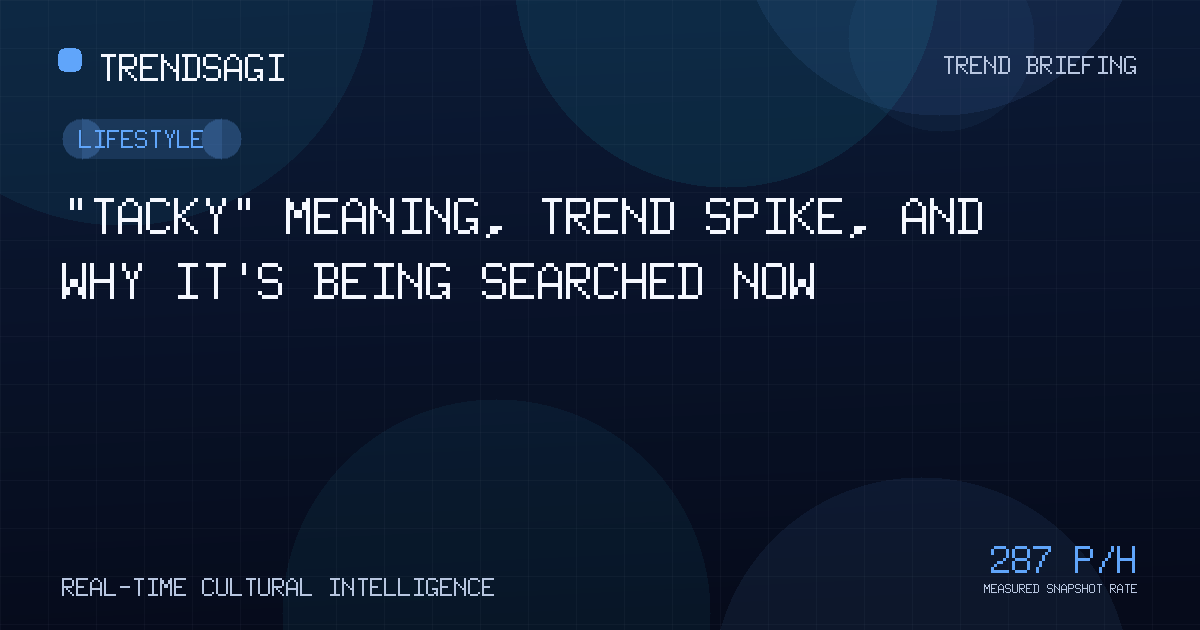
"Tacky" is being searched alongside "meaning vs. kitschy and corny" because the word is doing several unrelated jobs at once right now: reactions to supposed celebrity style, a viral backlash over hair and appearance, and a historical reference to Tacky's Revolt in 1760 Jamaica. The term's measured posting rate was 287.3 posts/hour over an exact 927-second window using 3 stored observations, as of 2026-10-27T14:05:17Z. In plain terms, the label is moving quickly, but no single verified event explains why.
The direct answer readers need first: "tacky" most commonly means showing poor taste or being gaudy, cheap, or inappropriately showy. It differs from "kitschy," which describes deliberately sentimental or campy art and objects, and from "corny" or "cheesy," which describe something overly sentimental, trite, or trying too hard to be charming. The storm of current searches appears to be mixing that definitional question with celebrity and style reaction stories, not one confirmed controversy.
The measured signal at a glance
| Item | Verified detail |
|---|---|
| Observation time | 2026-10-27T14:05:17Z |
| Measured snapshot rate | 287.3 posts/hour over a 927-second window, using 3 stored observations |
| Latest snapshot volume | 280 posts |
| Stored category | Lifestyle |
| Stored description | Not supplied |
The 287.3 posts/hour figure is a measured snapshot rate, not a live rate, forecast, reach, engagement, or unique-person count. The 280-post volume is a snapshot count, not a rate. Treat both as historical measurements taken at the timestamp above.
Why this topic may be moving
The available search-intent evidence does not establish a single verified cause. Instead, the "tacky" label is splitting across at least three unrelated clusters, which helps explain both the volume and the messy search intent.
- Style and celebrity reactions: The results include a Flipboard item from Sportskeeda describing NFL fans reacting to Taylor Swift's wedding photos to Travis Kelce, said to be leaked by the Daily Mail, with some commenters calling the photos "tacky." The photos' authenticity is not confirmed by the available material, so the "tacky" framing should be treated as fan commentary rather than a verified fact about the images.
- Appearance and hair backlash: A SHEfinds piece describes Erika Kirk being criticized over "tacky" style and extensions in a viral podcast clip showing off her "real" hair. The available material does not establish how widespread that criticism is beyond the cited clip.
- Historical confusion: An iHeart item covers the 1760 Tacky's Revolt that shook Jamaica. That "Tacky" is a historical figure and event name, not a usage of the modern adjective, which may be pulling unrelated searches into the same phrase.
Because these stories are unrelated, and because the available evidence does not establish that any one of them caused the current surge, the honest answer is that the cause is still unclear. What is clear is that the word is being used across multiple senses at once, and readers searching it are getting a mix of definitions and reaction coverage.
The most useful takeaway for readers is to separate the word's senses: tacky as bad taste, tacky as sticky texture, and Tacky as a historical figure are different things. Current searches are conflating them, and no single verified event explains the spike.
Why it matters
"Tacky" matters because it is a word people use to make judgments about taste, class, and etiquette, often without saying precisely which they mean. In fashion coverage, tacky usually describes an outfit, styling choice, or presentation seen as gaudy, cheap, or socially inappropriate. In everyday conversation, it can describe behavior, not just appearance: an action that feels rude, showy, or in poor taste. For brands, creators, and public figures, being labeled tacky can be reputationally costly even though the term is subjective.
For readers, the practical value is knowing which sense applies before joining a comment thread or sharing a reaction. A "tacky" wedding photo, a "tacky" hairstyle, and a historical "Tacky's Revolt" search are not the same subject. The following sections answer the definitional and trend questions people are actually asking.
Frequently asked questions
What does "tacky" actually mean and how is it different from kitschy, corny, and cheesy?
"Tacky" generally means showing poor taste, especially in a way that looks cheap, gaudy, or inappropriately showy. "Kitschy" describes art or objects that are deliberately sentimental, campy, or ironically stylish, while "corny" and "cheesy" describe things that feel overly sentimental, trite, or try-too-hard. The overlap is real, but tacky carries a stronger judgment about taste and social appropriateness.
Why are people calling Taylor Swift's leaked wedding photos tacky?
According to a Sportskeeda item republished on Flipboard, NFL fans reacted to wedding photos described as leaked by the Daily Mail, with some commenters calling them "tacky." The available material does not confirm that the photos are authentic, so the label should be read as fan reaction and commentary rather than a verified description of the images.
Why is Erika Kirk being criticized as tacky over her hair and style?
A SHEfinds article describes Erika Kirk being criticized over "tacky" style and extensions in a viral podcast clip that showed off her "real" hair. The available material does not establish whether that criticism is widespread beyond the cited clip, so it should be treated as a specific viral reaction rather than a broader consensus.
Is "tacky" about bad taste in appearance, behavior, or both?
Both. "Tacky" can describe appearance, such as an outfit or hairstyle seen as gaudy or cheap, and it can describe behavior, such as an action seen as rude or in poor taste. Context usually makes clear which sense is intended, but the underlying judgment is about taste and social appropriateness.
What was Tacky's Revolt in 1760 Jamaica?
According to an iHeart item, Tacky's Revolt was an uprising in 1760 that shook Jamaica. The "Tacky" in that name refers to a historical figure and event, not to the modern adjective, which is why the phrase can appear alongside current searches about the word's meaning.
Why is the word "tacky" spiking right now?
The available evidence does not establish a single verified cause. Searches appear to be pulling together unrelated items: reactions to Taylor Swift wedding photos described as leaked, criticism of Erika Kirk's style in a viral clip, and historical coverage of Tacky's Revolt. The measured snapshot rate of 287.3 posts/hour shows the term is moving fast, but it does not identify which story or definitional question is driving the motion.
What to watch next
Readers who want to track the "tacky" story honestly should watch for a few concrete signals rather than assuming one cause. First, check whether the Taylor Swift wedding photos are confirmed as authentic by a reliable source; if they are not, the "tacky" framing remains commentary. Second, watch whether the Erika Kirk criticism spreads beyond the cited viral clip, which would indicate a broader reaction. Third, look for any definitional explainer that links the current surge to specific stories, since the existing grammar coverage addresses meaning but not the live celebrity usage. Finally, watch whether the historical Tacky's Revolt results stay separate from the modern adjective, or whether the two continue to be conflated in search.
The signal itself can establish that the term is being posted about at a measured rate and that a snapshot volume exists. It cannot establish why the term is moving, whether any single event caused the spike, whether the celebrity photos are authentic, or how widespread any criticism is. Those are the open questions that future reporting would need to answer.
Methodology and limitations
This briefing is based on a stored snapshot observed at 2026-10-27T14:05:17Z, with a latest snapshot volume of 280 posts. The measured rate of 287.3 posts/hour was calculated over an exact 927-second window using 3 stored observations. It is a measured snapshot rate, not a live or current rate, and it should not be read as a forecast, reach, engagement, or unique-person count.
The search-intent brief behind this article did not establish a single verified reason for the topic's movement. Where external facts appear, they are attributed to the publishers named: englishgrammar.org for definitional distinctions, Sportskeeda via Flipboard for the Swift wedding-photo reactions, SHEfinds for the Erika Kirk criticism, and iHeart for the 1760 Tacky's Revolt. The authenticity of the leaked Swift photos and the breadth of the Erika Kirk criticism remain unconfirmed by the available material, and no search-volume, ranking, or traffic data is presented here.
Sources
- Cheesy vs. corny vs. hokey vs. schmaltzy vs. kitschy vs. tacky (Home of English Grammar) — englishgrammar.org
- "Looks like algae" "Tacky": NFL fans react as Taylor Swift's wedding photos to Travis Kelce get leaked by Daily Mail (Flipboard (Sportskeeda)) — flipboard.com
- Erika Kirk Criticized Over 'Tacky' Style & 'Extensions' In Viral Podcast Clip Showing Off Her 'Real' Hair (SHEfinds) — shefinds.com
- The 1760 Tacky's Revolt That Shook Jamaica (iHeart) — iheart.com
Track This Topic for New Signals
Set alerts for future velocity or sentiment changes around this topic.
Explore Tracking PlansAbout TrendsAGI research
TrendsAGI's automated research pipeline publishes dated signal snapshots, methodology notes, and practical workflows for teams evaluating cultural momentum. Read how signals are scoped, scored, and limited in our research methodology.