15-minute window · 3 observations · Measured Oct 19, 2026, 5:56 AM UTC · Provider: go_recent_snapshot_v2
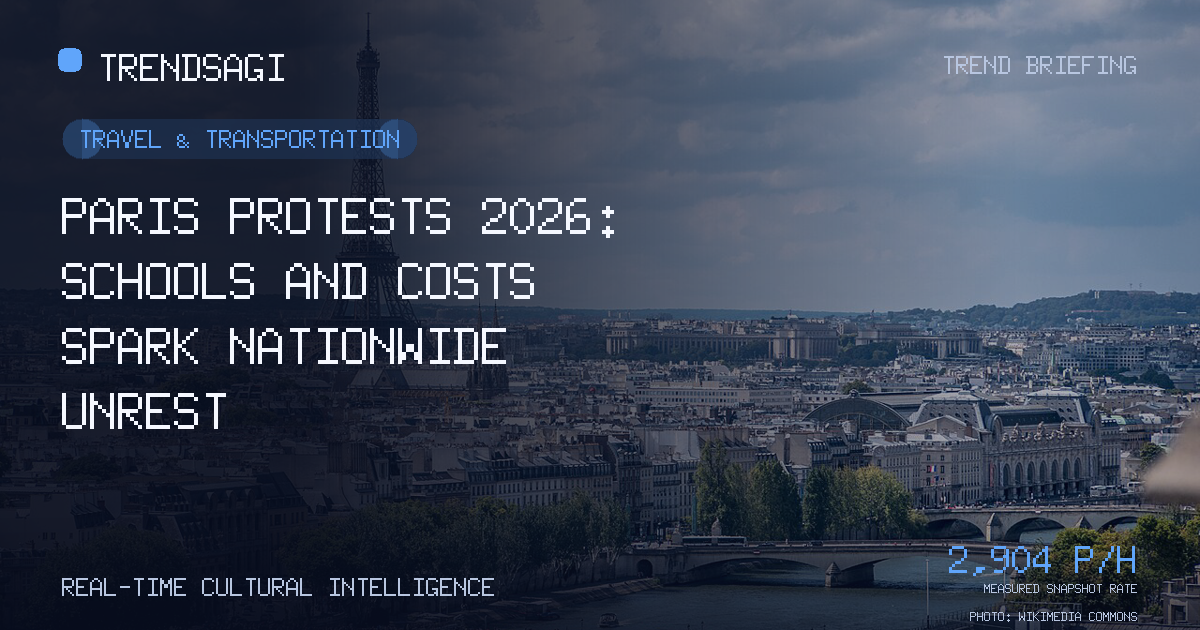
Paris Protests 2026: Schools and Costs Spark Nationwide Unrest
Paris protests over schools and living costs turned violent on 17 Oct 2026, driving a measured 2903.9 posts/hour social surge. Arrests near 2,400; Macron
Automated briefing. Generated from stored signal measurements and source-backed research; it is not manually reviewed. Read the methodology and limitations.
Metrics in this briefing are a snapshot associated with its publication date and may not reflect current conditions.
What changed
Social discussion of Paris and France protests surged sharply after student-led demonstrations over school conditions and the cost of living escalated into widespread riots, looting and arson on 17 October 2026. A measured snapshot rate of 2903.9 posts/hour was recorded over a 900-second window at 2026-10-19T05:56:57Z, with a snapshot volume of 2482 posts. The figure quantifies how rapidly the story spread on social platforms in the immediate aftermath of the violence and President Emmanuel Macron’s subsequent address.
| Observation time (UTC) | Measured posts/hour | Snapshot volume |
|---|---|---|
| 2026-10-19T05:56:57Z | 2903.9 | 2482 |
The high velocity reflects concentrated attention on images of devastated Paris streets, arrest totals and the government’s response rather than routine travel or tourism chatter.
Why this topic may be moving
Protests that began in mid-September 2026 among high-school students in Paris’s northern suburbs over teacher shortages, overcrowded classrooms and poor facilities broadened into a national mobilisation. On 17 October, students, teachers, unions and Yellow Vest supporters converged. Authorities estimated roughly 550,000 participants nationwide, including about 110,000 in Paris; organisers put the figure higher, near 800,000.
The large majority of marches remained peaceful. A violent fringe, however, engaged in arson, looting and clashes with police. Cars and barricades burned, shopfronts were smashed and public buildings were attacked in multiple cities, including the historic Limoges city hall. Paris saw particularly intense scenes around Place de la République and central commercial streets. Reports from the BBC, The Guardian and Al Jazeera documented whole streets left devastated, with hundreds of businesses damaged.
Arrest figures rose through the weekend. Early counts cited around 1,200 detainees; later interior ministry updates reported nearly 2,400 arrests nationwide, with a record number in Paris alone. Hundreds of police, gendarmes and firefighters were injured. One protester died after a cardiac arrest. Fresh, smaller-scale clashes continued in parts of Paris on 18 October.
The social-velocity spike captures the moment the story moved beyond traditional news cycles: the combination of dramatic street footage, rising arrest tallies and Macron’s televised response created a rapid feedback loop of attention that ordinary coverage describes only qualitatively.
Macron addressed the nation on the evening of 18 October. He drew a clear line between demonstrators with “legitimate demands” over schools and living costs and those who “destroyed, smashed and looted.” He stated that nothing justifies the violence, expressed anger and shame, promised justice for perpetrators, full transparency on the police response, and instructed the prime minister to convene stakeholders for concrete solutions in the coming days.
Why it matters
The events highlight accumulated pressure on France’s public services and household budgets ahead of the 2027 presidential election. For residents and visitors, the immediate practical effects include damaged commercial districts, temporary transport disruption in affected zones, heightened police presence and uncertainty about further demonstrations. Businesses face repair costs running into the hundreds of millions of euros according to trade representatives, though exact national totals remain unconfirmed.
The signal itself establishes only the intensity of online attention at one measured window. It does not measure unique users, geographic origin of posts, sentiment balance, or whether discussion is driven by participants, observers or opportunistic accounts. It also cannot distinguish organised political actors from opportunistic looters—claims that officials and political opponents have advanced without independent forensic consensus in the early reporting.
Travellers, local businesses, educators and policymakers have the most direct stake. Anyone monitoring French social stability or planning near-term activity in Paris should treat the measured rate as an early-warning indicator of elevated public focus rather than a forecast of further violence.
What to watch next
- Official updates on final arrest and injury tallies, and any court proceedings against those charged with violence or looting.
- Whether the promised stakeholder meetings produce visible measures on school staffing or purchasing-power support.
- Local prefect and mayor decisions on future rally authorisations or targeted restrictions.
- Transport and tourism advisories for central Paris commercial streets and major squares.
- Any sustained secondary mobilisation or decline in demonstration activity in the week after Macron’s address.
Practical next checks include official French interior ministry statements, Paris police prefecture updates, and major broadcasters’ live coverage rather than unverified social clips.
Frequently asked questions
What triggered the protests in Paris and across France?
Student demonstrations that started in mid-September over dilapidated school conditions, teacher shortages and overcrowding expanded to include cost-of-living grievances, fuelled by unions and Yellow Vest participants. The 17 October nationwide day of action marked the peak convergence of these issues.
How many people were arrested and how much damage occurred?
Interior ministry figures cited by multiple outlets rose to nearly 2,400 arrests. Hundreds of officers were injured. Damage included looted shops, burned vehicles and attacks on public buildings; trade groups described hundreds of millions of euros in commercial losses, though precise national totals were not yet finalised.
Did the protests start with students or cost-of-living issues?
They began with high-school students protesting school conditions and later absorbed broader cost-of-living and public-service anger. Both themes were prominent by 17 October.
What did Macron say in his address?
He condemned the violence as unjustified, distinguished peaceful protesters with legitimate concerns from those who destroyed and looted, pledged exemplary justice, full transparency on policing, and instructed the government to convene stakeholders for concrete solutions on the underlying issues.
Is the unrest continuing or under control?
The main wave peaked on 17 October. Smaller clashes and looting attempts continued into 18 October in parts of Paris and elsewhere, but overall intensity declined after the large marches ended and the presidential address.
Which areas of Paris were worst affected?
Place de la République and surrounding central streets saw the heaviest clashes, tear gas and water-cannon use. Commercial districts experienced widespread shopfront damage and looting; some residential and tourist-adjacent streets were left with burnt debris and shattered glass.
Methodology and limitations
The posts/hour figure is a measured snapshot rate derived from three stored observations over an exact 900-second window ending at the stated timestamp. It is not a live rate, forecast, engagement total or unique-person count. Snapshot volume records the post count at that observation. The metric captures relative social velocity around the topic label “Paris” but cannot establish causation, geographic concentration of posters, or the balance between reporting of peaceful grievances and coverage of violence. External facts are drawn only from contemporaneous reporting by named publishers and are subject to revision as official tallies are finalised. Unconfirmed claims—precise final economic damage, exact coordination by specific political groups, or post-19 October arrest increments—are omitted or noted as such.
Sources
- France protests: Burnt out cars and shattered glass on Paris streets after protests turn to riots and looting (BBC) — bbc.co.uk
- Arrests over France protests rise to 1,800, with whole streets in Paris ‘devastated’ – Europe live (The Guardian) — theguardian.com
- Paris left reeling as student-led protests turn chaotic (Al Jazeera) — aljazeera.com
Image: Paris by Yann Caradec from Paris, France, CC BY-SA 2.0, via Wikimedia Commons. The thumbnail adapts this photo with a title overlay and is shared under the same licence.
Track This Topic for New Signals
Set alerts for future velocity or sentiment changes around this topic.
Explore Tracking PlansAbout TrendsAGI research
TrendsAGI's automated research pipeline publishes dated signal snapshots, methodology notes, and practical workflows for teams evaluating cultural momentum. Read how signals are scoped, scored, and limited in our research methodology.