901-second window · 3 observations · Measured Oct 18, 2026, 12:57 AM UTC · Provider: go_recent_snapshot_v2
Marseille City Hall Stormed in 17 Oct Cost-of-Living Protests
Marseille city hall was briefly stormed on 17 Oct during cost-of-living protests. Verified timeline, injuries, arrests and the measured social spike of 655
Automated briefing. Generated from stored signal measurements and source-backed research; it is not manually reviewed. Read the methodology and limitations.
Metrics in this briefing are a snapshot associated with its publication date and may not reflect current conditions.
What changed
Marseille is trending after masked demonstrators briefly forced entry into the city hall on 17 October 2026 during nationwide cost-of-living protests, toppling a Marianne bust, tagging walls, attacking a municipal police post on the Canebière, setting fires and looting shops. Videos of the scenes and CRS reinforcements drove a measured snapshot rate of 655.3 posts/hour in a short overnight window, with a latest snapshot volume of 389 posts observed at 2026-10-18T00:57:27Z.
| Observation time (UTC) | Measured posts/hour | Snapshot volume |
|---|---|---|
| 2026-10-18T00:57:27Z | 655.3 | 389 |
The social amplification reflects the intensity of the Marseille footage more than the overall national turnout. The signal quantifies sudden velocity of discussion; it does not measure unique users, reach or ongoing volume after the observation window closed.
Why this topic may be moving
According to reporting by Le Parisien, franceinfo and AFP journalists on the ground, several dozen masked individuals rammed the wooden doors of Marseille’s Hôtel de Ville on the Vieux-Port with security barriers, entered the hall shouting references to taking the Bastille, overturned furniture and a bust of Marianne, and sprayed anarchist symbols before being dispersed within minutes. A municipal police post on the Canebière was attacked earlier, with windows broken and smoke devices thrown inside. Shops along the Canebière, Saint-Ferréol and nearby streets were looted.
The Bouches-du-Rhône prefect described facing 7,000 to 8,000 people he characterised as émeutiers rather than ordinary demonstrators. Mayor Benoît Payan condemned the intrusion as unacceptable, distinguished casseurs from legitimate protesters, and said he obtained immediate CRS reinforcements and armoured vehicles after speaking with President Emmanuel Macron. Nationally The Guardian and other outlets reported more than 1,200 arrests and widespread clashes, with Marseille among the most visually striking locations.
The brief city-hall breach and subsequent looting produced the sharpest social-media spike because the images were concrete, symbolic and easily shared, separating verified institutional damage from the broader peaceful mobilisation.
Why it matters
Residents, local businesses and visitors need clarity on whether the centre is secure. Commuters and event organisers face cancelled or disrupted Sunday markets and gatherings. Nationally the Marseille scenes feed the political argument over policing levels, the distinction between cost-of-living demonstrators and opportunistic violence, and the capacity of forces to protect public buildings. For anyone monitoring French social unrest, the combination of verified AFP and Le Parisien facts with the measured post velocity offers a data point on how quickly local disorder can dominate the national conversation.
The TrendsAGI measurement supplies objective evidence of amplification that traditional reporting cannot quantify on its own. It shows the topic moved fast enough overnight to register a high short-window rate; it cannot establish whether discussion is still rising or has already peaked.
What to watch next
- Updated arrest and injury figures specific to Marseille from the prefecture or Interior Ministry.
- Whether further CRS deployments or vehicle movements are announced for the coming days.
- Official statements on reopening of central commercial streets and any additional cancellations of public events.
- Cross-city comparisons: intensity in Marseille versus Paris, Limoges (where a town hall suffered severe fire damage) or Lyon.
- Any shift in social volume after the initial overnight spike—continued high discussion would signal lingering concern; rapid drop-off would indicate a short-lived news cycle.
Frequently asked questions
What exactly happened at Marseille city hall on 17 October?
Masked demonstrators forced the main doors of the Hôtel de Ville using barriers, entered the entrance hall for a short time, toppled a Marianne bust, damaged furniture and left tags. Police cleared the building within minutes and then secured the perimeter. Damage inside was described by the mayor as limited.
Were the protests linked to the Yellow Vests or student movements?
The nationwide day of action drew Yellow Vest veterans, high-school students, trade unionists and others protesting living costs and public services. Some participants in Marseille wore yellow vests or carried Palestinian flags, but authorities attributed the most violent acts to a minority of casseurs rather than the organised protest columns.
How many people were arrested or injured in Marseille?
Early evening figures from the prefecture cited roughly 20–30 arrests. Reports of police injuries varied across the day, with one count of at least 29 officers hurt and a later local figure of 107 officers injured in the department, three of them seriously. Precise final Marseille-specific totals after evening updates remain unconfirmed in the sources reviewed.
Did the violence involve the Olympique de Marseille store or fans?
Sportswear shops including JD Sports were among those looted in the central commercial triangle. Specific claims about an OM boutique have circulated but were not verified in the primary reports from Le Parisien, franceinfo or AFP cited here.
What has the mayor and Macron said in response?
Mayor Benoît Payan called the intrusion unacceptable, stressed that casseurs are not the same as legitimate demonstrators, and publicly confirmed he had obtained CRS and armoured reinforcements after contact with the Élysée. President Macron was reported to be following the situation closely and authorised the additional forces.
Is the situation still ongoing or under control?
By evening of 17 October the city-hall perimeter had been secured and additional CRS units were on the ground. Looting and scattered disorder continued for some hours in commercial streets. As of the overnight social-signal observation the acute phase of the city-hall incident itself was over, though the broader security posture remained elevated.
Methodology and limitations
The posts/hour figure is a measured snapshot rate calculated from three stored observations spanning an exact 901-second window ending at the stated timestamp. It is not a live rate, forecast, engagement metric or count of unique people. Snapshot volume records the absolute number of posts captured at that moment. The signal can establish that discussion accelerated sharply around the Marseille images; it cannot prove causation, measure geographic distribution of posters, or substitute for official casualty or arrest tallies. External facts are drawn only from contemporaneous reporting by named publishers and are limited to what those outlets verified on the day. Exact final Marseille-specific arrest and injury numbers after later updates, the precise number of CRS companies ultimately deployed, and the coordinated-versus-opportunistic nature of any particular shop attack remain outside the verified record used here.
Sources
- Building set ablaze and more than 1,200 arrested as police clash with protesters across France (The Guardian) — theguardian.com
- Mobilisation du 17 octobre : la mairie de Marseille investie, des CRS et des blindés envoyés en renfort (Le Parisien) — leparisien.fr
- Mobilisation du 17 octobre : la mairie et des commerces attaqués à Marseille (franceinfo) — franceinfo.fr
- Marseille town hall breached as France braces for nationwide cost-of-living protests (TRT World) — trtworld.com
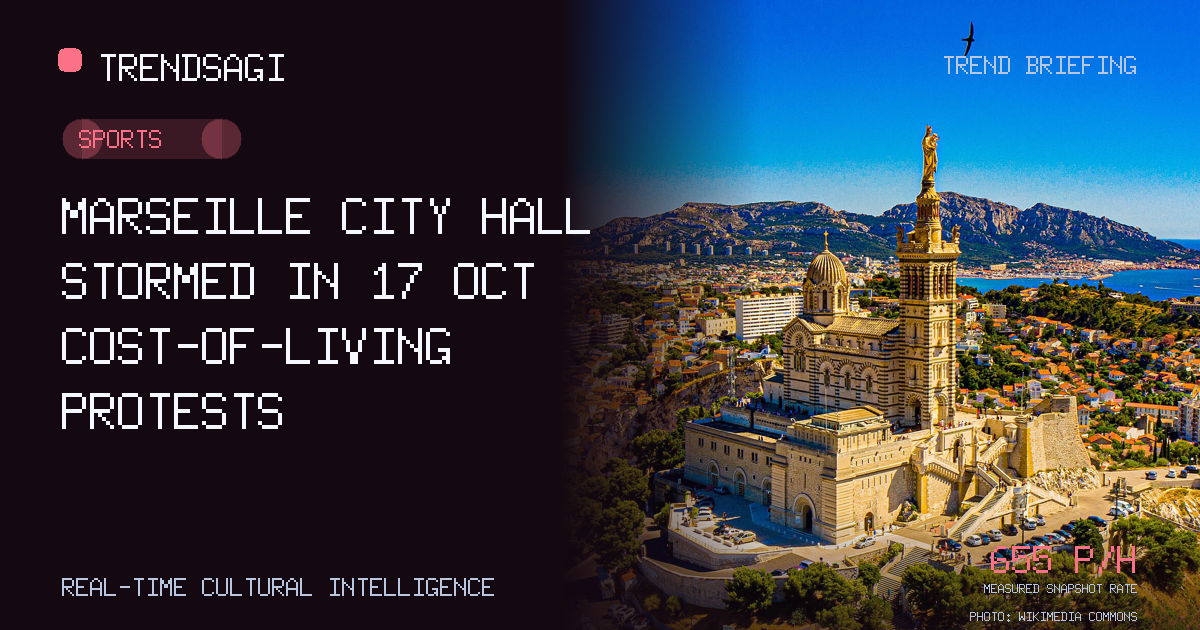
Image: Marseille by Earth777, CC BY-SA 4.0, via Wikimedia Commons. The thumbnail adapts this photo with a title overlay and is shared under the same licence.
Track This Topic for New Signals
Set alerts for future velocity or sentiment changes around this topic.
Explore Tracking PlansAbout TrendsAGI research
TrendsAGI's automated research pipeline publishes dated signal snapshots, methodology notes, and practical workflows for teams evaluating cultural momentum. Read how signals are scoped, scored, and limited in our research methodology.