896-second window · 3 observations · Measured Oct 18, 2026, 2:57 AM UTC · Provider: go_recent_snapshot_v2
Limoges Town Hall Fire: 1883 Building Largely Destroyed in Protests
Limoges town hall fire on 17 Oct 2026 left the 1883 historic building largely destroyed. Damage details, protest context and measured social spike explained.
Automated briefing. Generated from stored signal measurements and source-backed research; it is not manually reviewed. Read the methodology and limitations.
Metrics in this briefing are a snapshot associated with its publication date and may not reflect current conditions.
What changed
On 17 October 2026, masked individuals set fire to Limoges’s historic Hôtel de Ville during nationwide cost-of-living protests in France. The 1883 building, a listed monument, suffered catastrophic damage: the roof and campanile collapsed and two-thirds of the exterior was lost, according to the local prefect. Social discussion of the event reached a measured snapshot rate of 791.5 posts per hour, with a latest snapshot volume of 566 posts observed at 2026-10-18T02:57:32Z.
| Observation time (UTC) | Measured posts/hour | Snapshot volume |
|---|---|---|
| 2026-10-18T02:57:32Z | 791.5 | 566 |
Why this topic may be moving
The fire occurred in the late afternoon of 17 October after a protest march in Limoges. Witnesses and official accounts reported that a group of masked people first torched a police vehicle outside the town hall, then broke windows, entered the building and started the blaze. The fire spread rapidly through one wing, reached the timber roof structure and caused the campanile to collapse. Prefect Maurice Barate told AFP the structure was “largely lost,” describing the damage as a “catastrophe for heritage” and a deliberate act by hooligans rather than the main body of demonstrators.
TF1 Info and other French outlets confirmed the same assessment: the roof collapsed onto lower floors except the west wing, and roughly two-thirds of the façade had already disappeared by evening. The mayor of Limoges, Guillaume Guérin, stated that municipal services would continue and that the attack had destroyed a beloved building but not the Republic itself. No injuries or deaths were reported among the elected officials, municipal staff and police who had been inside.
The incident sits inside a wider national day of mobilisation against the cost of living. In Limoges several thousand people took part; authorities estimated several hundred radicalised individuals among them. Similar unrest affected other French cities the same day, but the destruction of a 143-year-old listed monument produced an especially sharp visual and cultural reaction.
Why it matters
The Hôtel de Ville de Limoges was completed in 1883 in a Renaissance Revival style inspired by the Paris city hall. Its façades, roofs and monumental fountain have been protected as a historic monument since 1975. The loss therefore goes beyond administrative disruption: it removes a major civic landmark from a city long associated with porcelain manufacture and 19th-century civic pride.
For local residents the immediate practical issues are continuity of civil-registry, wedding and municipal services, already promised by the mayor. For heritage professionals and cultural observers the event raises longer questions about protection of public monuments during periods of social tension. The measured social-media spike quantifies how quickly a regional heritage loss can amplify inside a national protest cycle—something traditional news timelines capture only after the fact.
A 19th-century civic landmark that had stood for 143 years was reduced in a single evening to a largely ruined shell, turning a local protest incident into a national symbol of heritage vulnerability.
What to watch next
- Official damage inventory and any statement on the fate of interior spaces such as the wedding hall and civil-registry offices.
- Temporary relocation of municipal services and the timeline for resuming full operations.
- Any announced restoration feasibility studies, cost ranges or insurance assessments (none verified at the time of the snapshot).
- Further arrests or judicial proceedings linked to the arson.
- Whether similar attacks on other French public buildings appear in subsequent protest days.
Practical next checks include statements from the Haute-Vienne prefecture, the City of Limoges and the Ministry of Culture. Watch signals are renewed footage of structural surveys, formal heritage listings updates, and any shift in national political rhetoric around the protection of monuments.
Frequently asked questions
What exactly happened to the Limoges town hall on 17 October 2026?
During the afternoon of a national cost-of-living protest, a group of masked individuals set fire to a police car outside the Hôtel de Ville, broke into the building and started a fire inside. The blaze spread to the roof; the campanile collapsed and the structure was declared largely lost by evening.
How much of the historic building was destroyed?
Prefect Maurice Barate stated that the roof had collapsed onto the lower floors except the west wing and that two-thirds of the exterior had already disappeared. French media described the campanile and large sections of the roof structure as lost.
Were there any injuries or deaths?
Authorities reported that elected officials, municipal staff and police who had been inside were evacuated without injury. No deaths were recorded in connection with the fire.
Who set the fire and how did it start?
Witnesses and officials described a group of masked people who first burned a police vehicle, then smashed windows, entered the ground floor and ignited the fire. The prefect characterised the act as deliberate arson by hooligans, distinct from the main protest march.
What is the historical significance of the Hôtel de Ville de Limoges?
Completed in 1883 and listed as a historic monument in 1975, the building is a prominent example of late-19th-century civic architecture modelled on the Paris city hall. Its façades, roofs and fountain formed a recognised landmark of the city.
How does this fit into the wider French cost-of-living protests?
The fire occurred on the margins of a nationwide day of demonstrations. In Limoges several thousand people marched; authorities noted a smaller contingent of radicalised individuals whose actions against the town hall produced the most dramatic local outcome of the day.
Methodology and limitations
The posts-per-hour figure is a measured snapshot rate calculated over an exact 896-second window from three stored observations ending at 2026-10-18T02:57:32Z. It quantifies sudden social amplification of the heritage loss; it does not measure reach, unique users, engagement quality or future volume. Snapshot volume records the absolute count of posts observed at that moment. The signal cannot establish the precise number of arsonists beyond “a group,” final reconstruction costs, or the survival of any interior artworks or archives. Those details remain unverified and are omitted. Attribution of damage assessments rests on statements reported by TF1 Info, AFP and the Haute-Vienne prefecture.
Sources
- 17 octobre : la mairie de Limoges, incendiée, "en grande partie perdue" (TF1 Info) — tf1info.fr
- Manifestation du 17 octobre : la mairie de Limoges ravagée par les flammes après une attaque de manifestants (actu.fr)
- Hôtel de ville de Limoges (Wikipédia) — fr.wikipedia.org
- Limoges fire: France on fire as 143-year-old town hall DESTROYED during 'ultra-left' nationwide riots (GB News) — gbnews.com
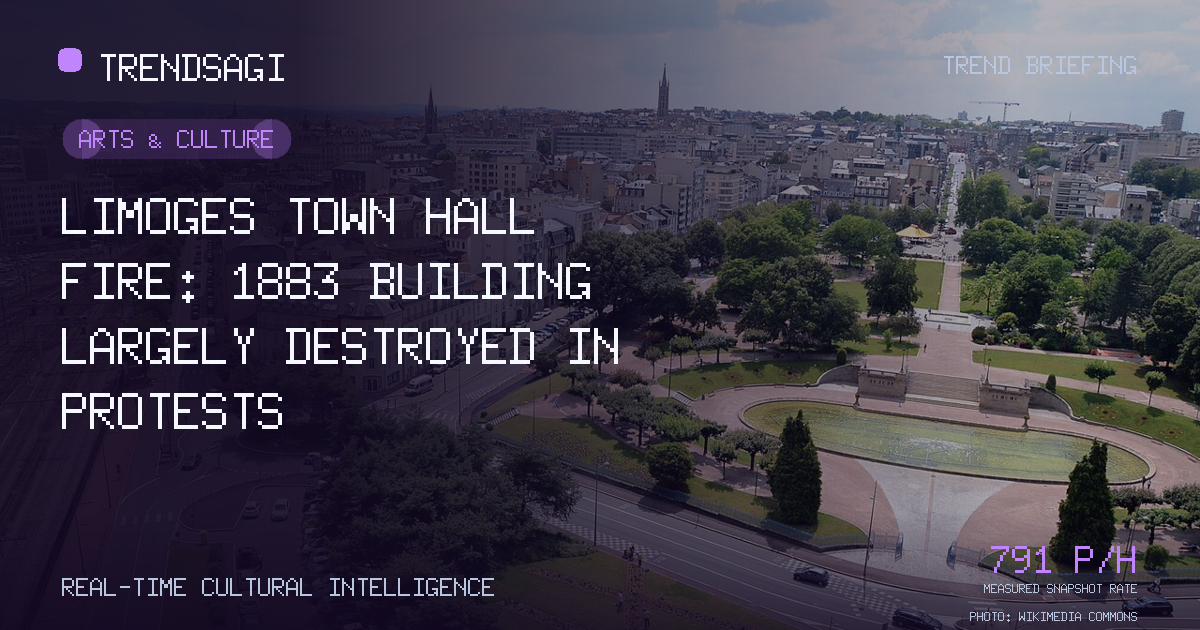
Image: Limoges by Babsy, CC BY-SA 3.0, via Wikimedia Commons. The thumbnail adapts this photo with a title overlay and is shared under the same licence.
Track This Topic for New Signals
Set alerts for future velocity or sentiment changes around this topic.
Explore Tracking PlansAbout TrendsAGI research
TrendsAGI's automated research pipeline publishes dated signal snapshots, methodology notes, and practical workflows for teams evaluating cultural momentum. Read how signals are scoped, scored, and limited in our research methodology.