903-second window · 3 observations · Measured Nov 4, 2026, 7:46 PM UTC · Provider: go_recent_snapshot_v2
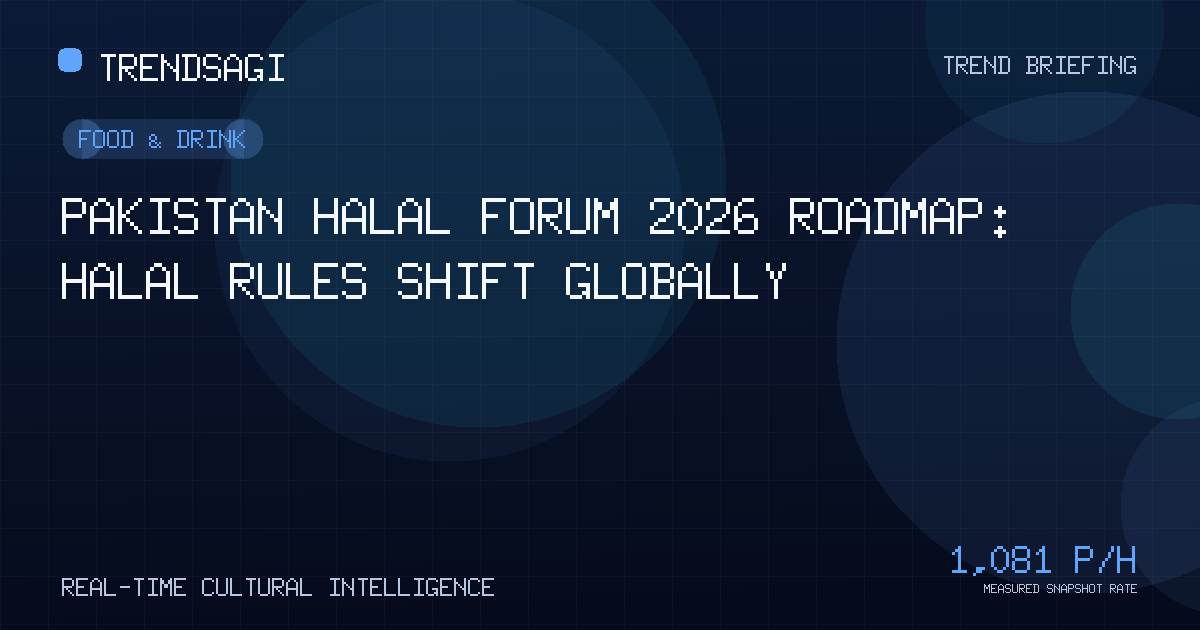
Pakistan Halal Forum 2026 Roadmap: Halal Rules Shift Globally
Pakistan Halal Forum 2026 closed in Karachi with an 'Intelligent Halal Economy' roadmap, as halal rules shift across several countries at once.
Automated briefing. Generated from stored signal measurements and source-backed research; it is not manually reviewed. Read the methodology and limitations or the editorial standards.
Metrics in this briefing are a snapshot associated with its publication date and may not reflect current conditions.
What changed
The halal story moved on several fronts in the same 48 hours. The 1st Pakistan Halal Forum 2026 concluded in Karachi on Nov 3–4 and unveiled a roadmap for what organizers call the "Intelligent Halal Economy," according to the Pakistan & Gulf Economist. That forum landed alongside Indonesia's halal certification mandate, a legislative push in Malaysia, and European debate over halal licensing reported by IQNA and Commercial Times. Together these make halal certification a live cross-border policy subject rather than a slow trade topic.
TrendsAGI measured a snapshot rate of about 1,080.6 posts per hour over an exact 903-second window, using 3 stored observations at 2026-11-04T19:46:12Z, with a latest snapshot volume of 486 posts. That rate is an observation, not a live figure or a forecast. Its shape — broad and multi-country — fits a news cycle spread across several jurisdictions rather than a single discrete event.
| Observation time | Measured posts/hour | Snapshot volume |
|---|---|---|
| 2026-11-04T19:46:12Z | 1080.6 | 486 posts |
Why this topic may be moving
The search results do not establish one verified trigger for the spike. What they do show is a cluster of halal-economy news in the same window:
- The Pakistan Halal Forum 2026 closing in Karachi on Nov 3–4 with a roadmap framed as the "Intelligent Halal Economy" (Pakistan & Gulf Economist).
- Malaysia's Consumers' Association of Penang (CAP) calling for a comprehensive Halal/Haram Act.
- Debate in Europe over whether halal licensing is needed (IQNA, in German).
- Coverage of Malaysia's halal industry transformation as the global halal economy grows (Commercial Times).
Indonesia's certification mandate is also part of the discussion fed to this briefing, but the specific extension details are not corroborated by an official Indonesian source in these results. Treat that part as reported but unconfirmed. The multi-country pattern is the strongest verified explanation available.
The halal label is no longer a purely religious marker managed inside one country — it is becoming a trade and regulatory question that crosses borders, which is why several governments and consumer groups moved on it in the same week.
Why it matters
For shoppers, the practical question is whether the label can be trusted and who governs it locally. For exporters and small producers, the question is harder: which authority is accepted in which market, and what does certification actually require before a container ships?
This is where most coverage falls short. Institutional announcements describe rules but rarely connect them to a producer's checklist. The Pakistan forum's roadmap is reported as a headline, but its concrete commitments are not explained in the sources reviewed. CAP's critique rests on "piecemeal legislation," yet no source in the results quantifies enforcement gaps or consumer harm from mislabeling. Searchers asking what halal certification covers, which countries require it by law, or how to enter the global halal market will find fragments, not a consolidated picture.
Who should care most: food and beverage exporters, cosmetics and pharmaceutical manufacturers, logistics providers handling segregated supply chains, certification bodies, and regulators watching how other countries tighten rules. Consumers comparing labels sit at the end of that chain.
What to watch next
- Whether the Pakistan forum's "Intelligent Halal Economy" roadmap produces published commitments, timelines, or a digital traceability standard — currently only the headline framing is verified.
- Any official Indonesian government statement confirming or correcting the reported certification mandate extension.
- Whether Malaysia's parliament takes up a comprehensive halal/haram act, or CAP's call stays a proposal.
- European licensing decisions or consultations on halal certification requirements.
- Whether reported market-entry efforts in Vietnam and Korea turn into actual certification approvals or export volumes — the results do not confirm that step.
Practical next checks
If you are preparing to export, verify the accepted certifier for each destination market before production, not after. Ask the certifier directly which scope applies — food only, or cosmetics, pharmaceuticals, and logistics too. Keep documentary evidence of slaughter methods, since stunning rules are a common point of rejection. For readers tracking the story rather than shipping product, watch for official government releases rather than trade-press summaries; the gap between announcement and implementing rule is where most confusion sits.
Frequently asked questions
What does halal certification actually cover beyond food?
The sources reviewed describe halal as extending into a wider economy, including cosmetics, pharmaceuticals, logistics, and finance-adjacent commerce. Exact scope depends on the certifying body and the importing country, so confirm the category coverage with the certifier before relying on a label.
Which countries require halal certification by law, and what are the deadlines?
Indonesia's certification mandate features prominently in the current news cycle, and Malaysia's rules are widely discussed, but the specific deadlines and any extension are not corroborated by an official source in the results reviewed here. Check each country's official regulator before planning shipments.
What did the 1st Pakistan Halal Forum 2026 conclude and what is the 'Intelligent Halal Economy' roadmap?
According to the Pakistan & Gulf Economist, the forum concluded in Karachi on Nov 3–4 and unveiled a roadmap for the "Intelligent Halal Economy." The concrete commitments behind that framing are not detailed in the sources reviewed, so treat the specifics as still unpublished.
Why are consumer groups like CAP calling for a comprehensive Halal/Haram Act in Malaysia?
The Consumers' Association of Penang argues that current halal regulation is piecemeal and wants a single comprehensive act, according to CAP. No source in the results quantifies enforcement gaps or consumer harm from mislabeling, so the size of the problem remains an open question.
What slaughter methods are permitted under halal rules, and why are captive bolt methods rejected?
Halal rules require the animal to be alive at the point of slaughter, with a swift cut and invocation; captive bolt stunning is rejected by many authorities because it can kill or render the animal insensible before the cut. The full reasoning of Malaysia's fatwa committee beyond its cited 2005 decision is not established in the sources reviewed.
How big is the global halal market and how fast is Muslim consumer spending growing?
Figures such as a roughly 2 billion Muslim population and about $3.1 trillion in spending by 2027 circulate widely, but the results reviewed repeat them without scrutiny of methodology or source caveats. Treat them as reported estimates rather than verified measurements.
Methodology and limitations
The rate in this briefing is a measured snapshot rate derived from 3 stored observations across an exact 903-second window ending 2026-11-04T19:46:12Z, with a latest snapshot volume of 486 posts. It is not a live rate, reach, engagement, or unique-person count, and it should not be read as a forecast.
The signal establishes that a multi-country halal conversation intensified in this window. It cannot establish a single cause, confirm the Indonesian mandate extension details, verify the Pakistan roadmap's commitments, or measure how market-entry efforts in Vietnam and Korea translate into approvals or export volumes. No search volume, ranking, or traffic figures are included because none were verified.
Sources
- 1st Pakistan Halal Forum 2026 Concludes in Karachi, Unveils Roadmap for The Intelligent Halal Economy (Pakistan & Gulf Economist) — pakistangulfeconomist.com
- CAP: Comprehensive Halal/Haram Act Needed (Consumers' Association of Penang (CAP)) — consumer.org.my
- Untersuchung der Notwendigkeit der Lizensierung von Halal in Europa (IQNA) — iqna.ir
- 全球清真經濟快速崛起 馬來西亞加速產業轉型 (工商時報 (Commercial Times)) — ctee.com.tw
Track This Topic for New Signals
Set alerts for future velocity or sentiment changes around this topic.
Explore Tracking PlansAbout TrendsAGI research
TrendsAGI's automated research pipeline publishes dated signal snapshots, methodology notes, and practical workflows for teams evaluating cultural momentum. Read how signals are scoped, scored, and limited in our research methodology.