1672-second window · 3 observations · Measured Oct 23, 2026, 3:57 PM UTC · Provider: go_recent_snapshot_v2
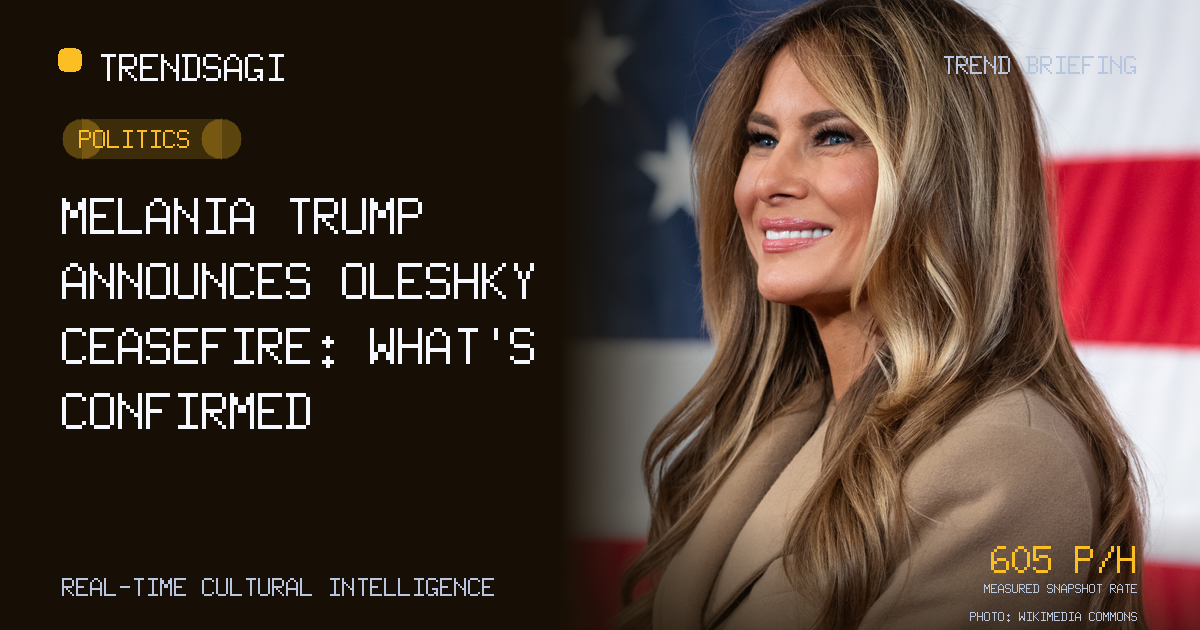
Melania Trump Announces Oleshky Ceasefire: What's Confirmed
Melania Trump announced an Oleshky ceasefire starting 29 October; the Kremlin welcomed it. Here is what is confirmed, what is not, and how the signal moved.
Automated briefing. Generated from stored signal measurements and source-backed research; it is not manually reviewed. Read the methodology and limitations.
Metrics in this briefing are a snapshot associated with its publication date and may not reflect current conditions.
What changed
First Lady Melania Trump announced a localized Russia–Ukraine ceasefire for the Russian-occupied city of Oleshky in Ukraine's Kherson region, with the pause set to begin on 29 October 2026 to allow humanitarian aid and civilian evacuation, according to Ukrinform. The Kremlin's Dmitry Peskov publicly welcomed the effort the same day, Anadolu Ajansı reported. The announcement is the verified trigger behind a sharp measured spike in posts discussing "Melania Trump ceasefire Oleshky," and the central factual question readers are searching is simple: what exactly has been agreed, and what remains unconfirmed?
The signal moved fast. Stored observations measured 935 posts at 15:57 UTC on 23 October 2026, a measured snapshot rate of 605.1 posts/hour over an exact 1,672-second window across three stored observations. That rate describes stored snapshots, not a live or forecast count: it tells us the conversation accelerated around the announcement itself, not how many people saw it or whether public interest will hold.
Signal at a glance
| Observation time | Measured posts/hour | Snapshot volume |
|---|---|---|
| 2026-10-23T15:57:49Z | 605.1 | 935 posts |
Why this topic may be moving
The verified cause is the announcement itself. On 23 October 2026, multiple outlets reported that Melania Trump announced a localized truce in Oleshky, and the Kremlin welcomed it publicly the same day. That combination — a White House-linked announcement plus a rapid Kremlin comment — gives the story two confirmation anchors in a single news cycle, which is exactly the kind of pairing that drives search and social velocity.
What the brief does not verify is equally important. The exact duration, terms and monitoring mechanism of the ceasefire are not confirmed. Whether the deal was formally negotiated by Melania Trump personally, or announced by the White House on her behalf, is unclear. Ukrainian government and presidential reaction is not reported in the material available here. Readers searching the query are looking for specifics — start date, area covered, who monitors it, whether both belligerents signed on — and the ranking coverage largely repeats the announcement and the Kremlin comment without filling those gaps.
The verified facts establish an announced start date and a Kremlin welcome; they do not yet establish a signed, monitored or Ukrainian-confirmed truce — that distinction is the story.
Why it matters
Oleshky sits in the Russian-occupied part of Kherson region, adjacent to the Dnipro River and the regional capital. A localized pause there matters for civilians because it would, if implemented as described, create a window for aid delivery and evacuation from a frontline-adjacent city. The scale of need and the number of civilians affected are not verified in this brief, so treat any specific casualty or displacement figure you see elsewhere with caution unless it comes from an identifiable official or humanitarian source.
The second reason it matters is diplomatic. A US first lady is not the usual channel for a military truce. The brief does not explain the legal or diplomatic basis for that role, and no independent party has verified the White House claims about the agreement. For readers trying to judge whether this is a precedent for wider de-escalation or a narrowly symbolic gesture, the honest answer is that the evidence does not yet settle it. Reporters and analysts should hold both possibilities open.
What to watch next
- Ukrainian confirmation. Watch for an official statement from Kyiv or President Zelensky's office either endorsing, qualifying or rejecting the localized truce. Absence of a Ukrainian response is a material gap.
- Terms and monitoring. Look for specifics on duration, the geographic perimeter, who monitors violations and what happens if the pause breaks. "Temporary" and a 29 October start are not enough to assess viability.
- Implementation before and after 29 October. Aid convoys moving, evacuation corridors opening or failing to open, and reports of shelling in or near Oleshky will be the practical test.
- Kremlin follow-through. Peskov's welcome is a public posture; watch whether Russian military behavior near Oleshky changes.
- Signal durability. Compare the measured posts/hour against later stored snapshots. A spike that decays quickly suggests announcement-driven heat; sustained volume suggests durable public concern.
Frequently asked questions
What exactly did Melania Trump announce about a ceasefire in Oleshky?
She announced a localized Russia–Ukraine ceasefire for the Russian-occupied city of Oleshky in Kherson region, intended to allow humanitarian aid and civilian evacuation, according to Ukrinform. The full terms and monitoring arrangements have not been verified.
When does the Oleshky ceasefire take effect and how long will it last?
The announced start is 29 October 2026. The duration is not verified in the available reporting, so any specific end date should be treated as unconfirmed.
Has Russia confirmed the truce, and what did the Kremlin say?
Kremlin spokesman Dmitry Peskov publicly welcomed Melania Trump's efforts on the Oleshky truce the same day, Anadolu Ajansı reported. A welcome is not the same as a formal, detailed confirmation of terms.
Has Ukraine confirmed or responded to the localized ceasefire?
Ukrainian government and presidential reaction is not reported in the verified material available for this briefing. That remains an open question and a key watch item.
What humanitarian aid and civilian evacuation will the pause allow?
The announced purpose is to permit humanitarian aid delivery and civilian evacuation from Oleshky. The number of civilians affected, the aid volume and the evacuation routes are not verified here.
Why is the US first lady, rather than the administration, leading this effort?
The verified material does not explain the diplomatic or legal basis for the first lady's role, nor whether she personally negotiated the arrangement or the White House announced it on her behalf. Treat explanations of that role as unconfirmed until a named official source addresses it.
Methodology and limitations
This briefing draws on a canonical stored signal with a snapshot observed at 2026-10-23T15:57:49Z and a snapshot volume of 935 posts. The 605.1 posts/hour figure is a measured snapshot rate calculated over an exact 1,672-second window using three stored observations; it is not a live rate, a forecast, a reach estimate, an engagement measure or a count of unique people. Attribution of the announcement is to Ukrinform and of the Kremlin comment to Anadolu Ajansı.
What the signal can establish: that conversation around this topic accelerated sharply around the 23 October announcement and that the topic is categorized as politics. What it cannot establish: whether the ceasefire terms are as described, whether Ukraine has accepted them, how many civilians are affected, or whether the arrangement will hold. Any figure beyond the stored volume and measured rate should be traced to a named publisher before it is repeated.
Sources
- Melania Trump announces localized ceasefire between Russia and Ukraine for Oleshky (Ukrinform) — ukrinform.net
- Kremlin welcomes Melania Trump's efforts on Oleshky truce (Anadolu Ajansı) — f.aa.com.tr
Image: Melania Trump by The White House, Public domain, via Wikimedia Commons.
Track This Topic for New Signals
Set alerts for future velocity or sentiment changes around this topic.
Explore Tracking PlansAbout TrendsAGI research
TrendsAGI's automated research pipeline publishes dated signal snapshots, methodology notes, and practical workflows for teams evaluating cultural momentum. Read how signals are scoped, scored, and limited in our research methodology.