899-second window · 3 observations · Measured Oct 20, 2026, 12:12 AM UTC · Provider: go_recent_snapshot_v2
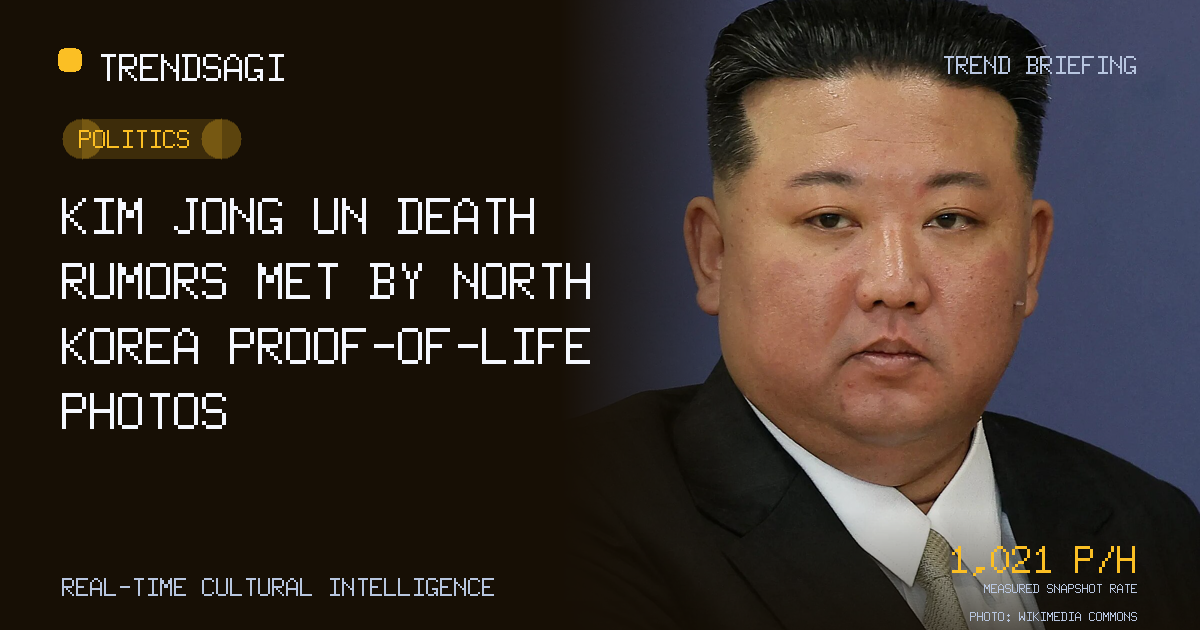
Kim Jong Un Death Rumors Met by North Korea Proof-of-Life Photos
Unverified claims Kim Jong Un died of a brain hemorrhage spiked discussion; North Korea released exhibition photos of him on Oct 19 as reported proof of life.
Automated briefing. Generated from stored signal measurements and source-backed research; it is not manually reviewed. Read the methodology and limitations.
Metrics in this briefing are a snapshot associated with its publication date and may not reflect current conditions.
What changed
Unverified social-media claims that North Korean leader Kim Jong Un had died from a brain hemorrhage triggered a sharp spike in discussion, reaching a measured rate of 1020.8 posts per hour in a short window ending at the 2026-10-20T00:12:17Z snapshot of 666 posts. North Korean state media then released photographs showing him inspecting a garment and footwear exhibition on October 19, widely reported as a response to the rumors.
| Observation time (UTC) | Measured posts/hour | Snapshot volume |
|---|---|---|
| 2026-10-20T00:12:17Z | 1020.8 | 666 posts |
The measured posts/hour figure reflects TrendsAGI’s calculation across three stored observations spanning an exact 899-second window. It quantifies the intensity of the rumor wave and the subsequent photo response; it does not measure reach, unique users, or ongoing volume after the snapshot.
Why this topic may be moving
According to the New York Post and Times Now, the claims originated with Wanjun Xie, a U.S.-based Chinese dissident linked to the China Democracy Party. On social media he alleged that Kim had suffered a severe cerebral hemorrhage, fallen into a coma, received emergency treatment involving specialists from Beijing’s Peking Union Medical College Hospital, and later died, with his body returned secretly to North Korea. Xie also floated successive claims of Chinese troop movements and power shifting either to Kim’s sister Kim Yo Jong or his daughter Kim Ju Ae. No medical records, witnesses, or official corroboration accompanied the posts.
North Korean state media (Korean Central News Agency) reported that Kim toured the 2026 National Garment and Footwear Exhibition on October 19. Photos released the following day show him examining children’s footwear, gesturing to officials, and inspecting women’s coats, accompanied in at least one image by his daughter Kim Ju Ae. Yonhap and other outlets relayed the state-media account, noting that the images have not been independently authenticated and that the precise time of capture remains unclear beyond the official claim.
The sequence matches a familiar pattern: unverified health rumors spread rapidly on social platforms, traditional outlets amplify them while labeling them unconfirmed, and Pyongyang responds with carefully staged imagery. TrendsAGI’s measured spike of 1020.8 posts per hour over that brief window captures the velocity of amplification that static news timelines often compress into a single “rumors circulated” sentence.
The social velocity of the death claims outpaced any independent verification, while the state’s photo release arrived within hours—illustrating how rumor intensity and official counter-messaging now operate on overlapping clocks.
Why it matters
Kim Jong Un’s health has long been a focal point for analysts of Korean Peninsula stability. Succession remains opaque. His sister Kim Yo Jong holds senior party and state roles and has acted as a public enforcer; his daughter Kim Ju Ae has appeared with increasing frequency at high-profile events, fueling speculation that she is being prepared as a potential heir. Any genuine incapacity or death would immediately raise questions about continuity of nuclear command, elite cohesion, and China’s preferred outcomes on its border.
For policymakers, markets, and intelligence consumers the practical value of this signal lies in the speed of the rumor-response cycle rather than in any confirmed medical fact. The measured social intensity shows how quickly unverified claims can dominate discussion and force a state-media reply. That pattern itself is data: it reveals the regime’s sensitivity to external narratives and the limited independent visibility into leadership health.
What to watch next
- Further state-media appearances or video of Kim in the coming days that can be cross-checked against known recent imagery for consistency of appearance and setting.
- Any South Korean or U.S. intelligence assessments that move beyond routine weight or lifestyle commentary to specific health indicators.
- Continued or renewed claims by the same social accounts, especially any that introduce new alleged medical details or troop movements.
- Whether Kim Yo Jong or Kim Ju Ae receive elevated public roles in the immediate aftermath, which could signal either routine continuity or quiet contingency planning.
- Secondary spikes in discussion volume if the photos are challenged as staged or if new unverified medical claims surface.
Practical next checks include monitoring KCNA and Rodong Sinmun for additional event coverage, tracking South Korean media for any quiet assessments, and noting whether major governments issue routine “no change in assessment” language.
Frequently asked questions
Did Kim Jong Un die from a brain hemorrhage?
No credible evidence supports the claim. The allegations remain unverified social-media assertions. North Korean state media released photographs on October 20 showing him active at an exhibition the previous day.
What do the new North Korean photos show?
According to the New York Post, Times Now, and Yonhap, the images depict Kim inspecting children’s footwear, gesturing while speaking with officials, and examining women’s coats at a garment and footwear exhibition. His daughter Kim Ju Ae appears alongside him in at least one photo. State media dated the visit to October 19; independent authentication of the exact capture time is not available.
Who started the death rumors and is there evidence?
Wanjun Xie, a U.S.-based Chinese dissident, posted the core claims on social media. The posts offered no medical records, identifiable witnesses, or other independently verifiable evidence. Outlets including Times Now and the New York Post described the material as unsubstantiated.
Has Kim Jong Un appeared publicly recently?
State media reported an appearance at a defense-related site around October 11. The October 19 exhibition visit is the most recent claim of public activity. Earlier 2020 health rumors were also followed by reappearances.
What happens if Kim Jong Un dies — who succeeds him?
No formal succession mechanism has been publicly confirmed. Analysts commonly discuss Kim Yo Jong, who already holds significant party and state authority, and Kim Ju Ae, who has been elevated in public imagery in recent years. Either outcome would likely involve intense elite bargaining and Chinese interest in stability.
How do these rumors compare to previous health scares about Kim?
Similar unverified death or coma claims circulated in 2020 after prolonged absences and reports of heart surgery. Kim reappeared, and the earlier claims were not substantiated. The current episode follows the same rapid-rumor-then-state-media-response arc, though the measured social velocity this time was captured in a short, high-intensity window.
Methodology and limitations
The 1020.8 posts/hour rate is a measured snapshot calculated from three stored observations over an exact 899-second window ending at 2026-10-20T00:12:17Z, when volume stood at 666 posts. It quantifies discussion intensity at that moment; it cannot establish medical facts, photo authenticity, or future stability. Independent verification of the exhibition images’ precise date and the absence of any medical evidence for the hemorrhage claims remain gaps. South Korean intelligence assessments of recent health beyond general observations are sparse in open sources. The signal is useful for tracking narrative speed and official reaction timing; it is not a substitute for primary intelligence or medical reporting.
Sources
- Kim Jong Un ‘proof of life’ photos released by North Korea after wild rumors dictator died from brain hemorrhage (New York Post) — nypost.com
- Where Is Kim Jong-Un? Death Rumors Run Rampant; Kim Yo Jong Takeover Claims Surface (Times Now) — timesnownews.com
- Kim Jong Un (Wikipedia) — en.wikipedia.org
Image: Kim Jong Un by Владимир Смирнов / ТАСС, CC BY 4.0, via Wikimedia Commons.
Track This Topic for New Signals
Set alerts for future velocity or sentiment changes around this topic.
Explore Tracking PlansAbout TrendsAGI research
TrendsAGI's automated research pipeline publishes dated signal snapshots, methodology notes, and practical workflows for teams evaluating cultural momentum. Read how signals are scoped, scored, and limited in our research methodology.