893-second window · 3 observations · Measured Nov 9, 2026, 4:29 AM UTC · Provider: go_recent_snapshot_v2
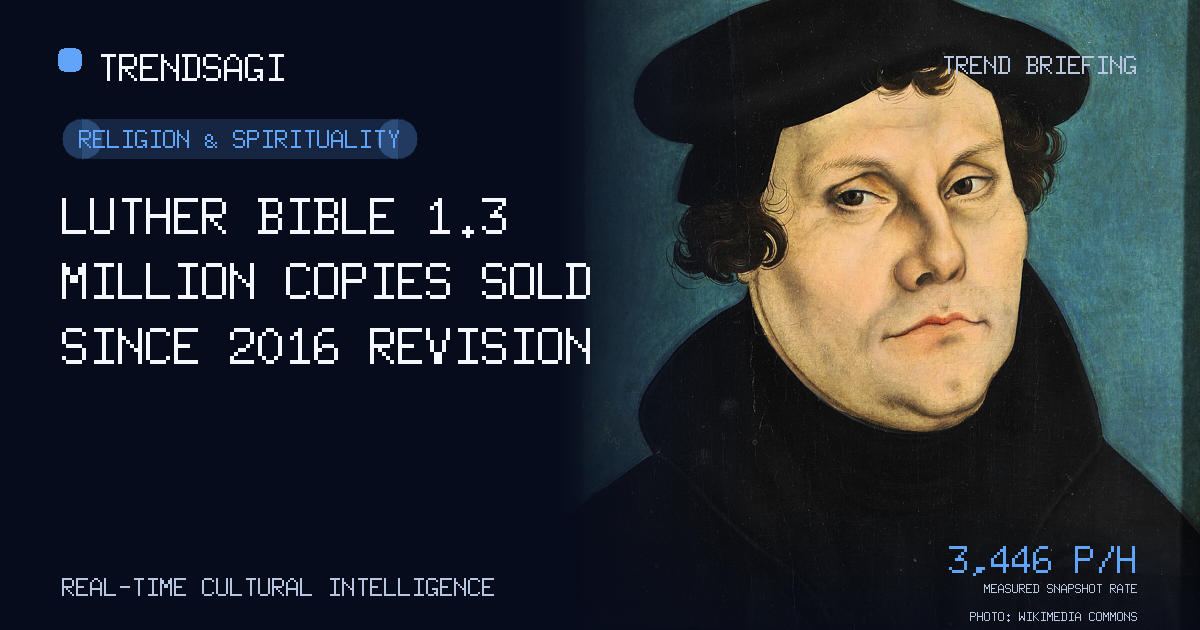
Luther Bible 1.3 Million Copies Sold Since 2016 Revision
The revised Luther Bible has sold 1.3 million copies since 2016, per Come On, amid 2026 Reformation anniversary coverage. A clear explainer of what is moving
Automated briefing. Generated from stored signal measurements and source-backed research; it is not manually reviewed. Read the methodology and limitations or the editorial standards.
Metrics in this briefing are a snapshot associated with its publication date and may not reflect current conditions.
What changed
The clearest verified signal around "Luther" in early November 2026 is a sales milestone for the revised Luther Bible: Come On reports that the new Lutherbibel has sold 1.3 million copies in the ten years since its 2016 revision. This sits alongside Reformation-anniversary coverage — Graphic Online marks the significance of Luther's 1517 reformation — and a theology post dated 7 November 2026 on Zwinglius Redivivus. Together these form a cluster of Luther-related content, not a single confirmed event.
TrendsAGI measured a snapshot rate of 3,445.9 posts/hour over an 893-second window using three stored observations at 2026-11-09T04:29:44Z, with a latest snapshot volume of 986 posts. That is a measured snapshot rate, not a live rate or forecast, and it cannot by itself tell us whether the activity is about the reformer, the Bible translation, or Luther College sports.
| Observation time | 2026-11-09T04:29:44Z |
|---|---|
| Measured posts/hour | 3,445.9 (snapshot rate over 893 seconds, 3 observations) |
| Latest snapshot volume | 986 posts |
Why this topic may be moving
The search-intent brief does not establish a single verified spike cause. What it does show is a cluster of early-November 2026 Martin Luther and Reformation content: reflection on the 509th anniversary of the 95 Theses of October 31, 1517, the Luther Bible sales figure, and academic theology writing. Nothing in the verified material confirms what drove the measured activity.
The ambiguity is structural. "Luther" matches the reformer, the Luther Bible, and Luther College athletics, whose swimming, soccer, and basketball results from November 5–7, 2026 also rank for the label. Searchers arriving at this topic may therefore have very different questions in mind, and no single cause can be assumed.
The useful takeaway for November 2026 is not that one Luther story is breaking, but that several longstanding Luther threads — anniversary reflection, a Bible translation's sales record, and college sports — are being read at the same time. Disambiguating them is more valuable than guessing at a trigger.
Why it matters
For readers, the practical value is a clear map of what "Luther" means right now. The 1.3 million copies figure from Come On is a concrete, checkable milestone in the reception of the 2016 revision of the Luther Bible, and it connects naturally to the anniversary coverage. Graphic Online's piece on the significance of the 1517 reformation provides the historical frame, while the Zwinglius Redivivus entry shows that theological commentary is still being published in the same window.
For editors, researchers, and anyone tracking religion coverage, the signal is a reminder that anniversary seasons generate steady background volume that can look like a spike. The measured rate is real, but its meaning is not self-evident. Treating the topic as a bundle of related but distinct stories is more accurate than treating it as one event.
What to watch next
- Whether coverage of the Luther Bible sales milestone grows beyond the initial Come On report, and whether additional outlets confirm or contextualize the 1.3 million figure.
- Whether Reformation-anniversary pieces begin to look ahead to a 510th anniversary; no verified source currently confirms any planned observance, so treat such claims as unconfirmed.
- Whether Luther College sports results continue to appear in the same search results, which would keep the label ambiguous for readers.
- Whether academic theology writing, such as the Zwinglius Redivivus post, moves from specialist venues into general-audience coverage.
- Whether any source offers a specific explanation for the measured activity; without one, the cause remains unclear.
Frequently asked questions
What exactly happened on October 31, 1517, and why does it still matter in 2026?
October 31, 1517 is traditionally associated with Martin Luther's 95 Theses, the document that opened his critique of indulgences and helped launch the Reformation. Graphic Online's anniversary coverage treats the 1517 reformation as historically significant, and it remains a reference point for discussions of religious reform and conscience.
Why is the Reformation being marked as 509 years, and what comes at 510?
Counting from 1517, 2026 falls 509 years later, which is why early-November coverage frames the anniversary that way. A 510th anniversary would fall in 2027, but no verified source in this brief confirms any planned observance.
How many copies of the revised Luther Bible have sold since 2016?
Come On reports that the new Lutherbibel has sold 1.3 million copies in the ten years since its 2016 revision. That figure is attributed to Come On and should be read as the outlet's reported number.
Why were Luther's German New Testament and other books banned in 1522?
The verified brief does not supply the specific reasons or the jurisdictions involved, so this cannot be answered from confirmed material here. The related search phrase "why was Luther's Bible banned in Saxony" points to a question readers are asking, but the brief does not verify an answer.
What is the connection between Luther's 95 Theses and modern religious freedom arguments?
The brief does not verify a specific argument linking the 95 Theses to modern religious freedom claims. What it does show is that anniversary coverage treats 1517 as significant, which is the connection most commonly drawn in general commentary.
Is the current 'Luther' trend about the reformer, the Bible translation, or Luther College sports?
The brief does not establish which of these is driving the measured activity. Search results split between theology and anniversary coverage, Luther Bible sales, and Luther College athletics recaps, so readers should check which Luther they are looking for.
Methodology and limitations
This briefing is based on a canonical stored signal observed at 2026-11-09T04:29:44Z, with a latest snapshot volume of 986 posts. The measured change rate is 3,445.9 posts/hour over an exact 893-second window using three stored observations. That figure is a snapshot rate, not a live rate, forecast, reach, engagement, or unique-person count, and snapshot volume should not be read as a rate.
The signal cannot establish why the topic is moving. The search-intent brief shows a cluster of early-November 2026 Luther content but no confirmed trigger. External facts are attributed to their publishers — Graphic Online, Come On, and Zwinglius Redivivus — and no claim is made about traffic, rankings, or search volume. Practical next checks include watching for additional outlets reporting the Luther Bible sales figure, monitoring whether anniversary coverage looks ahead to 510 years, and noting whether Luther College sports results persist in the same search results.
Sources
- Significance, Luther's reformation of 1517 (Graphic Online) — graphic.com.gh
- Neue Lutherbibel in zehn Jahren 1,3 Millionen Mal verkauft (Come On) — come-on.de
- 7 Nov 2026 – Zwinglius Redivivus — zwingliusredivivus.wordpress.com
Image: Martin Luther by Lucas Cranach the Elder, Public domain, via Wikimedia Commons.
Included in the TrendsAGI Trend Signal Index
This briefing recorded 3,445.9 posts/hour over 893-second window from 3 observations. The index publishes the archive-wide percentiles and the gate every rate has to clear.
Trend velocity statisticsTrack This Topic for New Signals
Set alerts for future velocity or sentiment changes around this topic.
Explore Tracking PlansAbout TrendsAGI research
TrendsAGI's automated research pipeline publishes dated signal snapshots, methodology notes, and practical workflows for teams evaluating cultural momentum. Read how signals are scoped, scored, and limited in our research methodology.