1811-second window · 3 observations · Measured Nov 6, 2026, 9:46 AM UTC · Provider: go_recent_snapshot_v2
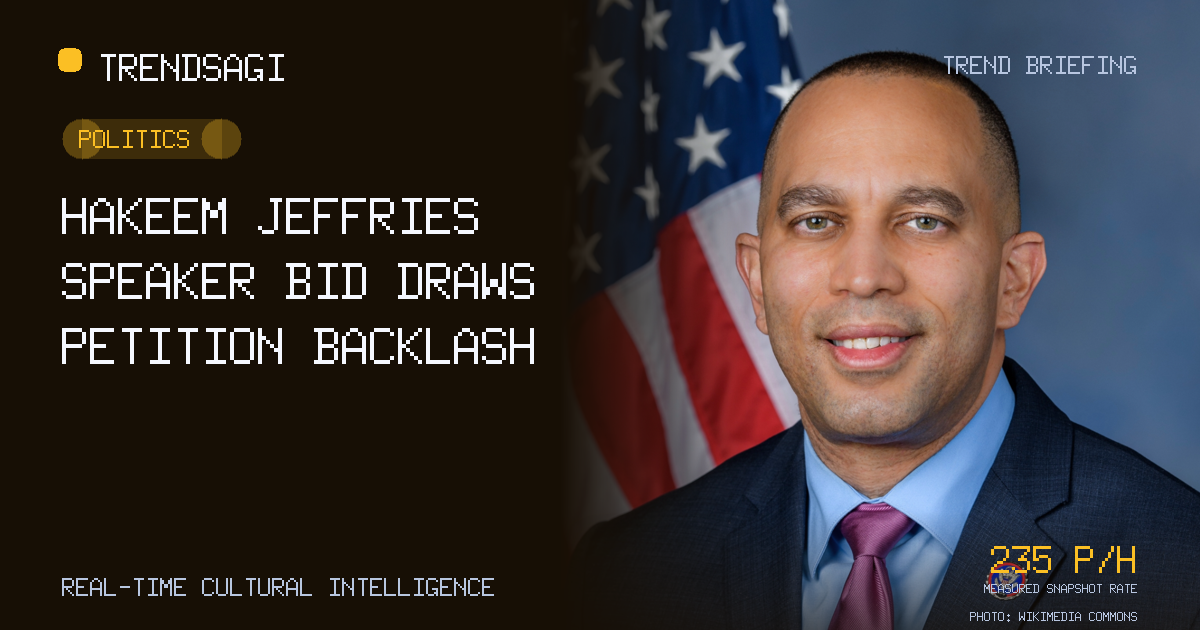
Hakeem Jeffries Speaker Bid Draws Petition Backlash
Jeffries launched a Speaker bid after Democrats won both chambers; a petition against him passed 500K signatures as measured discussion kept accelerating.
Automated briefing. Generated from stored signal measurements and source-backed research; it is not manually reviewed. Read the methodology and limitations or the editorial standards.
Metrics in this briefing are a snapshot associated with its publication date and may not reflect current conditions.
What changed
Hakeem Jeffries has launched a bid to become Speaker of the House after Democrats won both chambers in the 2026 midterms, and the story is now being driven less by the announcement than by the pushback against it. A petition opposing his Speakership has passed 500,000 signatures, according to Newsweek, and intra-party criticism is surfacing over his comments on impeachment. Interest is still building: TrendsAGI measured a snapshot rate of 234.5 posts per hour across the 1,811-second window ending 2026-11-06T09:46:47Z, with a latest snapshot volume of 376 posts. That measurement shows the conversation was still accelerating days after the November 3-4 announcements; it is a measured rate for that window, not a live or forecast figure.
| Observation time | Measured posts/hour | Snapshot volume |
|---|---|---|
| 2026-11-06T09:46:47Z | 234.5 | 376 posts |
Why this topic may be moving
The verified sequence is straightforward. Democrats won both chambers in the midterms, Jeffries moved to claim the Speaker's gavel, and opposition organized quickly enough that a petition against him crossed half a million signatures. That combination — a formal bid plus visible dissent — is what the search-intent brief identifies as the accelerant. Newsweek reports the 500,000-signature milestone; ORF reports that the Democratic representative wants to become Speaker.
What the data cannot tell us is which specific development is driving the current burst. The signal does not decompose the conversation into its triggers, so no single cause for the latest acceleration can be confirmed from the measurement alone. The timeline of events is documented; the attribution of each spike is not.
The momentum meter: reading the numbers correctly
The 234.5 posts/hour figure is a snapshot rate computed over a fixed window using three stored observations. It is useful for one narrow purpose: comparing how intense the conversation is now against how intense it was at the moment of the initial win and announcement coverage. A sustained rate days after a news event generally indicates the story has a second engine rather than a single news cycle.
The measurable story here is not that Jeffries announced a bid — that was expected after the midterms. It is that the opposition to his Speakership has scaled to a six-figure signature count while the conversation itself is still running at a high measured rate, which suggests two competing narratives are feeding each other.
What this metric is not: it is not a count of people, not reach, not engagement, and not a prediction that the petition will succeed or that Jeffries will fail. Volume and rate measure discussion, not sentiment or votes.
Why it matters
Two things are being conflated in most coverage, and separating them is the point. First, there is organized opposition — a petition with a verified signature count and, per the search brief, celebrity involvement including Mark Ruffalo. Second, there is broader Democratic opinion, about which the signal says nothing. A petition crossing 500,000 signatures is a fact about a campaign; it is not a whip count.
Second, Jeffries' impeachment comments have become a controversy in their own right, but the brief does not verify their full text or context, only that criticism is surfacing. Anyone trying to judge what his Speakership would mean for oversight of Trump should treat that as an open question rather than a settled one.
Who should care: anyone tracking House leadership mechanics, Democratic coalition management, and the gap between online mobilization and legislative outcomes. The international framing adds a dimension US outlets have underplayed — ORF's coverage centers the prospect of the first African American Speaker, a milestone the domestic conversation has largely treated as background.
What to watch next
- Whether the measured rate keeps climbing or decays after the petition milestone, which would indicate whether backlash is compounding or plateauing.
- Any official whip count or public endorsement tally from House Democrats — the brief supplies none, and sources describing Jeffries as "on track" are not the same as a vote count.
- The date the new House convenes and the scheduling of the Speaker vote. ORF frames this as early next year ("Anfang des Jahres") but no date is confirmed.
- Whether organized petition activity and general Democratic criticism continue to be reported as one phenomenon or are separated out.
- Any clarification of Jeffries' impeachment remarks in fuller context.
Frequently asked questions
Why is Hakeem Jeffries trending right now?
He launched a bid for Speaker after Democrats won both chambers in the 2026 midterms, and a petition opposing his Speakership has passed 500,000 signatures, per Newsweek, alongside intra-party criticism over his impeachment comments.
Has Jeffries officially announced his bid for Speaker, and when would the vote happen?
Yes, he has launched his bid, per ORF. The exact date and outcome of the floor vote are not confirmed; ORF describes the new House convening early next year without a set date.
Does he have the votes among House Democrats, or are there real calls to replace him?
Opposition is visibly organized — a petition past 500,000 signatures and reported criticism from within the party — but no verified whip count exists. Sources calling him the favorite do not establish that he has the votes.
What did Jeffries say about impeaching Trump, and why did it cause backlash?
His remarks on impeachment are the subject of intra-party criticism, but the full text and context are not verified here. What can be said is that the comments became a flashpoint in the Speakership fight.
How large is the petition against him and who is backing it?
It has passed 500,000 signatures, according to Newsweek. The identity of organizers and their full demands are not verified; the brief notes Mark Ruffalo's involvement but does not establish the campaign's structure.
Would he be the first Black Speaker of the House, and what would his agenda be?
ORF's coverage frames the bid around the prospect of the first African American Speaker, a milestone US coverage tends to underplay. A detailed agenda is not verified in the material available.
Methodology and limitations
The rate reported here was calculated from three stored observations over an exact 1,811-second window ending at 2026-11-06T09:46:47Z. It describes that window only. It does not indicate whether discussion is organic or coordinated, cannot separate supporters from opponents, and should not be read as reach or audience size.
Several items circulating around this story are unverified and are excluded or flagged as unconfirmed above: the floor vote date and result, any vote count, the petition's organizers and full demands, the complete impeachment quote, and a reported drop in Tesla and SpaceX share prices with no clear causal link.
Sources
- Petition to Replace Hakeem Jeffries as Democrats' House Speaker Hits 500k Signatures (Newsweek) — newsweek.com
- Repräsentantenhaus: Demokrat Jeffries will Sprecher werden (ORF) — orf.at
Image: Hakeem Jeffries by Office of Representative Hakeem Jeffries, Public domain, via Wikimedia Commons.
Track This Topic for New Signals
Set alerts for future velocity or sentiment changes around this topic.
Explore Tracking PlansAbout TrendsAGI research
TrendsAGI's automated research pipeline publishes dated signal snapshots, methodology notes, and practical workflows for teams evaluating cultural momentum. Read how signals are scoped, scored, and limited in our research methodology.