899-second window · 2 observations · Measured Nov 5, 2026, 9:01 PM UTC · Provider: go_recent_snapshot_v2
Fireworks AI Forge NVIDIA News vs Real Fireworks Explained
Fireworks is trending on an ambiguous label. See the measured 833.1 posts/hour rate, the Fireworks AI Forge NVIDIA news, and why real fireworks confuse the
Automated briefing. Generated from stored signal measurements and source-backed research; it is not manually reviewed. Read the methodology and limitations or the editorial standards.
Metrics in this briefing are a snapshot associated with its publication date and may not reflect current conditions.
What changed
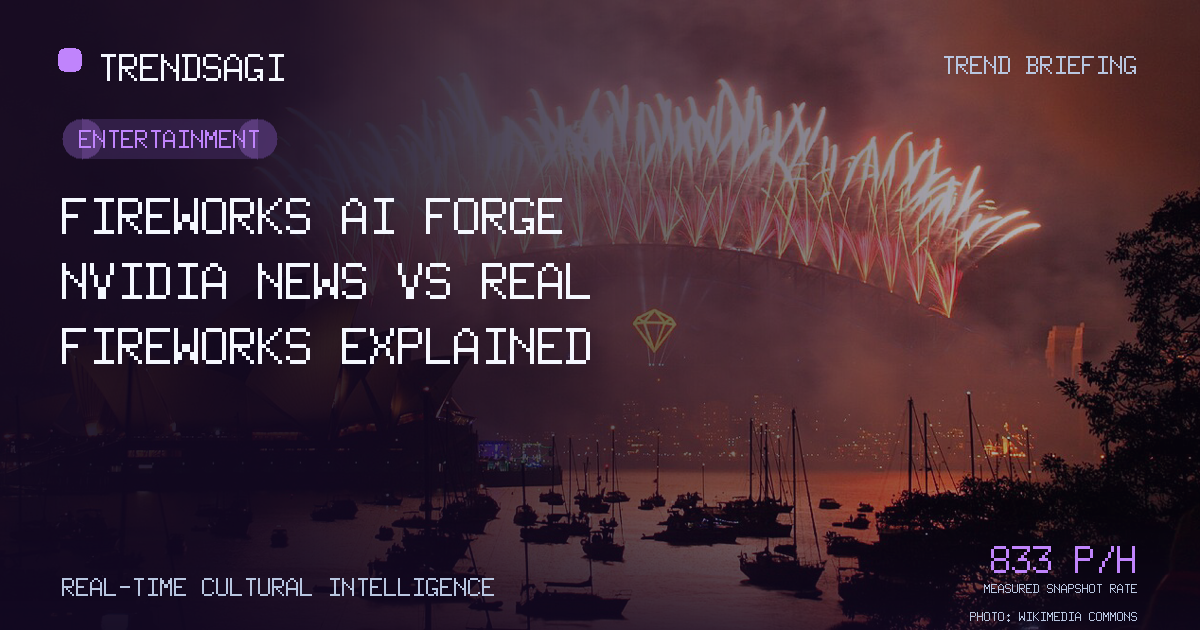
"Fireworks" is moving fast on a bare, ambiguous label, and the search-intent evidence does not pin it to a single verified trigger. At the observation taken 2026-11-05T21:01:07Z, the stored snapshot volume was 900 posts, and TrendsAGI measured a snapshot rate of 833.1 posts/hour across an exact 899-second window based on two stored observations. That is a measured rate at that moment, not a live or current figure.
The useful answer for searchers asking about "Fireworks AI Forge NVIDIA announcement": the label splits into two unrelated strands. One is Fireworks AI's Forge conference announcements, including NVIDIA European capacity, covered by Fireworks AI around Nov 2–3. The other is literal fireworks — confusing displays in San Francisco early on election night, which SFist attributed to an AI conference, plus seasonal fireworks discussion and changing search interest in New Zealand covered by Stuff. Nothing in the verified material establishes which strand the social volume reflects, or that the Forge conference drove the Nov 5 spike.
| Observation time | Measured posts/hour | Snapshot volume |
|---|---|---|
| 2026-11-05T21:01:07Z | 833.1 | 900 posts |
Why this topic may be moving
The honest answer is that the surge is real and measured, but its cause is unresolved. The verified coverage clusters into separate stories that happen to share one word:
- The AI company strand: Fireworks AI unveiled new products at its Forge conference, and coverage references NVIDIA European capacity. This is enterprise and developer news, framed largely by the vendor.
- The literal fireworks strand: SFist reported confusing early election-night fireworks in San Francisco and attributed the display to an AI conference. Separately, Stuff examined New Zealand's changing search interest in fireworks and seasonal rules.
- The developer strand: Fireworks documentation pages draw traffic from people trying to wire tools like Codex into the Fireworks API — integration intent, not news intent.
Because these are distinct events across different geographies, a single label burst can aggregate unrelated curiosity. The verified material does not specify the exact cause of the Nov 5 acceleration, so treat any single-cause explanation as unconfirmed.
The most defensible reading of this signal: search demand around "Fireworks" is a collision of an AI-product news cycle and ordinary fireworks curiosity, and the measured rate tells you how fast attention is arriving — not why.
Why it matters
Ambiguity has practical consequences for different readers:
- Enterprise technology buyers and platform teams evaluating Fireworks AI need a neutral read on what the Forge announcements mean, because most existing coverage is vendor PR or developer documentation rather than impact analysis.
- Developers searching for API setup are landing on docs that explain configuration but never explain why the company is in the news this week.
- General searchers who heard booms or saw a display want to know whether the trend is about fireworks in the sky or a company — and the two are being conflated.
- Analysts and editors watching topical velocity need to know the difference between a genuine burst and routine seasonal chatter, which is exactly what a measured rate over a defined window helps distinguish.
What to watch next
- Whether Fireworks AI publishes a detailed Forge recap or enterprise case studies — that would indicate sustained business intent rather than a one-off news bump.
- Whether NVIDIA-related capacity details get corroborated by a second, independent publisher, which would firm up the announcement strand.
- Whether local reporting in San Francisco or New Zealand adds fresh fireworks incidents, which would shift the label back toward literal meaning.
- Whether developer-doc traffic persists, suggesting durable integration interest rather than news-driven curiosity.
- Whether the measured rate holds across subsequent observations — a decay would point to a short news spike; sustained volume would suggest a broader unresolved label.
Frequently asked questions
What did Fireworks AI announce at its Forge conference?
Fireworks AI unveiled new products at its Forge conference, per Fireworks AI's own coverage. Reporting also references NVIDIA European capacity, but the verified material does not detail pricing or availability beyond that framing.
Is the Fireworks trend about the AI company or about actual fireworks?
Both appear in verified coverage, and the evidence does not establish which one the social volume reflects. Treat the label as ambiguous rather than assuming a single meaning.
Why were fireworks set off in San Francisco on election night?
SFist reported confusing early election-night fireworks in San Francisco and attributed the display to an AI conference. The exact organizer and nature of the display beyond that attribution are not confirmed in the verified material.
How does Fireworks AI's NVIDIA European expansion work and when does it start?
Coverage references NVIDIA European capacity in connection with Fireworks AI's Forge announcements, but the verified sources do not describe the technical mechanism or a start date. That detail should be treated as unconfirmed until Fireworks or NVIDIA publishes specifics.
Is firework search interest in New Zealand declining?
Stuff examined New Zealand's changing search interest in fireworks and framing around seasonal rules. The verified brief does not provide figures tying that decline to current 2026 spike data, so the size and direction of any change should not be quoted without the original reporting.
How do I connect Codex or LibreChat to the Fireworks API?
Fireworks AI's documentation, including its Codex page, covers setup and configuration for connecting tools to the Fireworks API. Those docs are the appropriate starting point, since this briefing does not reproduce configuration steps.
Methodology and limitations
This briefing rests on a stored signal observed at 2026-11-05T21:01:07Z with a snapshot volume of 900 posts, and a measured rate of 833.1 posts/hour calculated over an exact 899-second window using two stored observations. The rate is a measured snapshot figure for that window — not a live rate, forecast, reach, engagement, or unique-person count.
What the signal can establish: that attention to the label was accelerating quickly at that moment. What it cannot establish: whether the volume refers to Fireworks AI, literal fireworks, or both; the exact cause of the acceleration; the specific organizer of the San Francisco display; whether the Forge conference drove the Nov 5 spike; or any traffic, ranking, or keyword-volume figures. Categorization as Entertainment is a stored label and does not resolve the ambiguity. External facts are attributed to their publishers — Fireworks AI, SFist, and Stuff — and no source in the verified material connects post velocity directly to any single event.
Sources
- Fireworks unveils new products at Forge (Fireworks AI) — fireworks.ai
- Confusing Fireworks In SF Early on Election Night Were For an AI Conference (SFist) — sfist.com
- Losing its spark? New Zealand's changing search interest in fireworks (Stuff) — stuff.co.nz
- Codex - Fireworks AI Docs — docs.fireworks.ai
Image: Fireworks by Rob Chandler, CC BY-SA 2.0, via Wikimedia Commons. The thumbnail adapts this photo with a title overlay and is shared under the same licence.
Track This Topic for New Signals
Set alerts for future velocity or sentiment changes around this topic.
Explore Tracking PlansAbout TrendsAGI research
TrendsAGI's automated research pipeline publishes dated signal snapshots, methodology notes, and practical workflows for teams evaluating cultural momentum. Read how signals are scoped, scored, and limited in our research methodology.