1155-second window · 3 observations · Measured Oct 24, 2026, 11:00 PM UTC · Provider: go_recent_snapshot_v2
Evo Morales: La Paz raid, US visa list and persecution claim
Evo Morales denounced a La Paz house raid and called a US visa list a useless paper; the stored signal measured 308.5 posts/hour at 23:00 UTC.
Automated briefing. Generated from stored signal measurements and source-backed research; it is not manually reviewed. Read the methodology and limitations.
Metrics in this briefing are a snapshot associated with its publication date and may not reflect current conditions.
What changed
A stored signal labeled "Morales" moved sharply in the window ending 2026-10-24T23:00:04Z, and the verified search results point to former Bolivian president Evo Morales rather than to any other public figure with that surname. According to La Razón Digital Bolivia, Morales denounced a police raid on a house he owns in La Paz and accused the government of persecution (reported Oct 21–22, 2026). The following day, per the same coverage, he attacked a new US visa-restriction list with the phrase "la visa es un papel inútil" — the visa is a useless piece of paper. That phrase, together with "lista de vetados Estados Unidos Bolivia" and "allanamiento," is what searchers are typing.
The measurable part of the signal is straightforward: the topic registered 356 posts in the latest stored snapshot and a measured snapshot rate of 308.5 posts per hour across 3 stored observations over an exact 1,155-second window. That is a measurement of how fast the stored stream accumulated at that timestamp — not a live rate, a forecast, an audience size, or a reach figure. TrendsAGI cannot establish from these numbers whether the acceleration came in Spanish or English, or whether part of the surge involved people searching for the vallenato singer Miguel Morales, the Polish disco polo act Morales, an analyst named Morales, or an unrelated chatbot.
| Observation time | Measured posts/hour | Snapshot volume |
|---|---|---|
| 2026-10-24T23:00:04Z | 308.5 | 356 posts |
Why this topic may be moving
The verified cause is two news beats landing within days of each other. First came the raid: La Razón Digital Bolivia reports that Morales publicly denounced an allanamiento at a property he uses in La Paz and cast it as part of a campaign of persecution by the current government. Then came the diplomatic beat: a new US visa-restriction list appeared, and Morales dismissed it as meaningless. A second outlet, Exito Noticias, carries a related angle in which a Bolivian analyst named Morales questions why former officials from an earlier government appear on US lists and demands investigations.
Taken together, these are the most recent and most multiply-sourced Morales items in the results, which is why they are the best available explanation for the spike — but the connection is an inference, not a confirmed causal link.
Two separate stories are being reported as one grievance: a police search at home and a foreign visa list abroad, both framed by Morales as political persecution. Readers should keep the legal question and the diplomatic question apart.
Why it matters
Bolivia's political memory is long, and Morales remains a figure whose statements can reset national argument. A police action at a former president's residence is a constitutional and institutional question, not just a political one: it raises whether ordinary judicial process is being applied or whether a government is targeting an opponent. A US visa list is a separate instrument with separate consequences, mostly affecting travel and banking exposure for named individuals.
For readers outside Bolivia, this is the moment the country's domestic dispute acquires an international frame. For anyone tracking US sanctions and visa-restriction practice in the Americas, it is a test case in how such lists are received — and in how quickly a named politician can convert inclusion into a narrative of foreign interference.
Who should care: Bolivia watchers, human-rights and rule-of-law monitors, journalists covering the Andes, diaspora communities following La Paz politics, and analysts who model how political risk reaches travel and financial exposure.
What to watch next
- An official statement. No result in the verified set includes a government or police confirmation or justification of the raid. Its absence or appearance is the single most useful next data point.
- A legal trail. Look for a prosecutor's filing, a court order, or a named charge. Without that, "persecution" remains a political characterization.
- The visa list itself. Its exact name, publication date, and full contents are unconfirmed in the verified material. Watch for the publishing US agency to release authoritative text.
- Morales' whereabouts. Unverified. Whether he is in Bolivia or abroad changes how the raid and any warrant matter practically.
- Mobilization. Whether supporters respond with protests, legal filings, or petitions to international bodies is not yet confirmed.
- Rate direction. Compare the next stored snapshot against 308.5 posts/hour to see whether attention is still building or already fading after the Friday visa remarks.
Frequently asked questions
Why was Evo Morales' house in La Paz raided, and who ordered it?
Morales denounced a police raid on his La Paz-area home and blamed the government, according to La Razón Digital Bolivia. The verified material does not establish the stated legal basis or name the authority that ordered it.
Who is Christian Velasco and why was his home also intervened?
This cannot be answered from the verified material. Readers searching for that name alongside the raid should treat any claim as unconfirmed until an official record or direct reporting establishes the connection.
What is the US visa-restriction list that Morales called a 'useless piece of paper'?
It is a US government list restricting visas for named Bolivian individuals. Morales' remark was reported as "la visa es un papel inútil." The exact title, date and full contents of the list are not verified here.
Which ex-authorities are on the US blacklist and what are they accused of?
Exito Noticias reports an analyst named Morales questioning why former government authorities appear on US lists and calling for investigations. The specific names and allegations are not verifiable from the material available.
Is there any official government confirmation of the raids?
None appears in the verified results. What exists is Morales' own denunciation and related press coverage, which is not the same as official confirmation.
Methodology and limitations
This briefing rests on a canonical stored signal: a snapshot at 2026-10-24T23:00:04Z with 356 posts, and a measured snapshot rate of 308.5 posts per hour calculated from 3 stored observations spanning 1,155 seconds. All figures describe that stored window only.
What the signal can establish: that discussion volume around this label was elevated and accelerating at that timestamp. What it cannot establish: who was posting, in what language, why they searched, or how many distinct people were involved; any reach, engagement or forecast; or that every post concerned Evo Morales.
The label itself is ambiguous. The mapping to Evo Morales is inferred from the news results, not confirmed — the surname also belongs to a vallenato singer, a Polish band, and at least one analyst. The raid's legal basis, the visa list's precise contents, Morales' whereabouts, any warrant or charges, and any official response all remain unverified and should be reported as open questions.
Sources
- Morales denuncia allanamiento a su vivienda en La Paz y acusa al Gobierno de persecución (La Razón Digital Bolivia) — larazon.bo
- Analista Morales cuestiona que exautoridades del Gobierno se encuentren en listas de EE.UU. y exige investigaciones (Exito Noticias) — exitonoticias.com.bo
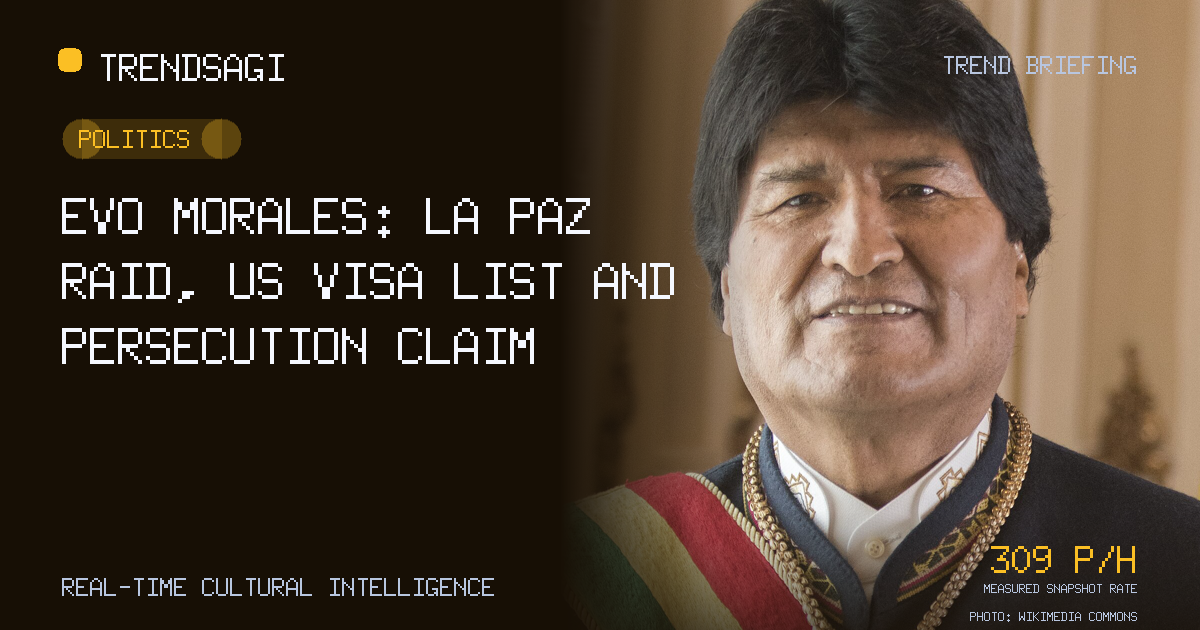
Image: Evo Morales by EneasMx, CC BY-SA 4.0, via Wikimedia Commons. The thumbnail adapts this photo with a title overlay and is shared under the same licence.
Track This Topic for New Signals
Set alerts for future velocity or sentiment changes around this topic.
Explore Tracking PlansAbout TrendsAGI research
TrendsAGI's automated research pipeline publishes dated signal snapshots, methodology notes, and practical workflows for teams evaluating cultural momentum. Read how signals are scoped, scored, and limited in our research methodology.