1792-second window · 3 observations · Measured Nov 6, 2026, 10:16 AM UTC · Provider: go_recent_snapshot_v2
Bank of England Raises Rates to 4%: What It Means for Mortgages
Bank of England raised rates to 4% on 5 November 2026, its first hike since 2023. What it means for mortgages, savings and what to watch next.
Automated briefing. Generated from stored signal measurements and source-backed research; it is not manually reviewed. Read the methodology and limitations or the editorial standards.
Metrics in this briefing are a snapshot associated with its publication date and may not reflect current conditions.
What changed
The Bank of England raised its benchmark interest rate by 0.25 percentage points to 4% on 5 November 2026, its first increase since 2023, citing energy-driven inflation tied to conflict in the Middle East and projecting inflation near 5% by mid-2027, according to the Bank of England and The Economic Times. Governor Andrew Bailey signalled that further increases are not excluded. For households, the practical question is what a 4% Bank Rate does to mortgage payments, savings rates and the cost of borrowing, and whether more hikes are coming.
Attention on the decision is building quickly. Across a measured window of 1,792 seconds (about 30 minutes) ending at the snapshot time below, TrendsAGI recorded a measured snapshot rate of 18.1 posts per hour, based on three stored observations totalling 59 posts at the latest reading. That is a measured rate for that window only, not a live figure, reach or audience count — but it indicates the story was actively accelerating as of the snapshot, rather than sitting at routine background levels.
| Observation time | 2026-11-06T10:16:32Z |
|---|---|
| Measured posts/hour (snapshot rate) | 18.1 |
| Snapshot volume | 59 posts |
Why this topic may be moving
The verified trigger is the rate decision itself and its forward guidance. Three elements in the reporting plausibly explain the wide pickup: the hike is the first since 2023, the Bank linked it to energy-driven inflation from Middle East conflict, and Bailey left the door open to more tightening. Corpay Currency Research frames the move as building a foundation for further tightening, which points to the second element — the outlook for more hikes — as the part markets and households are reacting to.
Beyond that, the brief does not establish the precise drivers of individual posts or searches, so any claim about what specifically is fuelling social discussion would be speculation. What is verified is that the decision drew international coverage and social discussion.
Why it matters
A Bank Rate change passes through to households unevenly, and timelines differ by product. The important distinction for readers:
- Mortgages: borrowers on tracker or variable deals typically feel a change soonest, while fixed-rate deals already agreed are unaffected until they end. The brief does not verify specific payment figures, so treat any pound amounts you see elsewhere with caution unless sourced.
- Savings: higher rates can feed through to savings products, but the pace and pass-through vary by provider; no verified figures were available here.
- Borrowing costs: wider credit and business lending costs tend to track the rate outlook, not just the level.
For businesses, the tension is between rising input and financing costs and the Bank's determination to bring inflation down. The brief notes press coverage of business cost concerns but does not verify specific figures, so the safest read is directional: higher rates raise the cost of carrying debt for firms already facing higher energy bills.
The headline number is 4%, but the part that moves decisions is the guidance: the Bank has said further increases are not excluded, so mortgages, savings and business borrowing should be read against the outlook, not just the level.
What the vote split tells you
Reports describe a vote split of 8-1, with Catherine Mann reportedly favouring a half-point increase. The meaning is straightforward: the committee raised rates but was not unanimous, and at least one member wanted to go further. That dissent, combined with Bailey's comments, is the hawkish signal markets watch. The full reasoning behind the dissent is not verified in the brief, so it should be treated as reported but unexplained.
What to watch next
- Inflation prints: whether energy-driven inflation behaves as the Bank projects, including its forecast of close to 5% by mid-2027 versus roughly 4.8% in the second quarter as reported across outlets.
- Bailey's language: any shift from 'not excluded' to firmer guidance would matter.
- The next MPC decision: the Bank sets rates eight times a year; the brief does not verify specific 2026-27 meeting dates, so check the Bank of England's own calendar rather than secondary summaries.
- Market pricing: the brief notes scattered reaction detail — a record FTSE 250, the FTSE 100 near a three-month high, and pound strength. Watch whether those moves hold as the rate outlook is repriced.
- Lender behaviour: whether mortgage and savings providers adjust rates and how quickly.
- Social velocity: whether the measured posting rate keeps climbing, plateaus, or fades in the days after the decision.
Frequently asked questions
What is the Bank of England base rate now and how much did it rise?
The Bank Rate is now 4%, after a 0.25 percentage point increase on 5 November 2026. It is the first increase since 2023.
Why did the BoE raise rates for the first time since 2023?
The Bank cited energy-driven inflation linked to Middle East conflict, and projected inflation near 5% by mid-2027, according to the Bank of England and The Economic Times.
Will there be more rate increases, and when is the next MPC meeting?
Governor Andrew Bailey signalled further increases are not excluded, but no further hike has been decided. The MPC meets eight times a year; the brief does not verify the specific date of the next meeting, so confirm it with the Bank of England.
How does the 4% Bank Rate affect mortgage payments and savings rates?
Tracker and variable mortgage borrowers typically see changes soonest, while fixed deals are unaffected until they end; savings rates can rise but pass-through varies by provider. Specific payment and savings figures were not verified in the research behind this briefing.
What is the BoE's inflation forecast for 2027 and how does the Middle East conflict factor in?
The Bank projects inflation near 5% by mid-2027, with energy-driven inflation linked to Middle East conflict cited as the reason for the hike. This is a forecast, not a confirmed outcome.
How did markets and the pound react to the decision?
Reporting cited in the research notes pound strength, a record FTSE 250 and the FTSE 100 near a three-month high. Those details were scattered across coverage and have not been consolidated here into a single verified market summary.
Methodology and limitations
The change figure here is a measured snapshot rate: 18.1 posts per hour over an exact 1,792-second window, calculated from three stored observations, with 59 posts in the latest snapshot at 2026-11-06T10:16:32Z. It is not a live rate, forecast, reach estimate, engagement metric, or count of unique people, and it should not be compared directly with platform analytics.
This briefing relies on the verified decision facts attributed above to the Bank of England, The Economic Times and Corpay Currency Research. It does not verify specific mortgage, savings or household impact figures, the exact publication timestamp of the Bank's decision page beyond the date, the full reasoning behind the reported dissent, specific upcoming MPC dates, or any search volume or traffic data. The inflation projection is a forecast, not an outcome. Treat anything beyond these points as unconfirmed.
Sources
- Interest rates and Bank Rate: our latest decision (Bank of England) — bankofengland.co.uk
- Bank of England hikes rates to 4%, first raise since 2023, says more may come amid high UK inflation (The Economic Times) — economictimes.indiatimes.com
- Bank of England raises rates, builds foundation for more tightening ahead (Corpay Currency Research) — corpaycurrencyresearch.com
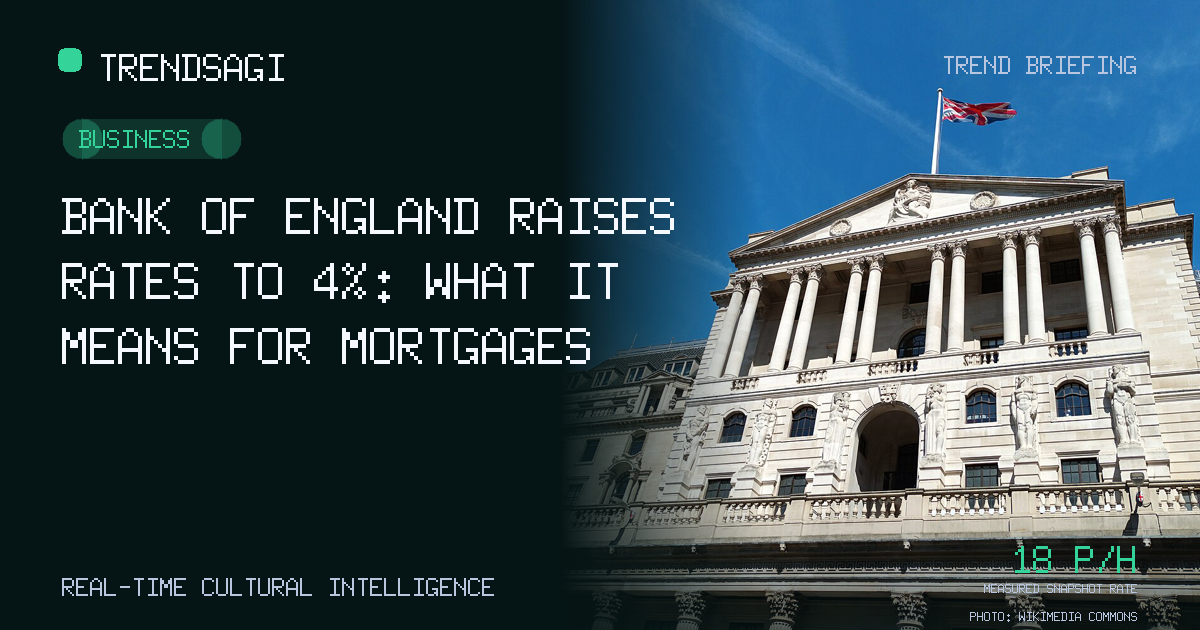
Image: Bank of England by acediscovery, CC BY 4.0, via Wikimedia Commons.
Track This Topic for New Signals
Set alerts for future velocity or sentiment changes around this topic.
Explore Tracking PlansAbout TrendsAGI research
TrendsAGI's automated research pipeline publishes dated signal snapshots, methodology notes, and practical workflows for teams evaluating cultural momentum. Read how signals are scoped, scored, and limited in our research methodology.