902-second window · 3 observations · Measured Nov 6, 2026, 7:16 PM UTC · Provider: go_recent_snapshot_v2
5th of November Explained: Guy Fawkes, Bonfire Night and the Mask
Why is the 5th of November marked with bonfires and a Guy Fawkes mask? The 1605 plot, the V for Vendetta link, and France's 2026 strikes on the same date.
Automated briefing. Generated from stored signal measurements and source-backed research; it is not manually reviewed. Read the methodology and limitations or the editorial standards.
Metrics in this briefing are a snapshot associated with its publication date and may not reflect current conditions.
What changed
The 5th of November is being searched and discussed because Guy Fawkes Day — Bonfire Night — falls on November 5, and 2026 coverage is dominated by explainers on the 1605 Gunpowder Plot and the V for Vendetta mask, according to the search-intent brief citing Clarin and Newsbomb. A separate driver sits on the same calendar square: nationwide strikes and demonstrations in France were also held on November 5, 2026, with turnout figures reported by Franceinfo. TrendsAGI measured a snapshot rate of 59.9 posts per hour over an exact 902-second window ending at 2026-11-06T19:16:39Z, from 3 stored observations, with a latest snapshot volume of 40 posts.
Put plainly: the date is moving for two unrelated reasons at once. One is a centuries-old British commemoration of a foiled plot against Parliament; the other is a contemporary French labour mobilisation that happens to share the date. Neither is caused by the other, and the mask that ties them together in public imagination is a pop-culture layer, not a historical one.
| Observation time (UTC) | 2026-11-06T19:16:39Z |
|---|---|
| Measured snapshot rate | 59.9 posts/hour (902-second window, 3 stored observations) |
| Latest snapshot volume | 40 posts |
Why this topic may be moving
Two verified threads explain the attention, and they should be kept apart.
- The Gunpowder Plot anniversary. The brief attributes to Clarin and Newsbomb the framing that 2026 coverage centres on explainers about the 1605 Gunpowder Plot and the V for Vendetta mask. This is the evergreen core of the date: the story of a failed conspiracy to blow up Parliament, retold every year with bonfires and fireworks.
- French strikes on the same date. Franceinfo reported on corteges on 5 November finding strong turnout, with a quote from a participant about continuing to believe in change. This is a distinct news driver with its own domestic context.
What the brief does not establish is why, precisely, conversation accelerated at the moment of the snapshot. The signal shows the topic spiking around the date; it does not separate British tradition chatter from French protest chatter, nor from mask-related pop-culture posting. That attribution is unconfirmed in the supplied material.
Why it matters
For readers arriving from a search, the value is disambiguation. "The 5th of November" is used to mean at least three things, and conflating them produces muddled explanations:
- a historical anniversary with a folk tradition attached;
- a symbol of anti-establishment protest via the Guy Fawkes mask;
- a date on which unrelated French demonstrations occurred in 2026.
For anyone tracking attention — editors, cultural commentators, communications teams planning around the date — the practical takeaway is that the topic behaves like a calendar spike with a news rider, not a slow-burn evergreen. The measured snapshot rate shows conversation accelerating around the date rather than sitting flat, though it cannot tell you which platform, which country, or which of the two drivers dominates.
The 5th of November carries three meanings at once — a 1605 plot remembered with fire, a mask that became shorthand for protest, and, in 2026, a French labour mobilisation that merely shared the date. The calendar explains the coincidence; it does not explain the connection.
What to watch next
- Whether the spike persists past the date. Calendar-driven topics typically decay fast; a slow decay would suggest the mask or protest angle is sustaining interest independently.
- Language and geography of the conversation. A split between English-language tradition chatter and French-language protest chatter would confirm the two-driver explanation; a blended stream would complicate it.
- Turnout reconciliation in France. Organiser and authority figures on the 5 November 2026 demonstrations conflict in the source set; a reconciled figure would sharpen that side of the story.
- Any reporting on event disruption. Whether 2026 Bonfire Night events were cancelled, scaled back, or affected by weather or safety rules is not confirmed in the brief. Watch for it.
- Winter holiday framing. Coverage often folds the date into a broader seasonal calendar; note whether it is treated as a standalone news event or as seasonal content.
Frequently asked questions
What happened on November 5, 1605, and who was Guy Fawkes?
November 5, 1605 is the date associated with the Gunpowder Plot, a conspiracy to attack Parliament that was foiled. Guy Fawkes is the figure most closely remembered in connection with it, and the anniversary is what Bonfire Night commemorates.
Why is the date marked with bonfires, fireworks and burning effigies?
The commemoration is traditionally observed with bonfires and fireworks, and effigy burning is part of the customary imagery associated with the date. The brief confirms the bonfire-and-fireworks framing but does not detail the regional variation in practice.
Where does the rhyme 'Remember, remember the fifth of November' come from?
The rhyme is widely cited in coverage of the date, but its provenance is treated inconsistently. One commentary loosely attributes it to around 1870, and the full text and exact origin are not established in the verified material, so treat any precise dating as unconfirmed.
How did Guy Fawkes become linked to the V for Vendetta mask and modern protest?
Modern coverage asserts a link between the Guy Fawkes mask, the V for Vendetta story, and protest contexts, and 2026 explainers pair the two explicitly. The brief does not establish the specific dates or the cultural sequence by which that association formed, so the mechanism is best described as widely reported rather than verified in detail here.
Are the French demonstrations on November 5 connected to Guy Fawkes Day?
No. The French nationwide strikes and demonstrations held on November 5, 2026 were a separate mobilisation that happened to fall on the same date, as reported by Franceinfo. Sharing a calendar date is not a connection.
Is November 5 a public holiday in the UK?
This is not confirmed in the verified material. Whether November 5 holds official public holiday status in any part of the UK, and how observance varies across England, Scotland, Wales and Northern Ireland, is unconfirmed here and should be treated as an open question.
Methodology and limitations
The signal is a stored observation, not a live feed. The rate of 59.9 posts per hour is a measured snapshot rate calculated over an exact 902-second window using 3 stored observations, ending at 2026-11-06T19:16:39Z. The latest snapshot volume is 40 posts. That figure is a count of posts in the snapshot, not a rate, and the rate is not a forecast, a reach estimate, an engagement measure, or a count of unique people.
What the signal can establish: that conversation around this topic was accelerating at a measurable pace at the moment of observation, consistent with a date-driven spike.
What it cannot establish: the platform breakdown, the geographic distribution, the language mix, or which of the two verified drivers carried the conversation. The brief also leaves several points unconfirmed — the official holiday status of November 5, the exact origin and full text of the rhyme, whether any 2026 observances were cancelled or altered, and the precise French turnout, which is disputed between organisers and authorities and not independently reconciled in these results. The exact number of posts and the social-platform breakdown behind the measured rate are likewise not corroborated by news sources.
Practical next checks for anyone following this: compare the next stored observation to see whether the rate is rising or decaying; look for language-segmented conversation to test the two-driver explanation; and watch for reconciled French turnout reporting and any confirmed changes to Bonfire Night events.
Sources
- "Remember, remember the fifth of November": What is Guy Fawkes Day and why is it celebrated? (Clarín) — clarin.com
- «Remember, remember, the 5th of November»: Η Συνωμοσία της Πυρίτιδας και το «V for Vendetta» (Newsbomb) — newsbomb.gr
- "Je continue de croire au changement" : les cortèges du 5 novembre font le plein (Franceinfo) — franceinfo.fr
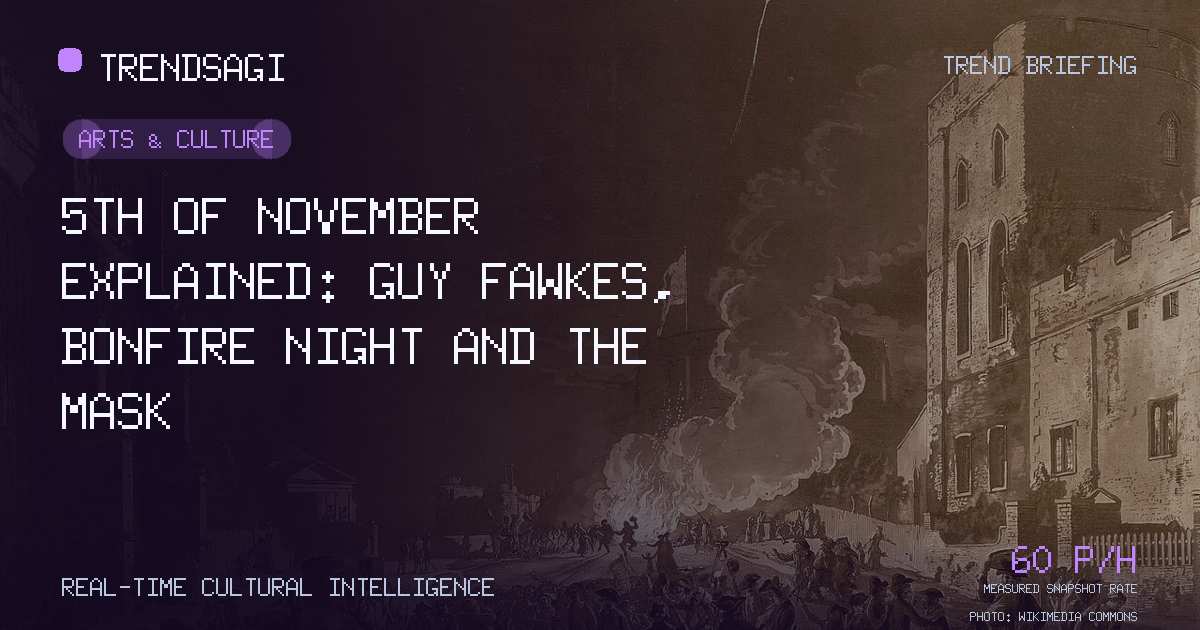
Image: Guy Fawkes Night by Paul Sandby, Public domain, via Wikimedia Commons.
Track This Topic for New Signals
Set alerts for future velocity or sentiment changes around this topic.
Explore Tracking PlansAbout TrendsAGI research
TrendsAGI's automated research pipeline publishes dated signal snapshots, methodology notes, and practical workflows for teams evaluating cultural momentum. Read how signals are scoped, scored, and limited in our research methodology.