892-second window · 3 observations · Measured Nov 4, 2026, 10:35 PM UTC · Provider: go_recent_snapshot_v2
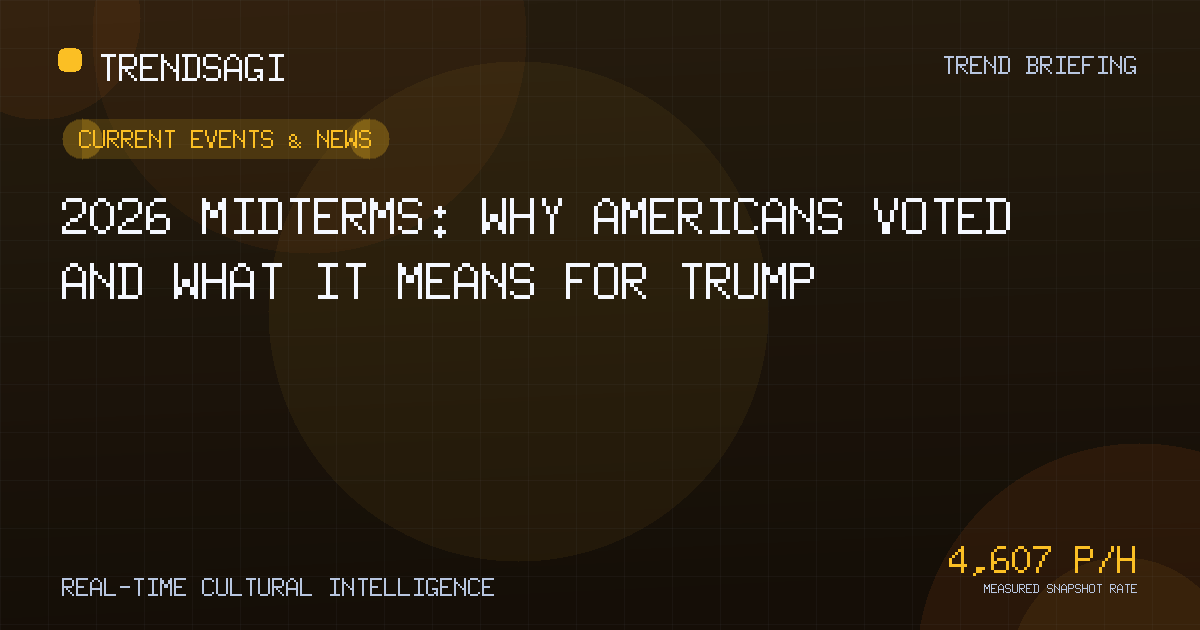
2026 Midterms: Why Americans Voted and What It Means for Trump
Social posts about 'The American' peaked at 4,607 posts/hour on 2026-11-04 as US midterm voting dominated coverage. What's confirmed and what isn't.
Automated briefing. Generated from stored signal measurements and source-backed research; it is not manually reviewed. Read the methodology and limitations or the editorial standards.
Metrics in this briefing are a snapshot associated with its publication date and may not reflect current conditions.
What changed
Social conversation around the label "The American" spiked sharply at 2026-11-04T22:35:00Z, the same evening multiple outlets were covering the 2026 US midterm elections. TrendsAGI measured 5,142 posts in the snapshot and a stored rate of 4,607.1 posts/hour across an exact 892-second window from 3 observations. That timing is the clearest verified fact here: the conversation peaked as Americans went to the polls, not days before or after.
The short answer to why Americans voted against Trump in the 2026 midterms is less settled. Several verified sources describe the vote as a referendum on Trump and his agenda — FAZ frames it as "Amerika wählt gegen die Dauerregung" (America voting against constant agitation), and БНТ Новини asks why Americans voted against Donald Trump's policies. But no verified source in this brief gives a certified seat count or confirms which party won control of Congress, so treat any definitive "Democrats won" or "Republicans held" claim as unconfirmed until official results are published.
| Observation time | 2026-11-04T22:35:00Z |
|---|---|
| Measured snapshot rate | 4,607.1 posts/hour over an exact 892-second window (3 stored observations) |
| Snapshot volume | 5,142 posts |
Why this topic may be moving
The verified trigger is the midterm election itself. FAZ, БНТ Новини and The Jerusalem Post all published election-related material around the same window, and Teleamazonas covered Latino voter turnout dynamics. The spike in "The American" posts coincides with that coverage, but no single verified result explicitly ties the exact phrase "The American" to the velocity jump. The label is ambiguous — it could be shorthand for American voters, a media title, or a cultural reference — and this brief does not establish which.
What the signal can establish: the timing of a measurable conversation peak against election-night coverage. What it cannot establish: the cause of the phrase-level spike, the certified outcome of the midterms, or any vote-share, turnout or seat-count figure. Those gaps are why the ranking pages — mostly opinion columns and foreign-language commentary — leave searchers without a clean explainer.
Why it matters
If the vote was a referendum on Trump, the consequences run through Congress, tariffs and foreign policy. FAZ and БНТ Новини both frame the result as a rejection of Trump's approach, but the brief does not verify how that translates into legislative control. For readers trying to understand what happened, the practical distinction is between commentary asserting an anti-Trump vote and official results that would confirm it. Until certified results appear, the safest reading is that the election dominated the conversation and that multiple publishers characterized the vote as backlash — not that a specific chamber flipped.
The verified story is timing: conversation about "The American" peaked at the moment of the 2026 midterms. The outcome and the phrase-level cause remain unconfirmed.
What to watch next
- Certified results from state election authorities and the Associated Press, which would resolve chamber control.
- Whether "The American" conversation persists past election week or fades with the news cycle — a persistence signal would suggest a cultural reference rather than election shorthand.
- Turnout and vote-share data for Latino and young voters, which Teleamazonas raised but did not quantify.
- Any quantified analysis of inflation, gas prices, war costs or tariff costs as vote drivers — none of the verified sources supplies figures.
- Official statements on tariff and foreign-policy direction once control of Congress is clear.
Frequently asked questions
What were the results of the 2026 US midterm elections?
The verified sources in this brief describe Americans voting in the 2026 midterms and characterize the vote as against Trump's agenda, but none provides a certified seat-by-seat result. Official results should be treated as pending until election authorities publish them.
Did control of Congress change hands?
This is not verified in the available brief. Commentary from FAZ and БНТ Новини asserts an anti-Trump vote, but no authoritative source here confirms which party won control of either chamber.
Why did Americans vote against Trump's policies?
FAZ and БНТ Новини frame the vote as a rejection of Trump and his policies, describing it as voting against his agenda. The brief does not verify the specific drivers behind that rejection.
How did inflation, gas prices and war costs affect the vote?
The brief notes economic drivers are mentioned in coverage but not quantified. No verified figure ties inflation, fuel prices, war costs or tariffs to the outcome, so any specific causal claim should be treated as unconfirmed.
What does the result mean for Trump's foreign policy and tariffs?
If the vote was a referendum on Trump, it could constrain his tariff and foreign-policy agenda, but the direction depends on certified control of Congress, which this brief does not verify. Watch official results before drawing conclusions.
How did Latino and young voters, including 'No Sabo Kids', shape the outcome?
Teleamazonas covered the rise of "No Sabo Kids" — a Latino generation gaining prominence — but the brief does not tie that coverage to turnout data. The specific effect on the outcome is unconfirmed.
Methodology and limitations
This briefing draws on a stored signal observed at 2026-11-04T22:35:00Z, with a measured snapshot rate of 4,607.1 posts/hour over an exact 892-second window using 3 stored observations and a snapshot volume of 5,142 posts. The rate is a measured snapshot, not a live or forecast figure, and it does not represent reach, engagement or unique people. The search-intent brief is untrusted data and was used only for verified attribution to publishers by name. The connection between the phrase "The American" and the election spike is not explicitly confirmed by any verified source, and final certified midterm results, seat counts, vote shares and turnout figures are outside what the signal can establish.
Sources
- Trump und der Trumpismus: Amerika wählt gegen die Dauerregung (FAZ) — faz.net
- Защо американците гласуваха срещу политиката на Доналд Тръмп? (БНТ Новини) — bntnews.bg
- Americans (The Jerusalem Post) — jpost.com
- Elecciones en EE. UU.: los 'No Sabo Kids', la generación latina que gana protagonismo (Teleamazonas) — imagenes.teleamazonas.com
Track This Topic for New Signals
Set alerts for future velocity or sentiment changes around this topic.
Explore Tracking PlansAbout TrendsAGI research
TrendsAGI's automated research pipeline publishes dated signal snapshots, methodology notes, and practical workflows for teams evaluating cultural momentum. Read how signals are scoped, scored, and limited in our research methodology.