901-second window · 3 observations · Measured Oct 28, 2026, 3:49 AM UTC · Provider: go_recent_snapshot_v2
Trump and Talarico rallies in Lubbock: what happened
Trump and Talarico held dueling rallies in Lubbock on Oct. 27, 2026. What happened, why the city council canceled its meeting, and what the Senate race signals.
Automated briefing. Generated from stored signal measurements and source-backed research; it is not manually reviewed. Read the methodology and limitations.
Metrics in this briefing are a snapshot associated with its publication date and may not reflect current conditions.
What changed
Lubbock became the center of Texas political attention on Tuesday, Oct. 27, 2026, when President Donald Trump and Democratic U.S. Senate candidate James Talarico held rallies about three miles apart in the reliably Republican West Texas city, according to The Texas Tribune and Yahoo. The same-day appearances came as the state's Senate race between Ken Paxton and Talarico entered its final stretch, and the city council even canceled its Tuesday evening meeting for lack of a quorum because of the Trump visit.
TrendsAGI's stored signal shows a measured snapshot rate of 231.7 posts per hour over an exact 901-second window ending at 2026-10-28T03:49:47Z, based on three stored observations. The latest snapshot volume was 216 posts. That rate describes the measured pace at that moment; it is not a live rate, a forecast of reach, or a count of unique people.
| Observation time (UTC) | Measured snapshot rate | Snapshot volume |
|---|---|---|
| 2026-10-28T03:49:47Z | 231.7 posts/hour | 216 posts |
Why this topic may be moving
The verified driver is the dueling-rally day itself. Trump and Talarico were in the same city on the same day, roughly three miles apart, during a competitive statewide Senate race. The Texas Tribune reported on the Lubbock rallies as the 2026 election nears its end, and Yahoo examined why both figures were visiting Lubbock on the same day.
That combination — a presidential visit and a high-profile Democratic Senate candidate in a deep-red city — gives national and state political coverage a clear "why is Lubbock in the news" hook. The city council's cancellation for lack of a quorum adds a local-government angle that helps the story travel beyond political audiences.
What the stored signal cannot establish is why individual posts were created, what they said, or whether the attention was driven by the rallies alone. The measurement shows the pace and timing of the surge; it does not identify the content or intent behind each post.
Why it matters
For readers in Lubbock, the day brought practical disruption: two major political events, security and traffic around the venues, and a canceled council meeting. For readers following the Texas Senate race, the visit is a test of how each campaign is spending time and attention in West Texas rather than only in the state's big metros.
The "battleground" framing deserves scrutiny. Lubbock is a Republican stronghold, and the verified sources describe the city that way. The rallies show that both campaigns wanted a West Texas moment, but they do not by themselves prove the city is competitive. The brief does not verify whether the rallies changed the race's trajectory.
What stands out is not just that two rallies happened, but that a reliably Republican city became the stage for a same-day political contrast — and that local logistics, down to a canceled council meeting, became part of the story.
What to watch next
- Whether either campaign releases verified crowd or attendance figures, which the available sources do not establish.
- Follow-up reporting from The Texas Tribune and other outlets on what each campaign said it gained from the West Texas visits.
- Local Lubbock coverage of traffic, security, and downtown disruption around the Civic Center, plus any rescheduled council business.
- Whether the Senate race polling or campaign schedules shift in West Texas after the rallies.
- TrendsAGI's own stored observations, to see whether the measured posting pace around Lubbock persists or fades in the next snapshot window.
Frequently asked questions
Why were Trump and James Talarico both in Lubbock on the same day?
The verified reason is that both held political rallies in Lubbock on Tuesday, Oct. 27, 2026, about three miles apart, as the 2026 election neared its end and the Texas Senate race between Ken Paxton and Talarico remained competitive. Yahoo examined why both were visiting the same day.
What time and where did each rally take place, and did the Talarico venue change?
The available verified brief does not provide exact rally times or confirm a venue change for Talarico. It does identify the Fiesta Center as a related Talarico rally search term and notes that local logistics, including venue details, are a gap in the pages currently ranking.
How big were the crowds at each event?
Exact crowd sizes were not verified in the available sources. The brief explicitly lists exact crowd sizes and total attendance or ticket figures as unconfirmed, so any specific number should be treated with caution until a campaign or credible outlet publishes it.
What does the dueling-rally visit signal about the Texas Senate race between Ken Paxton and Talarico?
It signals that both sides wanted a visible West Texas moment in a competitive statewide race, according to the verified framing from The Texas Tribune and Yahoo. It does not establish that the rallies changed the race's outcome or that Lubbock itself is competitive.
Why did the Lubbock City Council cancel its meeting?
The city council canceled its Tuesday evening meeting for lack of a quorum because of the Trump visit, according to the verified brief. The cancellation is a concrete local effect of the presidential stop.
Is Lubbock actually competitive, given it's a Republican stronghold?
The verified sources describe Lubbock as a reliably Republican West Texas city, and the brief notes little context on its electoral history and demographics. The dueling rallies show attention, not a proven shift in the city's partisan lean.
Methodology and limitations
TrendsAGI measured 231.7 posts per hour over an exact 901-second window using three stored observations, with the latest snapshot at 2026-10-28T03:49:47Z showing 216 posts. This is a measured snapshot rate from stored data, not a live or current rate, and it does not represent reach, engagement, or unique people.
The signal cannot verify exact crowd sizes, total attendance, whether the rallies changed the Senate race, or any causal link between the political news and unrelated Lubbock rent and home-price stories that may appear in search results. The brief also does not confirm specific social-post trends beyond TrendsAGI's own measurement. External facts are attributed to The Texas Tribune and Yahoo as publishers; no links are included here.
Sources
- Trump, Talarico rally in Lubbock as 2026 election nears end (The Texas Tribune) — texastribune.org
- Is Lubbock a battleground? Why Trump and Talarico are visiting the same day (Yahoo) — yahoo.com
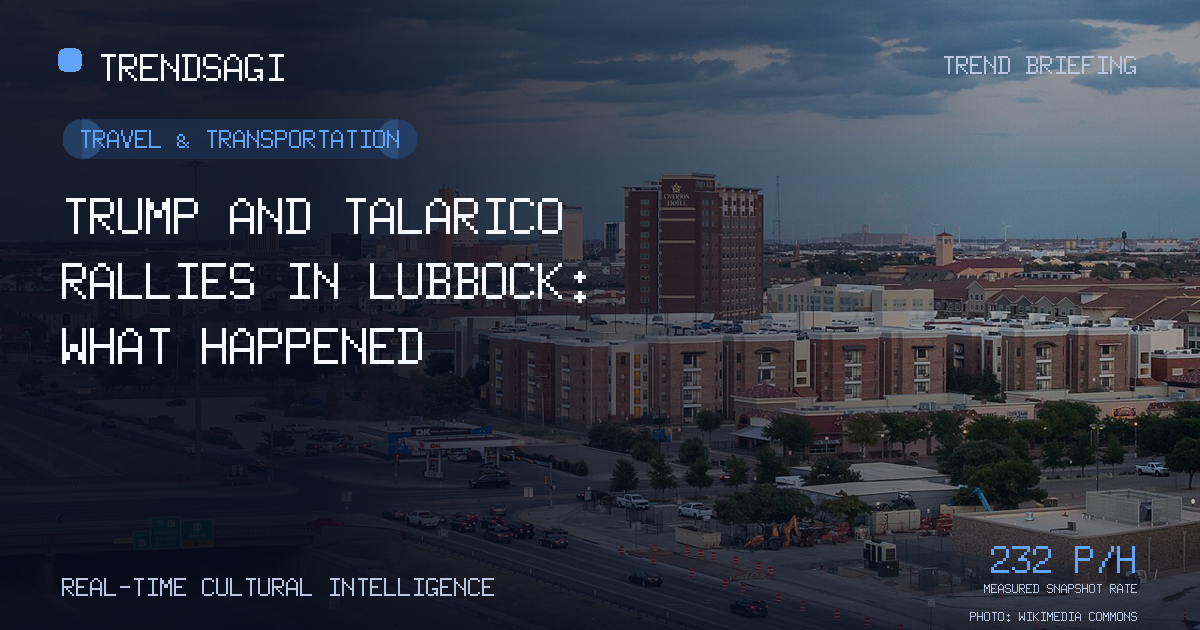
Image: Lubbock, Texas by Noah Puente, CC0, via Wikimedia Commons.
Track This Topic for New Signals
Set alerts for future velocity or sentiment changes around this topic.
Explore Tracking PlansAbout TrendsAGI research
TrendsAGI's automated research pipeline publishes dated signal snapshots, methodology notes, and practical workflows for teams evaluating cultural momentum. Read how signals are scoped, scored, and limited in our research methodology.