902-second window · 3 observations · Measured Oct 31, 2026, 12:15 AM UTC · Provider: go_recent_snapshot_v2
Trick or Treat Hours 2026: Timing, Origins and Why It's Trending
Trick-or-treat 2026 hours are set locally. See the measured Halloween posting spike, where the custom comes from, and how to find your town's official times.
Automated briefing. Generated from stored signal measurements and source-backed research; it is not manually reviewed. Read the methodology and limitations or the editorial standards.
Metrics in this briefing are a snapshot associated with its publication date and may not reflect current conditions.
What changed
Interest in "trick or treat hours [town name] October 31 2026" is spiking right as Halloween begins in North America. Stored measurements at 00:15 UTC on October 31, 2026 show 6,000 posts in the latest snapshot and a measured snapshot rate of about 3,425 posts per hour across a 902-second observation window. That rate is a measured figure from stored observations, not a live or forecast number. The short answer readers want: there is no single national trick-or-treat time — hours are set locally, usually by town or neighborhood custom, so the only reliable answer for a specific place comes from that municipality or local police/fire department announcement.
| Observation time | Measured posts/hour | Snapshot volume |
|---|---|---|
| 2026-10-31T00:15:21Z | 3,425 | 6,000 posts |
Why this topic may be moving
The verified picture is seasonal, not event-driven. The stored description of the topic is a generic Halloween label, the category is Entertainment, and the search-intent analysis behind this briefing shows only ordinary seasonal Halloween coverage. There is no verified evidence that any single news event caused this specific surge, and that should be said plainly rather than guessed at.
What the timing does tell us is that the conversation is peaking exactly when searchers start asking practical questions: what time does trick-or-treating start tonight, is it still happening, and what do I hand out. The timing of the spike lines up with the start of Halloween in North American time zones, which is consistent with demand for local scheduling answers.
The measured rate shows the conversation is large and immediate at the moment Halloween begins — but it cannot tell us what any individual town has scheduled, or whether participation is rising or falling.
Why it matters
For readers, this is a scheduling question with a short window. Parents, homeowners handing out candy, and local organizers all need an answer before dark, and the pages currently ranking do not aggregate it. Each municipal page covers one town; photo galleries and human-interest stories do not answer timing questions at all. That fragmentation is the real reason this topic keeps getting searched rather than answered.
For anyone watching the conversation — local newsrooms, community groups, retailers planning candy stock — the useful signal is that interest clusters tightly around Halloween itself, not across the preceding weeks. Planning that assumes a long ramp-up may be misreading the pattern.
What the signal can and cannot establish
The signal can establish that posting volume around this topic was substantial and concentrated at the moment Halloween began, measured at 3,425 posts per hour over a 902-second window using three stored observations. It can establish the snapshot volume of 6,000 posts.
It cannot establish why. It does not show search volume, rankings, participation rates, candy sales, or the number of towns involved in any trend. It also cannot tell us whether "trick or treat" refers to something other than the Halloween custom in any given post — the label is generic. Treat the origin question as unresolved rather than as evidence of a specific cause.
What to watch next
- Whether measured posting volume keeps climbing through the evening of October 31 or flattens after the first few hours — that would distinguish a scheduling-driven spike from general seasonal chatter.
- Municipal and local police announcements, which are the only authoritative source for a given town's hours.
- Whether non-candy and alternative-treat discussion grows relative to candy discussion, which would support the anecdotal shift in what people hand out.
- Any verified reporting on participation; the "hanging on by the skin of its teeth" framing attributed to Spectrum Local News is a single expert characterization, not participation data.
Frequently asked questions
What time does trick-or-treating start and end on October 31, 2026?
There is no universal start or end time. Most towns and neighborhoods set their own windows, commonly in the late afternoon to early evening, but the only reliable answer for your area comes from your municipality, local police, or a community announcement.
Is trick-or-treating on October 31 this year, and do towns move it if Halloween falls on a weekend?
October 31, 2026 falls on a Saturday, and trick-or-treating is still observed on Halloween itself in most places. Some towns do schedule or publicize alternate hours, so check your local announcement rather than assuming.
Where did the phrase 'trick or treat' and the door-to-door custom come from?
The door-to-door custom draws on older Scottish and Irish traditions such as guising and souling, in which people went house to house for food or coins in exchange for verses or prayers. The modern phrase and candy-centered practice are later American adaptations. General reference accounts often note a vandalism-related origin for the "trick" half, but the specific sourcing behind that claim is not verified here.
Is trick-or-treating declining since COVID, and are fewer kids participating?
Spectrum Local News has reported that trick-or-treating has been hanging on by "the skin of its teeth" since COVID. That is a single expert characterization; no participation statistics were verified for this briefing, so treat any decline claim as unconfirmed.
What are people giving out instead of candy this year, and why?
Reports have circulated about alternative treats including potatoes and "Trick or Tater" offerings, and about health-conscious and sugar-free options. The scale of these trends and the reasons behind them are not verified here, so they are best described as anecdotal rather than measured.
How do I find official trick-or-treat hours for my own town?
Search your town or city name plus "trick or treat hours," then confirm on the official municipal site, police department page, or parks and recreation announcement. Local news and community social accounts often repeat the official window, but the municipal source is the one to rely on.
Methodology and limitations
This briefing uses a stored topic signal observed at 2026-10-31T00:15:21Z, with a latest snapshot volume of 6,000 posts. The change rate of approximately 3,425 posts per hour was measured over an exact 902-second window using three stored observations. It is a measured snapshot rate at that moment, not a live rate, a forecast, a reach estimate, or a count of unique people.
External facts are attributed to their publisher where verified. The search-intent analysis behind this briefing was limited and did not supply search-volume or ranking data, participation statistics, or candy sales figures, so none appear here. No single causing event is confirmed; the pattern is consistent with ordinary seasonal Halloween interest.
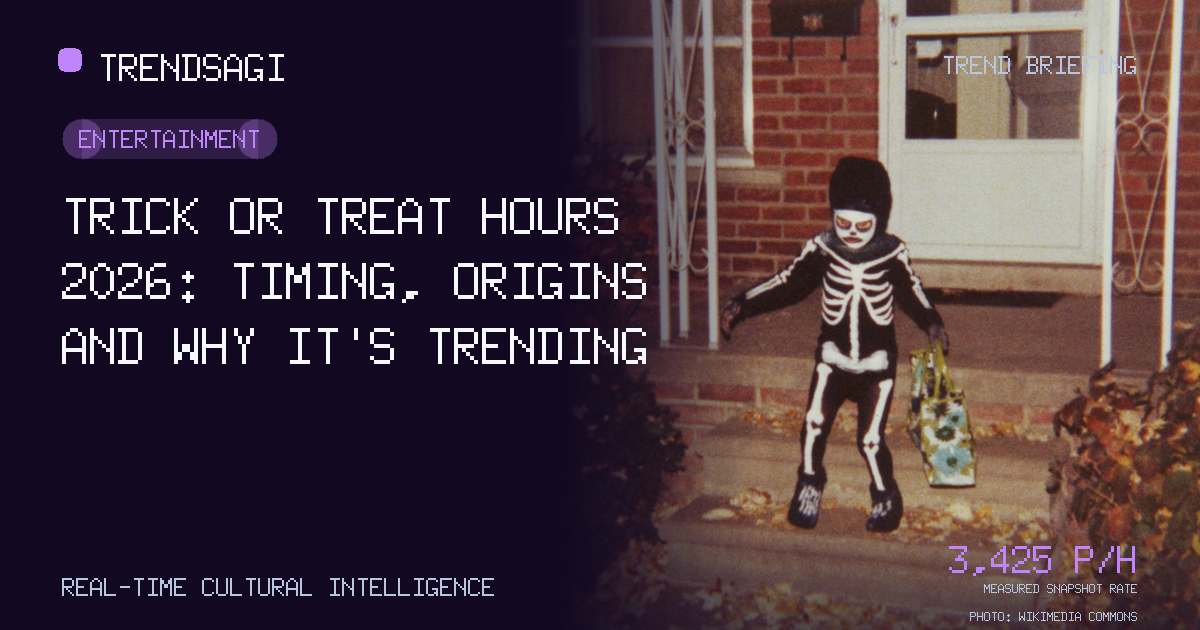
Image: Trick-or-treating by Don Scarborough, CC BY-SA 2.5, via Wikimedia Commons. The thumbnail adapts this photo with a title overlay and is shared under the same licence.
Track This Topic for New Signals
Set alerts for future velocity or sentiment changes around this topic.
Explore Tracking PlansAbout TrendsAGI research
TrendsAGI's automated research pipeline publishes dated signal snapshots, methodology notes, and practical workflows for teams evaluating cultural momentum. Read how signals are scoped, scored, and limited in our research methodology.