15-minute window · 3 observations · Measured Oct 16, 2026, 9:27 PM UTC · Provider: go_recent_snapshot_v2
Tesla Roadster Demo: Thrusters, Hops and 2028 Production
Tesla’s October 2026 Roadster demo used cold-gas thrusters for hops and flips; production targeted for 2028. Snapshot rate hit 6154.9 posts/hour with key
Automated briefing. Generated from stored signal measurements and source-backed research; it is not manually reviewed. Read the methodology and limitations.
Metrics in this briefing are a snapshot associated with its publication date and may not reflect current conditions.
What changed
Tesla and Elon Musk unveiled the long-delayed next-generation Roadster on October 15, 2026, at a SpaceX facility in Texas with a stunt-heavy demonstration that included upside-down driving, mid-air hops and flips over other vehicles, and a claimed 0-60 mph time under one second. The livestreamed event, featuring cold-gas thrusters and suction technology, drove a sharp rise in discussion. TrendsAGI measured a snapshot rate of 6154.9 posts per hour over a 900-second window ending at the 2026-10-16T21:27:11Z observation, alongside a snapshot volume of 5538 posts.
| Observation time (UTC) | Measured posts/hour | Snapshot volume |
|---|---|---|
| 2026-10-16T21:27:11Z | 6154.9 | 5538 |
The measured rate quantifies the intensity of the immediate reaction window after the reveal. It does not represent unique users, sustained daily volume, or engagement metrics such as likes or views. It simply records how densely posts mentioning the topic clustered in that short interval.
Why this topic may be moving
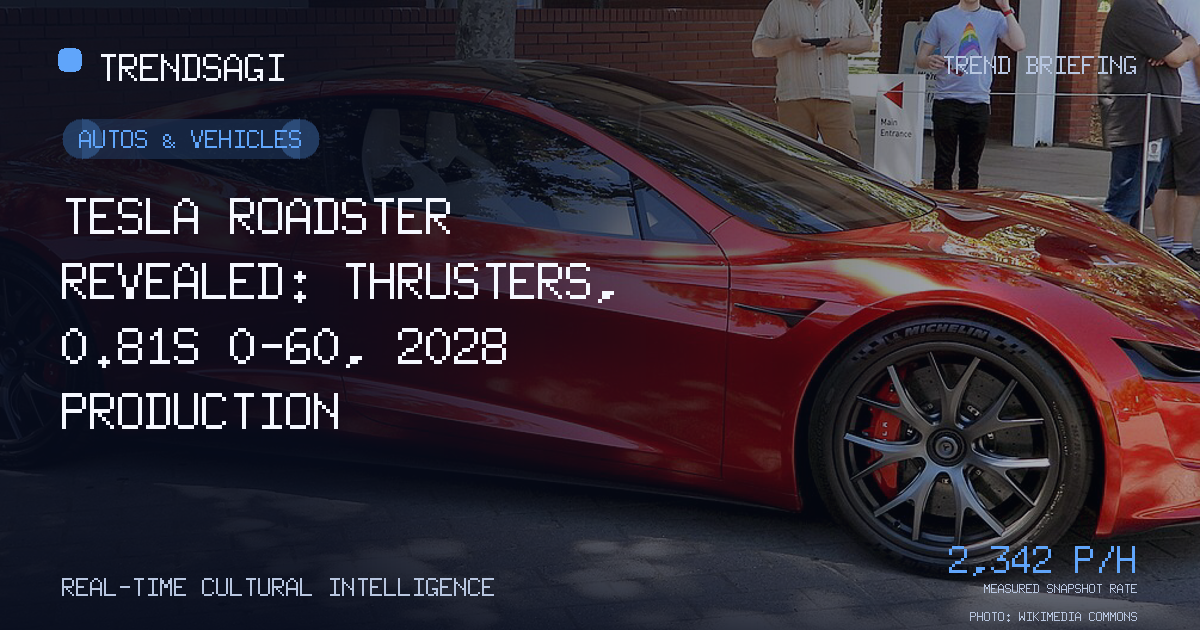
Coverage from WIRED, The Verge, NBC News and others confirms the core facts of the event. A prototype drove up an inverted ramp using a fan-based suction system that Tesla says can generate up to 2 Gs of downforce, remained inverted, then launched and used cold-gas thrusters to right itself and land. A second sequence saw the vehicle hop over a lineup of Tesla models, including a Semi, while performing a mid-air flip. Tesla timed a 0-60 mph run at 0.81 seconds with thruster assist. Production is targeted for 2028.
Three configurations were outlined. Performance is described as road-ready with active aerodynamics and the suction system. Thrust adds rear-mounted cold-gas thrusters for sub-one-second acceleration and is limited. Rocket is the single-seat, invite-only version with ten thrusters positioned around the vehicle that performed the aerial maneuvers; Tesla has indicated it is not approved for public-road use. Compressed air stored in carbon-overwrapped pressure vessels totaling roughly 600 liters supplies the thrusters and can be recharged onboard. No combustion propellant is involved.
The demonstration showed short-duration hops and controlled landings rather than sustained flight; the social spike tracked the spectacle and the production timeline more than any claim of everyday aerial commuting.
Reservations reopened with a $50,000 deposit for Performance and $250,000 for Thrust. Final retail prices remain unannounced. Range is stated around 300 miles across trims, a reduction from the 2017 concept’s far higher targets. Original 2017 promises included four seats, roughly 600 miles of range, and much earlier production; the 2026 vehicle is a two-seater (one in Rocket form) with a later timeline and different performance packaging.
Why it matters
For Tesla watchers and prospective buyers the reveal finally replaces years of teaser images and shifting dates with a concrete, if still distant, production window and clear tiering of capability. The social-velocity reading supplies a quantitative benchmark of how intensely the “flying car” framing landed compared with prior Musk product events. Anyone holding an older reservation or considering a new deposit needs to understand that only the Performance and limited Thrust versions appear positioned for broader availability, while Rocket remains closed and non-street-legal.
Regulators and safety analysts will scrutinize cold-gas systems, high-pressure vessels, and the suction fans. Independent verification of the 0.81-second figure, thruster force duration, and real-world safety margins is still absent. The signal itself cannot establish whether private Rocket units will ever be delivered or how road-legal the lower trims will ultimately be certified.
What to watch next
- Official Tesla reservation terms for legacy 2017 deposit holders versus new buyers.
- Any NHTSA or FAA statements on cold-gas thrusters or suction systems in production vehicles.
- Battery and range figures under repeated thruster use versus normal driving.
- Concrete production milestones at Giga Texas or other sites in 2027–2028.
- Whether the measured post rate decays or re-accelerates around follow-up technical deep-dives or regulatory filings.
Frequently asked questions
Did the Tesla Roadster actually fly or just hop/jump?
It performed short, controlled hops and mid-air flips assisted by cold-gas thrusters, including launches over other vehicles and a landing from an inverted ramp. Coverage describes brief airborne periods rather than sustained free flight.
What are the three versions (Performance, Thrust, Rocket) and which can leave the ground?
Performance is the road-ready base with suction and active aero. Thrust adds rear thrusters for acceleration. Rocket is the single-seat, invite-only version with full perimeter thrusters that executed the aerial stunts; only Rocket is described as capable of leaving the ground in the demonstrated manner.
When does production start and can I buy one for public roads?
Tesla targets production start in 2028. Performance is positioned as road-ready; Thrust is race-oriented and limited; Rocket is not approved for public roads according to Tesla statements reported by multiple outlets.
How much is the reservation deposit and is there a final price?
Current deposits are reported at $50,000 for Performance and $250,000 for Thrust. Final retail prices have not been announced.
What technology (thrusters, suction) enables the stunts and is it street-legal?
Fan-based suction provides downforce for inverted driving and grip; cold-gas thrusters fed by roughly 600 liters of compressed air enable hops, orientation control and boost. The full Rocket configuration is not street-legal; lower trims with suction only are intended for road use subject to future certification.
How does this compare to Musk’s original 2017 promises on range and speed?
The 2017 concept targeted higher range (around 600 miles), four seats and earlier production. The 2026 version offers roughly 300 miles of range, two seats (one in Rocket), a 2028 production target, and thruster-assisted acceleration claims that exceed the original 1.9-second 0-60 figure.
Methodology and limitations
The posts-per-hour figure is a measured snapshot rate derived from three stored observations spanning an exact 900-second window ending at the stated timestamp. Snapshot volume is the count of posts observed at that moment; it is not a rate, reach metric, or unique-author count. The rate captures clustering intensity during and immediately after the reveal but cannot distinguish bot activity, quote-tweet cascades, or geographic concentration. External facts are drawn from contemporaneous reporting by WIRED and other publishers; independent technical validation of thruster force, duration, or safety limits remains unavailable. Readers should treat claimed acceleration and flight capability as manufacturer demonstrations pending third-party testing.
Sources
- The Tesla Roadster 2 Is Here—and It Flies (WIRED) — wired.com
- Elon Musk (Wikipedia) — en.wikipedia.org
Image: Elon Musk by Gage Skidmore, CC BY-SA 4.0, via Wikimedia Commons. The thumbnail adapts this photo with a title overlay and is shared under the same licence.
Track This Topic for New Signals
Set alerts for future velocity or sentiment changes around this topic.
Explore Tracking PlansAbout TrendsAGI research
TrendsAGI's automated research pipeline publishes dated signal snapshots, methodology notes, and practical workflows for teams evaluating cultural momentum. Read how signals are scoped, scored, and limited in our research methodology.


.jpg)