990-second window · 2 observations · Measured Oct 16, 2026, 8:30 PM UTC · Provider: go_recent_snapshot_v2
Tesla Roadster Revealed: Thrusters, 0.81s 0-60, 2028 Production
Tesla unveiled the second-gen Roadster on Oct 15 with thrusters claiming 0.81s 0-60 and 2028 production. Snapshot rate hit 2341.7 posts/hour; key facts and
Automated briefing. Generated from stored signal measurements and source-backed research; it is not manually reviewed. Read the methodology and limitations.
Metrics in this briefing are a snapshot associated with its publication date and may not reflect current conditions.
What changed
Tesla unveiled its redesigned second-generation Roadster on October 15, 2026, at a SpaceX test facility in McGregor, Texas. The demonstration featured cold-gas thrusters and suction fans that let the prototype drive upside-down, perform aerial flips over other Teslas, and claim a 0-60 mph time of 0.81 seconds, with production targeted for 2028. Conversation around the topic spiked immediately afterward.
TrendsAGI measured a snapshot rate of 2341.7 posts per hour over a 990-second window ending at 2026-10-16T20:30:23Z, when the stored volume reached 2400 posts. That rate quantifies the intensity of the instantaneous reaction to the reveal; it does not measure unique users, engagement, or ongoing volume.
| Observation time (UTC) | Measured posts/hour | Snapshot volume |
|---|---|---|
| 2026-10-16T20:30:23Z | 2341.7 | 2400 |
Why this topic may be moving
According to reporting from Autoweek, the event showed the prototype climbing an inverted ramp and holding upside-down via underbody suction fans, then leaving the structure and flipping under thrust before landing. Tesla engineers described two carbon-overwrapped pressure vessels holding roughly 250 kg of compressed air across about 600 liters, feeding ten nozzles. The company attributed the thruster technology to SpaceX cold-gas systems adapted for atmospheric use.
Multiple outlets, including Reuters and TechCrunch, confirmed the three configurations announced after the demo: Performance (road-ready, suction system, claimed under 1.6 s 0-60), Thrust (adds rear thrusters, claimed under 0.9 s), and Rocket (invite-only, perimeter thrusters for lift and rotation, claimed under 0.59 s). Reservation deposits are listed at $50,000 for Performance and $250,000 for Thrust; Rocket requires an invitation. Production is stated for 2028. No final retail prices or independent third-party timing of the 0.81-second run have been published.
The spectacle proves the hardware can stage dramatic maneuvers under controlled conditions; what remains unproven is how those systems translate into durable, street-legal ownership for ordinary drivers.
Why it matters
For hypercar buyers and track enthusiasts, the Roadster introduces a new performance axis—thrust and active downforce beyond tire grip. Performance owners gain suction-aided cornering without the complexity of thrusters. Thrust and Rocket buyers accept added mass, refill logistics, and regulatory uncertainty in exchange for sub-second acceleration and limited aerial capability. Conventional hypercar owners watching the signal should note that Tesla’s claimed numbers, if realized in production form, would shift the acceleration benchmark far beyond current tire-limited cars.
The measured social velocity of 2341.7 posts per hour captures public interest intensity right after the reveal more precisely than later aggregated news coverage. It cannot establish technical verification, regulatory approval, or eventual sales volume. Anyone considering a reservation needs to treat the deposits as non-binding placeholders whose refund terms and conversion to actual purchase contracts remain company-controlled.
What to watch next
- Any independent timing runs or instrumented tests of the claimed 0.81-second (or production-target) 0-60 figures.
- Regulatory filings or statements on street legality of thruster-equipped versions in the United States, Europe, and other major markets.
- Clarification of final purchase prices, battery capacity, and real-world range under standardized testing.
- Details on how the high-pressure air tanks are refilled in practice and how many full-thrust cycles are available per fill.
- Engineering trade-offs versus the 2017 prototype, especially mass, packaging, and durability of the SpaceX-derived systems for series production.
Frequently asked questions
What exactly happened at the October 15, 2026 Tesla Roadster reveal?
At SpaceX’s McGregor, Texas test site, Tesla demonstrated a prototype that used underbody suction fans to drive upside-down on an inverted ramp and cold-gas thrusters to perform aerial flips and a controlled landing. Autoweek and other outlets reported a live 0-60 mph claim of 0.81 seconds with thruster assistance. Production was stated for 2028.
Can the new Tesla Roadster actually fly, and how do the cold-gas thrusters work?
The demo showed short aerial hops and flips powered by compressed-air thrusters. Tesla engineers, as reported by Autoweek, described two pressure vessels holding about 250 kg of air feeding ten nozzles; the system uses expansion of pressurized gas rather than combustion. Sustained flight is not claimed; the maneuvers were brief and controlled.
What are the differences between the Performance, Thrust, and Rocket versions?
Performance is described as road-ready with active aerodynamics and a multi-mode suction system. Thrust adds rear-mounted cold-gas thrusters for higher acceleration. Rocket is a single-seat, invite-only configuration with additional thrusters around the body for lift and rotation; Tesla has indicated it is not approved for public-road use in all regions.
When will the Tesla Roadster go into production and how much does a reservation cost?
Tesla has targeted production for 2028. Reservation deposits are currently listed at $50,000 for the Performance version and $250,000 for the Thrust version; Rocket is invitation-only. These are deposits, not final purchase prices, which have not been announced.
Is the Tesla Roadster street-legal, and what is the claimed range and top speed?
Performance is presented as road-ready; the thruster-equipped Thrust and Rocket versions face unresolved regulatory questions in major markets. Tesla has claimed more than 300 miles of range and a top speed exceeding 230 mph for the configurations shown; neither figure has been independently verified under standardized testing.
How does the suction/fan downforce system work and was the 0.81-second 0-60 independently verified?
The multi-mode suction system uses fans and ground sealing to generate downforce, enabling the upside-down demonstration. The 0.81-second 0-60 figure is a Tesla claim from the event; no independent third-party timing has been published.
Methodology and limitations
The posts-per-hour figure is a measured snapshot rate derived from two stored observations spanning exactly 990 seconds and ending at the stated timestamp. It quantifies conversation intensity at that moment and cannot be read as a live rate, forecast, reach metric, or count of unique individuals. External facts about the reveal are drawn from contemporaneous reporting by Autoweek, Reuters, TechCrunch, and related coverage; claims of performance, legality, pricing, and range remain company statements pending independent confirmation. Gaps persist around third-party verification of the acceleration number, regulatory pathways for thruster versions, final retail pricing, real-world energy consumption, and practical tank-refill logistics.
Sources
- Tesla Roadster 2.0 Can Fly, Drive Upside Down, and Hit 60 in 0.81 Second (Autoweek) — autoweek.com
- Tesla Roadster (second generation) (Wikipedia) — en.wikipedia.org
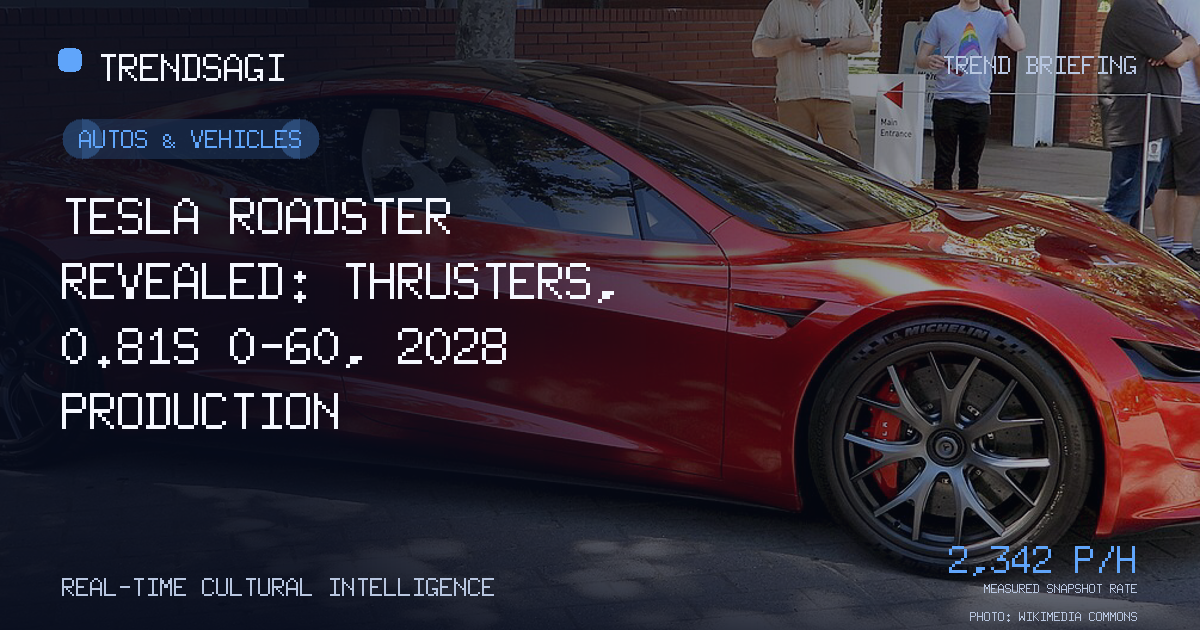
Image: Tesla Roadster (second generation) by Editor928111, CC BY-SA 4.0, via Wikimedia Commons. The thumbnail adapts this photo with a title overlay and is shared under the same licence.
Track This Topic for New Signals
Set alerts for future velocity or sentiment changes around this topic.
Explore Tracking PlansAbout TrendsAGI research
TrendsAGI's automated research pipeline publishes dated signal snapshots, methodology notes, and practical workflows for teams evaluating cultural momentum. Read how signals are scoped, scored, and limited in our research methodology.


.jpg)