2720-second window · 2 observations · Measured Oct 11, 2026, 2:12 AM UTC · Provider: go_recent_snapshot_v2
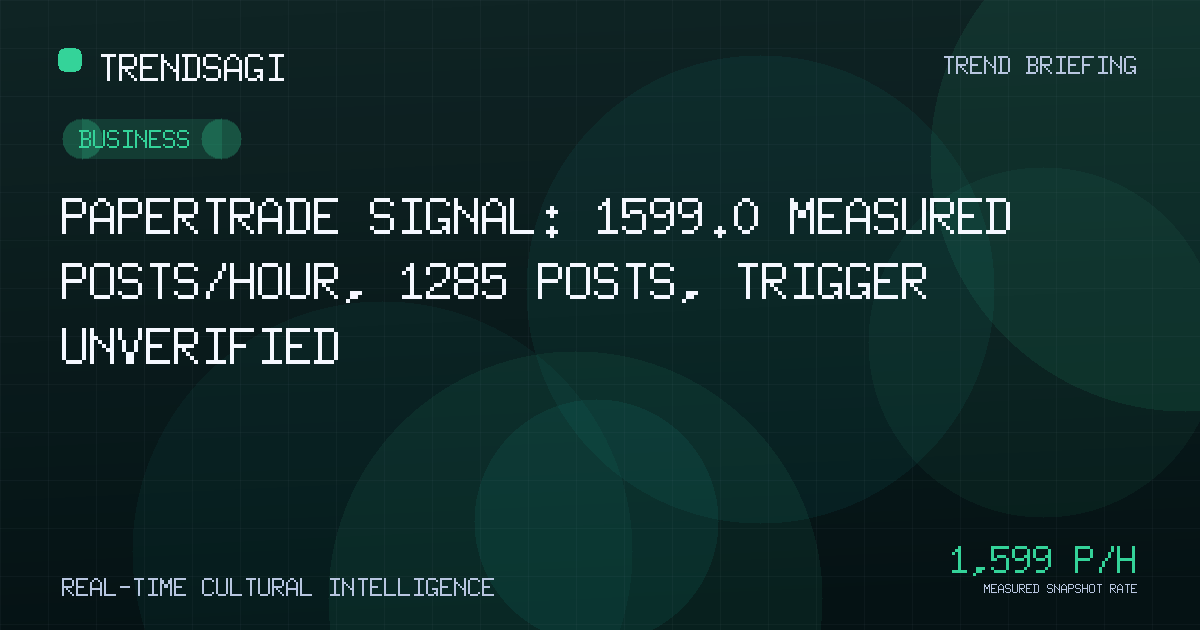
Papertrade signal: 1599.0 measured posts/hour, 1285 posts, trigger unverified
Papertrade measured 1599.0 posts/hour; the latest snapshot held 1285 posts, but post-level checks are needed before drawing business conclusions.
Automated briefing. Generated from stored signal measurements and source-backed research; it is not manually reviewed. Read the methodology and limitations.
Metrics in this briefing are a snapshot associated with its publication date and may not reflect current conditions.
What changed
The stored #papertrade signal shows increased posting activity, but no verified public trigger explains the increase. For a business reader, the takeaway is straightforward: the conversation warrants investigation, yet it does not establish that a market event, company action, product launch, regulatory change, or broader shift in demand occurred.
The measured change is 1599.0 posts/hour, based on 2 stored observations across an exact 2720-second window and measured at 2026-10-11T02:12:20Z. It is a measured snapshot rate, not a live or current rate, forecast, audience reach, engagement level, or count of unique people.
| Observation time | 2026-10-11T02:12:20Z |
|---|---|
| Measured snapshot rate | 1599.0 posts/hour |
| Snapshot volume | 1285 posts |
| Exact comparison window | 2720 seconds |
| Stored observations used | 2 |
What the signal can establish
The latest stored snapshot contained 1285 posts associated with the tracked topic. Separately, the stored observations produced a measured change rate of 1599.0 posts/hour. These measurements answer different questions: one describes stored volume at an observation point, while the other summarizes change over a defined comparison window.
The signal does not reveal how many people posted, whether accounts are unique, how often content was reposted, or whether people saw it. It also supplies no direct measure of sentiment, purchase intent, or market activity. The increase can therefore set monitoring priorities, but it cannot support a claim that investment behavior or business performance changed.
Why this topic may be moving
No verified public context establishes why the signal moved. The stored category is Business, but a broad category and an absent description are not a causal explanation. The label is also semantically ambiguous: it could refer to simulated trading, a product or publication name, a campaign tag, or another use.
- External reaction: A dated business or market development could have prompted discussion, but no particular event is verified here.
- Scheduled activity: A campaign, livestream, publication, community event, or coordinated promotional effort could create a temporary cluster.
- Reposting or automation: Duplicate syndication, automated accounts, or repeated use of a tag could amplify apparent conversation volume.
- Collection effects: A change in sampling, query behavior, moderation, or classification could alter the observed rate without a comparable change in real-world activity.
- Content collision: Posts with different meanings may share the same label, making several discussions appear to be one unified trend.
These are testable hypotheses, not findings. A defensible cause requires post-level evidence and, for an outside-event explanation, a verifiable publication or event record aligned with the timing.
Why it matters
Community, communications, and reputation teams should care because a concentrated conversation can affect how a topic is perceived and amplified. If the sample contains financial simulation content, product teams and educators may want to inspect recurring questions or misconceptions. If it does not, classification or tag misuse may be the more relevant issue.
For market observers, the distinction is especially important. A high posting rate is not trading volume, order flow, customer adoption, or evidence of price direction. Acting on the metric before examining the posts could turn a platform-volume spike into a false business conclusion.
Decision rule: Treat 1599.0 posts/hour as an investigation trigger, not proof of a business catalyst. A conclusion becomes stronger only when the posts, participating accounts, and a credible external explanation align.
What to watch next
The immediate priority is to determine whether this is sustained public discussion, a temporary burst, amplification, or a measurement artifact.
- Persistence: Compare the next stored observation using the same definition and window. A single elevated window may be transient; repeated elevation across comparable observations would make the pattern more durable.
- Breadth: Count distinct accounts and separate original posts, reposts, and likely automated items. Participation by many accounts is different from one group repeating a message.
- Authenticity: Inspect duplicate wording, linked destinations, profile histories, and near-simultaneous submissions for signs of coordinated or automated amplification.
- Concentration: Check whether posts cluster around a few accounts, subtopics, or organizations. Concentration could indicate amplification or a localized event rather than broad interest.
- Semantic fit: Read a representative sample and classify what the posts actually mean. Verify whether they concern simulated trading before assigning a sector, audience, or use case.
- External corroboration: Test any candidate trigger against an original dated publication and independent reporting. Timing alignment is useful evidence, but it is not enough on its own.
- Business transmission: Look for an observable path to business impact, such as product questions, customer concerns, hiring, sales, or policy consequences. Posting activity alone does not show that such a path exists.
The most useful next evidence is a clear chain connecting a verified trigger to original posts, independent corroboration, and a measurable business consequence. Without those links, the cause and implications remain open.
Methodology and limitations
At 2026-10-11T02:12:20Z, the stored snapshot volume was 1285 posts. The measured snapshot rate was 1599.0 posts/hour over an exact 2720-second window using 2 stored observations. No smoothing, extrapolation, or forecast has been added.
Snapshot volume and measured rate are separate quantities. The volume is not reach or a count of unique accounts, and the rate is not current activity, engagement, or audience size. The supplied record does not provide post text, account identities, geography, language coverage, collection rules, deduplication methods, spam controls, or a historical baseline.
With 2 observations, the signal documents measured change within the stored comparison window but cannot establish a long-term trajectory, persistence, or turning point. No public trigger has been verified, so no specific cause is attributed. The defensible conclusion is elevated measured posting activity requiring validation, not a confirmed business development.
Track This Topic for New Signals
Set alerts for future velocity or sentiment changes around this topic.
Explore Tracking PlansAbout TrendsAGI research
TrendsAGI's automated research pipeline publishes dated signal snapshots, methodology notes, and practical workflows for teams evaluating cultural momentum. Read how signals are scoped, scored, and limited in our research methodology.