897-second window · 3 observations · Measured Oct 15, 2026, 1:57 AM UTC · Provider: go_recent_snapshot_v2
Starlink Ukraine Speed Limits: What Changed Overnight
Ukraine reported sudden Starshield speed limits above 160 km/h on 14 Oct 2026, disrupting drones. Musk says US controls Starshield; partial restoration noted.
Automated briefing. Generated from stored signal measurements and source-backed research; it is not manually reviewed. Read the methodology and limitations.
Metrics in this briefing are a snapshot associated with its publication date and may not reflect current conditions.
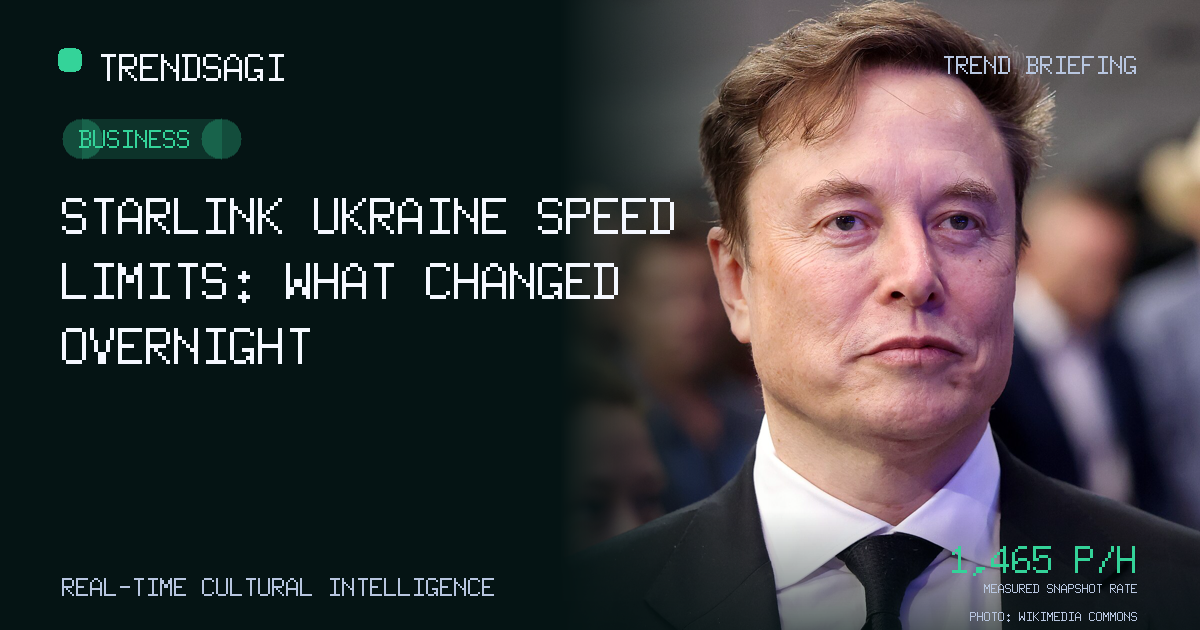
What changed
Overnight into 14 October 2026, Ukrainian forces reported sudden speed restrictions on military-grade Starshield terminals (a SpaceX Starlink variant), limiting reliable connectivity above roughly 100 mph / 160 km/h. The change disrupted drone and frontline missions without prior warning. Social discussion of the topic reached a measured snapshot rate of 1464.7 posts/hour, with a latest snapshot volume of 1674 posts observed at 2026-10-15T01:57:32Z.
| Observation time (UTC) | Measured posts/hour | Snapshot volume |
|---|---|---|
| 2026-10-15T01:57:32Z | 1464.7 | 1674 |
Ukrainian officials, including presidential adviser Serhiy Beskrestnov, described the restriction as applying to Starshield terminals in motion and said it led to the disruption or cancellation of multiple missions. Defence sources confirmed terminals lose connection once vehicles or assets exceed the threshold.
Why this topic may be moving
Reporting from BBC, CNN and The Guardian establishes a clear sequence. Ukrainian units detected the limit overnight; the 7th Rapid Reaction Corps and other formations reported connection drops even at somewhat lower speeds during flights, complicating control of interceptor and mid-range strike drones. Logistics, reconnaissance and frontline communications were also affected.
Elon Musk stated on X that Starshield systems are owned and controlled by the US government, so any limits on speed or usage are decided by the US military and ultimately the president. He distinguished this from commercial Starlink, which SpaceX owns and which is limited to civilian or defensive activities and cannot support offensive use. Ukraine’s former defence minister Mykhailo Fedorov later noted that connectivity at speeds up to 160 km/h was being restored and called for complete removal of the Starshield limit.
The timing coincides with heightened US-Ukraine tensions, including reported pressure over strikes on Russian energy infrastructure. Ukrainian officials publicly linked the change to the political situation, though no independent confirmation of a specific directive has been published by major outlets.
The distinction between US-controlled Starshield and commercial Starlink is central: the former carries the operational limits reported on 14 October, while Musk has repeatedly framed the latter as unsuitable for offensive missions.
Why it matters
Starshield has been a core enabler for Ukrainian drone operations that require continuous high-speed connectivity. Interceptor drones used against faster Russian threats and mid-range strike systems lose effectiveness when the link drops for even 10–20 seconds. Frontline units described mission cancellations and reduced capability for mobile logistics and reconnaissance.
The episode underscores Ukraine’s dependence on a single satellite architecture whose military tier is under US government control. Defence ministry sources indicated the limit remained in place even after partial improvement in connection quality at the stated threshold. Readers tracking battlefield communications, SpaceX government contracts, or US policy toward Ukraine should treat the event as a live operational constraint rather than a resolved technical glitch.
What to watch next
- Official statements from the US Department of Defense or White House clarifying whether any directive was issued.
- Further Ukrainian defence ministry updates on whether the 160 km/h threshold is lifted or tightened.
- Operational reports from frontline units on restored or continued mission disruption rates.
- Any SpaceX or Musk follow-up distinguishing commercial Starlink availability from Starshield parameters.
- Sustained or declining social volume around related phrases such as Starshield Ukraine outage or Musk Starlink speed limit.
Practical next checks include monitoring Ukrainian Telegram channels used by defence advisers and confirmed reporting from BBC, CNN and The Guardian for restoration status. The measured social velocity quantifies intensity of discussion in a short window; it cannot establish causation, intent, or the exact technical mechanism behind the speed threshold.
Frequently asked questions
What exactly changed with Starlink/Starshield in Ukraine on Oct 14?
Ukrainian forces reported that Starshield terminals began losing connectivity when assets exceeded approximately 100 mph / 160 km/h, with no advance notice. The restriction disrupted several drone and frontline missions according to presidential adviser Serhiy Beskrestnov and defence ministry sources cited by BBC and CNN.
Is the restriction controlled by SpaceX/Musk or the US government?
Musk stated that Starshield systems are owned and controlled by the US government and that limits are decided by the US military and ultimately the president. Commercial Starlink remains under SpaceX control and is restricted to civilian or defensive use.
How does the speed limit affect Ukrainian drones and missions?
Interceptor and mid-range strike drones lose real-time control when the terminal drops connection above the threshold, leading to cancelled or degraded missions. Frontline logistics, reconnaissance and communications were also reported as impaired by Ukrainian units.
Has service been partially restored and under what conditions?
Mykhailo Fedorov reported that connectivity at speeds up to 160 km/h was being restored. Ukraine’s defence ministry noted improved connection quality at that speed while stating the limit itself continued to apply.
What did Musk say about the restrictions?
Musk wrote that Starshield is US-government controlled, any speed or usage limits are set by the US military and ultimately the president, and commercial Starlink cannot be used for offensive military action.
Is this linked to Trump administration pressure on Ukraine?
Ukrainian officials publicly associated the timing with broader political tensions, including pressure over energy strikes. Major outlets report the coincidence but have not published independent confirmation of a specific directive.
Methodology and limitations
The social figures are a measured snapshot rate of 1464.7 posts/hour derived from three stored observations over an exact 897-second window ending at the stated timestamp, together with the corresponding snapshot volume of 1674 posts. These numbers describe discussion intensity in that window only; they do not measure unique users, reach, engagement, or causation. The briefing relies solely on verified reporting from BBC, CNN and The Guardian for the sequence of events and statements. Exact technical implementation details, the existence of any formal US directive, and complete restoration status beyond the partial reports already published remain unconfirmed by those sources. The signal establishes that the topic spiked in public discussion concurrent with the reported operational change; it cannot by itself prove intent or long-term policy.
Sources
- Ukrainian military’s access to Starlink satellite internet suddenly restricted (The Guardian) — theguardian.com
- Ukraine says Starlink restriction disrupting military as Musk claims US controls those systems (CNN) — edition.cnn.com
- Starlink restrictions affecting Ukraine's front line operations, Kyiv says (BBC) — bbc.com
Image: Elon Musk by Gage Skidmore, CC BY-SA 4.0, via Wikimedia Commons. The thumbnail adapts this photo with a title overlay and is shared under the same licence.
Track This Topic for New Signals
Set alerts for future velocity or sentiment changes around this topic.
Explore Tracking PlansAbout TrendsAGI research
TrendsAGI's automated research pipeline publishes dated signal snapshots, methodology notes, and practical workflows for teams evaluating cultural momentum. Read how signals are scoped, scored, and limited in our research methodology.
.jpg)