1816-second window · 3 observations · Measured Oct 10, 2026, 7:58 PM UTC · Provider: go_recent_snapshot_v2
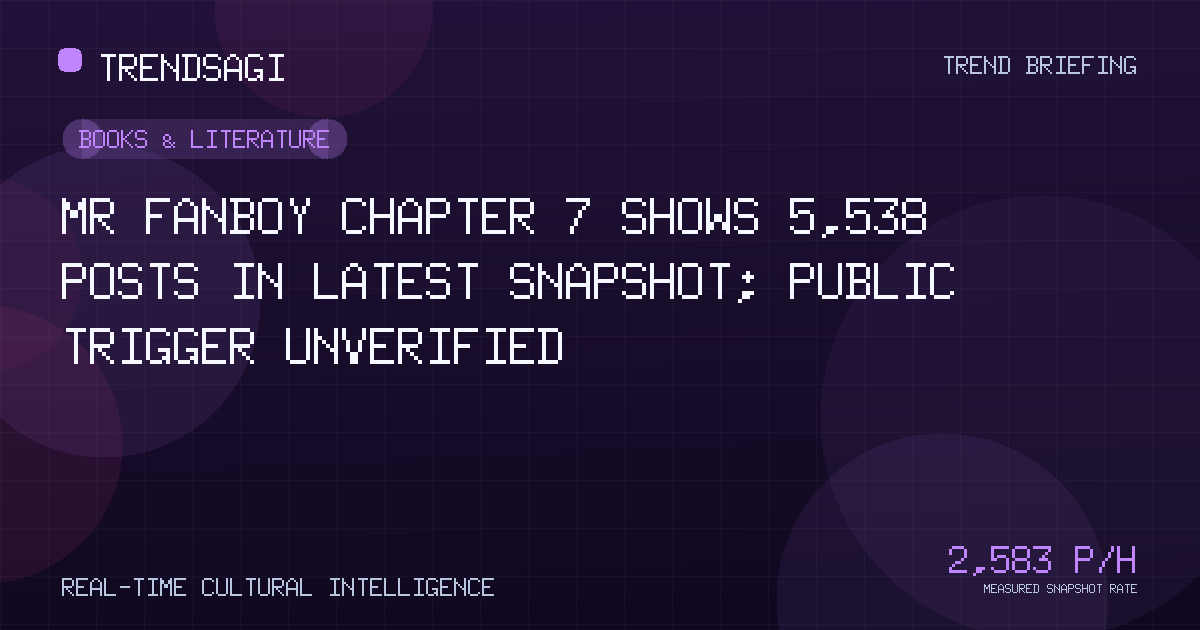
MR FANBOY CHAPTER 7 shows 5,538 posts in latest snapshot; public trigger unverified
MR FANBOY CHAPTER 7 shows 5,538 posts and a measured 2,582.8 posts/hour; the trigger is unclear, and these are the key checks next.
Automated briefing. Generated from stored signal measurements and source-backed research; it is not manually reviewed. Read the methodology and limitations.
Metrics in this briefing are a snapshot associated with its publication date and may not reflect current conditions.
What changed
The latest snapshot for the exact label “MR FANBOY CHAPTER 7” contains 5,538 posts. That establishes the size of the captured set at the observation time, not the number of participants. No verified public item is attached to the signal, so the reason for the topic’s movement remains unclear.
The measured snapshot rate was 2,582.8 posts/hour over the exact 1,816-second window using 3 stored observations, measured at 2026-10-10T19:58:18Z. It is a historical snapshot measure—not a live or current rate, forecast, reach, engagement, or unique-person count—and it should not be compared with platform-wide activity without matching coverage.
| Metric | Observed value |
|---|---|
| Observation time | 2026-10-10T19:58:18Z |
| Measured snapshot rate | 2,582.8 posts/hour |
| Latest snapshot volume | 5,538 posts |
Why this topic may be moving
The label is specific enough to cluster posts but not enough to identify the work, creator, platform, or event. “Chapter” may indicate serial fiction, but the record does not prove that interpretation. The stored category, Books & Literature, supplies an editorial bucket rather than source-level context.
- Release or update: A chapter publication could concentrate discussion, but no such trigger is verified here.
- Redistribution: A previously published item might be recirculated through reactions, excerpts, or recommendations.
- Audience coordination: Readers or creators may be prompting others to revisit a named section.
- Classification effects: A platform label, search result, or moderation action could make existing posts look newly active.
These are testable hypotheses, not findings. Until a dated public item is verified, attributing the rise to a release, recommendation, dispute, or platform decision would go beyond the evidence.
The strongest supported conclusion is that discussion clustered under this exact label intensified during the measured window—not that a release, recommendation, or controversy caused the increase.
What the signal can establish
The signal is useful as an early warning, but not as a complete account of the conversation.
- It establishes that the captured set contained 5,538 posts under the exact supplied label at the stated observation time.
- It quantifies posting pace during the exact observed window without presenting that measurement as live activity.
- It gives investigators a concrete label and time boundary from which to trace likely sources.
It cannot establish whether the label names an official chapter, fan-made work, reaction video, comment cluster, or something else. It does not reveal sentiment, geography, language, author concentration, organic participation, or duplicate exposure. Most importantly, it does not prove that a specific post, release, recommendation, dispute, or platform intervention caused the movement.
Why it matters
For a genuine fiction community, the immediate question is whether readers are responding to new material or amplifying old material. Writers and editors can use the signal to check whether conversation is concentrated around a particular passage, but should not treat post volume as evidence of quality or durable demand. Community teams can also look for coordination, spam, or label collisions before drawing conclusions.
For readers, the practical value is avoiding a mistaken conclusion that high volume automatically means broad popularity, official confirmation, or a newly released chapter. Analysts should preserve the exact label and timestamp because broader queries could merge this signal with unrelated uses of “fanboy” or “chapter.”
What to watch next
Prioritize provenance over scale. The next useful checks are:
- Trace the onset: Inspect the earliest retrievable posts inside and around the stored window. Note repeated text, quoted sources, linked material, and accounts that appear repeatedly.
- Verify a primary event: Look for a dated public item from the relevant creator, publisher, or platform and compare its timing with the observed acceleration. The label alone is not evidence of publication.
- Audit the label: Check exact-phrase, capitalization, and generic “chapter 7” variants to determine whether unrelated works or discussions were combined.
- Separate original posts from redistribution: Distinguish reactions, quotations, screenshots, and cross-posts. Repetition can enlarge the apparent conversation without adding equivalent participation.
- Check persistence: Compare later snapshots with this observation. Sustained activity would support a different interpretation from a short concentrated burst.
- Map the substance: Determine whether posts are focused on interpretation, promotion, criticism, correction, or fandom coordination. Similar volume can support very different conclusions.
Concrete watch signals
- A verifiable chapter release or update shortly before the observed acceleration.
- Independent accounts directing readers to the same primary item.
- Continued elevated snapshot volume after the initial burst.
- A creator clarification, correction, or acknowledgment tied to the exact label.
- Evidence of a label collision, unrelated-work mix-up, or reused promotional phrase.
Methodology and limitations
The latest observation is timestamped 2026-10-10T19:58:18Z and contains 5,538 posts. The supplied measured change is 2,582.8 posts/hour across the exact 1,816-second window represented by 3 stored observations. Snapshot volume and measured rate describe different aspects of the signal and should remain separate.
With only 3 observations, the available series cannot show the full shape of the activity curve or reliably distinguish a sustained trend from a brief surge. Post volume may also include repeated material, and it does not reveal how many distinct people participated. No public trigger has been verified, so the cause of the movement is not assigned. The Books & Literature category helps locate the signal editorially but does not establish the underlying work, source, or event.
Track This Topic for New Signals
Set alerts for future velocity or sentiment changes around this topic.
Explore Tracking PlansAbout TrendsAGI research
TrendsAGI's automated research pipeline publishes dated signal snapshots, methodology notes, and practical workflows for teams evaluating cultural momentum. Read how signals are scoped, scored, and limited in our research methodology.