901-second window · 3 observations · Measured Nov 1, 2026, 4:30 PM UTC · Provider: go_recent_snapshot_v2
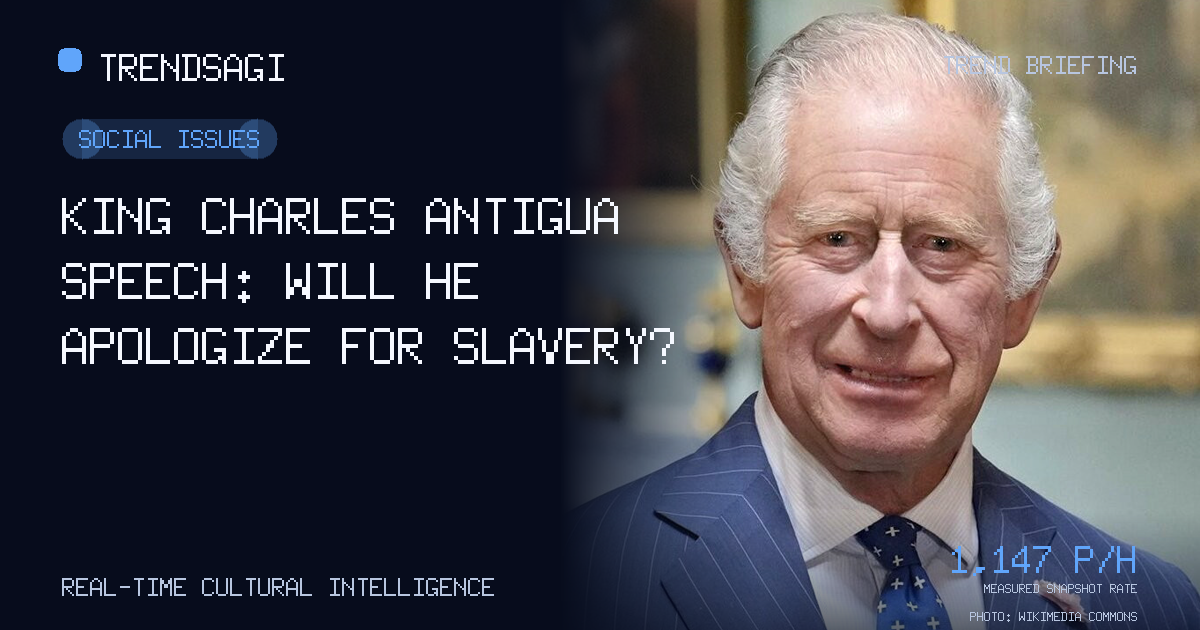
King Charles Antigua Speech: Will He Apologize for Slavery?
King Charles is expected to address slavery in Antigua as Andy Burnham signals openness to an apology. What the brief verifies, and what is still unconfirmed.
Automated briefing. Generated from stored signal measurements and source-backed research; it is not manually reviewed. Read the methodology and limitations or the editorial standards.
Metrics in this briefing are a snapshot associated with its publication date and may not reflect current conditions.
What changed
King Charles's Antigua speech on slavery has become a live news event rather than a historical debate. According to the verified search-intent brief, Charles is touring the Bahamas, Guyana, and Antigua and Barbuda and is expected to address Britain's role in the transatlantic slave trade with "unflinching honesty" and "sincere sorrow" at the Commonwealth summit in Antigua, while UK PM Andy Burnham has signaled openness to a formal apology for slavery. The brief does not confirm the exact text of the speech, whether the King used the word "apology," or the precise date and time he spoke, so treat those details as pending rather than settled.
Attention is moving unusually fast. TrendsAGI's stored observations measured 1,146.7 posts/hour over an exact 901-second window ending at 2026-11-01T16:30:39Z, with a snapshot volume of 972 posts at that observation (the latest of three stored observations). That figure is a measured snapshot rate, not a live rate, forecast, reach, or engagement count, but it is well ahead of a normal news cycle and puts the story among the faster-moving social issues of the moment.
| Observation time (UTC) | Measured posts/hour | Snapshot volume |
|---|---|---|
| 2026-11-01T16:30:39Z | 1,146.7 | 972 posts |
Why this topic may be moving
The brief attributes the movement to two converging forces. First, the King's Caribbean tour and the anticipated Antigua address put an institutional moment on the calendar: a monarch speaking about slavery's legacy in a region shaped by it, at a Commonwealth gathering. Second, Westminster politics raised the temperature, since the Prime Minister's reported openness to a formal apology shifts the question from what the palace may say to what the government might do.
PBS NewsHour frames the tour as Charles being unable to escape Britain's role in slavery, and The Times of India frames the Antigua speech as the moment the apology question returns to the spotlight. The brief also notes the topic is being amplified by new studies and commentary on slavery's legacy, including health disparities, reparations, and anti-literacy laws. TrendsAGI cannot establish from this signal alone which of these drivers dominates, and the pages reviewed did not provide a single verified cause for the spike.
A separate opinion strand should be separated from news reporting: The Observer ran a commentary arguing that reparations will not solve the class struggles facing Black people today. That is a published argument, not a factual finding about what an apology would achieve.
Why it matters
Searchers are not only asking what the King said. They are asking what the difference is between sorrow and apology, who holds the power to apologize, and what reparations would actually involve. The distinction matters because the palace position, as described in the brief, is that the decision belongs to the government rather than the royals. If that is the standing position, the speech can set a moral tone without producing a legal or diplomatic act.
The practical stakes run through Caricom's reparatory justice agenda, which the brief references but does not itemize. Readers deserve to know that an apology and a reparations program are separate questions, and that a formal apology may carry symbolic weight without changing material conditions. The brief does not confirm any government commitment or its terms.
The fastest-moving question here is not whether the King can express sorrow, but whether a formal apology follows from the government, and what that would change in practice.
What to watch next
- The published text of the Antigua address, especially whether the word "apology" appears. This is unconfirmed in the brief.
- Any statement from the UK government clarifying whether a formal apology is under consideration and on what terms.
- Caricom's response and whether its reparatory justice agenda is addressed directly.
- Follow-through comparisons: what other nations and institutions have done on apologies and reparations, a gap the brief says ranking pages leave open.
- Whether the measured posting rate holds or fades once the speech text circulates; the 1,146.7 posts/hour is a snapshot, not a trend guarantee.
- Plain-language scrutiny of economic and health legacy claims. The brief does not verify the economic magnitude of slavery's contribution to British wealth.
Frequently asked questions
Will King Charles formally apologize for slavery at the Commonwealth summit in Antigua?
The brief does not confirm that a formal apology will be issued. It says the King is expected to address slavery with "unflinching honesty" and "sincere sorrow," and that the palace position reportedly leaves the apology decision to the government.
What did King Charles say about slavery in his Antigua speech, and did he use the word 'apology'?
The exact text of the speech is not confirmed in the brief, and no verified source reviewed confirms whether he used the word "apology." Check the published transcript before reporting specifics.
What is the difference between expressing 'sincere sorrow' and a formal state apology?
Sorrow is an expression of regret by a speaker; a formal state apology is an official act by a government. The brief indicates the decision on a formal apology belongs to the government, which is why the two should not be treated as equivalent.
Does the power to issue a formal apology rest with the monarchy or the UK government?
As described in the brief, Buckingham Palace says the decision belongs to the government rather than the royals. The brief does not confirm any government decision.
What has UK PM Andy Burnham said about apologizing for slavery?
The brief says the Prime Minister has signaled openness to a formal apology for slavery. It does not confirm a commitment or the terms of any apology.
Methodology and limitations
This briefing rests on a stored social signal observed at 2026-11-01T16:30:39Z and a search-intent brief summarizing coverage from PBS NewsHour, The Times of India, and The Observer. The 1,146.7 posts/hour figure is a TrendsAGI internal measurement over 901 seconds using three stored observations, and the 972 figure is snapshot volume, not a rate. Neither is independently verified by a cited source, and neither establishes reach, engagement, or unique people.
The signal shows that attention is concentrated now; it cannot establish why. Several details remain unconfirmed: the speech date and time, its text, whether "apology" was used, and whether the UK government will issue a formal apology. The brief also does not verify the economic scale of slavery's contribution to British wealth. The figure shows that the apology question became a live event, not what the outcome will be.
Sources
- King Charles III can't escape Britain's role in slavery as he tours Caribbean nations (PBS NewsHour) — pbs.org
- Will King Charles apologise for slavery? Antigua speech puts Britain's past in spotlight (The Times of India) — timesofindia.indiatimes.com
- Slavery reparations won't solve the class struggles facing black people today (The Observer) — observer.co.uk
Image: Charles III by White House, Public domain, via Wikimedia Commons.
Track This Topic for New Signals
Set alerts for future velocity or sentiment changes around this topic.
Explore Tracking PlansAbout TrendsAGI research
TrendsAGI's automated research pipeline publishes dated signal snapshots, methodology notes, and practical workflows for teams evaluating cultural momentum. Read how signals are scoped, scored, and limited in our research methodology.