881-second window · 3 observations · Measured Oct 26, 2026, 10:18 PM UTC · Provider: go_recent_snapshot_v2
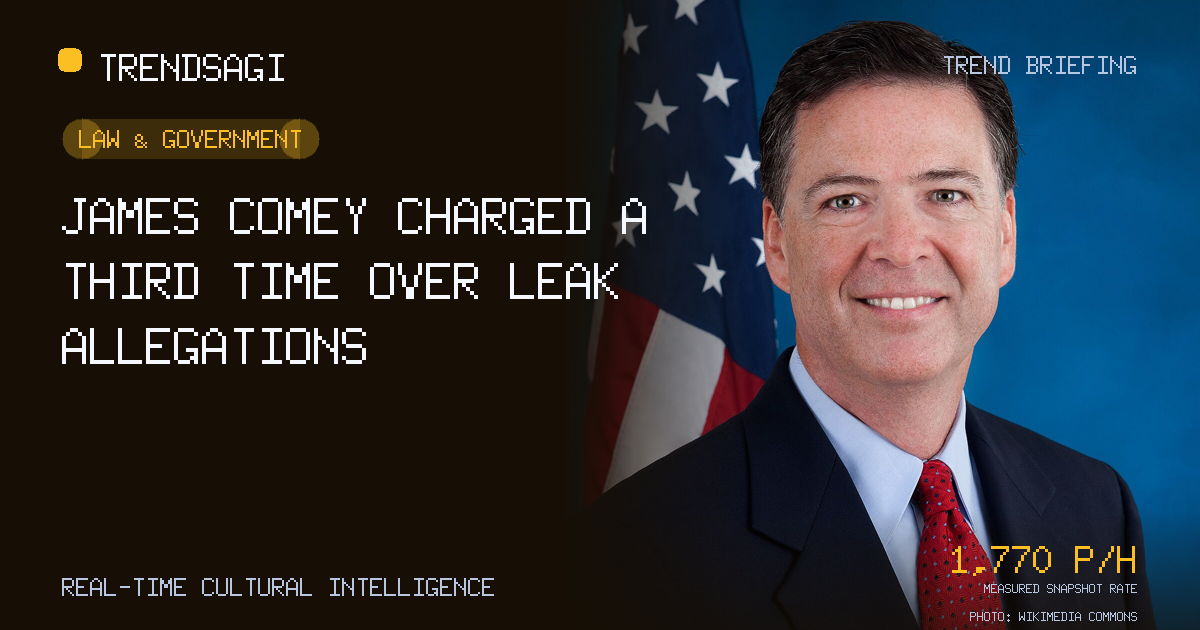
James Comey Charged a Third Time Over Leak Allegations
Justice Department unsealed a third case against James Comey on Oct 26, 2026. What he's charged with, the grand-jury bypass, and a timeline of all three cases.
Automated briefing. Generated from stored signal measurements and source-backed research; it is not manually reviewed. Read the methodology and limitations.
Metrics in this briefing are a snapshot associated with its publication date and may not reflect current conditions.
What changed
The Justice Department unsealed a third criminal case against former FBI Director James Comey on Monday, October 26, 2026, charging him with transmitting national defense information and conspiracy to leak it to a reporter, according to CNN, BBC and BNO News. The filing was made without a grand jury, and its unsealing drew immediate coverage from CNN, BBC, AP, AFP and others — the trigger for the search spike around "James Comey charged third time." TrendsAGI measured 1,769.7 posts per hour across an 881-second window ending 2026-10-26T22:18:08Z, on a latest snapshot volume of 1,125 posts, indicating the story is spreading on social platforms beyond the news cycle alone.
| Observation time (UTC) | Measured posts/hour | Snapshot volume |
|---|---|---|
| 2026-10-26T22:18:08Z | 1,769.7 | 1,125 posts |
The rate above is a measured snapshot rate over one window, not a live figure, forecast, reach or unique-person count.
Quick answer: this is a federal charge, not a conviction, and no source in the verified brief confirms a current indictment. The distinctive feature is the procedural mechanism — a criminal information filed without a grand jury.
Why this topic may be moving
The verified cause is the news filing itself: the Justice Department unsealed the case on October 26, 2026, charging Comey with transmitting national defense information and conspiring to leak it to a reporter. CNN, BBC and BNO News all carried the story, and the search brief attributes the spike to that wave of coverage. No source in the results identifies a social-platform cause separate from the filing, so any claim of an independent online trigger would be speculation.
What the search brief does show is which sub-questions are absorbing attention: whether Comey has been indicted, and why prosecutors bypassed a grand jury. Those two questions recur across the queries searchers are using — "James Comey third indictment," "James Comey criminal information grand jury bypass" — which suggests the mechanics of the filing, not just the headline, are driving demand for explanation.
The three cases, side by side
The brief gives a fragmented timeline that is worth assembling, with the caveat that the earlier two cases are only partially described across sources.
- September 2025 — false statements and obstruction case. One of the two earlier prosecutions against Comey. Reported as dismissed; the exact procedural posture and outcome are not consistently described.
- The earlier "86 47" matter. A separate case referenced in coverage. The characterization that it concerned threats against Donald Trump stemming from an "86 47" shell photo comes from a Norwegian NRK report and is not corroborated by the other results, so treat it as unconfirmed.
- October 2026 — national defense information leak case. The current filing: transmitting national defense information and conspiracy to leak it to a reporter, filed without a grand jury and unsealed October 26, 2026.
The consistent thread across all three is that none is a final adjudication. Readers searching "James Comey charges dismissed previous cases" should know that dismissal of an earlier case does not automatically determine the fate of this one, and the brief does not establish the precise grounds on which the earlier dismissals rested.
What the grand-jury bypass actually means
Most ranking coverage mentions the bypass in a single clause. In plain terms: an indictment is a formal charge returned by a grand jury; a criminal information is a charging document filed directly by prosecutors without that step. The brief confirms the Comey filing was made without a grand jury but does not state the government's stated reason for choosing that route.
Comey's lawyers argue the bypass invalidates the case, according to the search brief's summary of the response. Whether that argument succeeds is not established by any verified source, and courts treat procedural challenges to charging instruments in varied ways. Readers should treat "could the case be dismissed on procedural grounds" as an open legal question, not a prediction.
The most useful way to read this story is procedural, not political: the charge is new, the mechanism is unusual, and the legal fight is likely to be about how the case was brought before it is about what it alleges.
Why it matters
A prosecution of a former FBI director is significant on its own. But the sharper significance here is institutional: charging a senior former official by criminal information rather than grand-jury indictment puts the mechanics of federal charging decisions under scrutiny. Defense counsel's objection is likely to make the procedure itself the first battleground.
For legal analysts, journalists and anyone tracking the intersection of law enforcement and politics, the questions to hold onto are narrow and verifiable: what document was filed, in which court, before which judge, and what does the docket show next.
What to watch next
- The docket. No page in the current coverage tracks the case docket. Watch for an assigned judge, a scheduling order, and any motion to dismiss premised on the charging mechanism.
- Court response to the bypass argument. The defense's procedural challenge is the clearest near-term test.
- Identification of the outlet and document. Neither the unnamed national media outlet nor the specific contents of the October 2016 document are established in available results. If either is confirmed, the substance of the leak allegation becomes checkable.
- Clarification of the earlier cases. More consistent reporting on the status and outcome of the September 2025 case and the "86 47" matter would let readers compare all three accurately.
- Rate movement. A further measured window above or below 1,769.7 posts/hour would show whether attention is still accelerating or has plateaued. Note this is a measurement tool, not a forecast.
Frequently asked questions
What exactly is James Comey charged with in this third case?
Transmitting national defense information and conspiracy to leak it to a reporter, per CNN, BBC and BNO News. The brief does not establish the specific contents of the underlying October 2016 document.
Is this an indictment or a criminal information, and why did prosecutors bypass a grand jury?
It is a criminal information — a charging document filed by prosecutors without a grand jury, which is unusual in a case of this profile. The sources in the brief do not state the government's reason for choosing that route.
How does this third case differ from the two earlier charges against Comey?
This one centers on alleged transmission of national defense information to a reporter and was filed without a grand jury. The earlier cases — a September 2025 false-statements and obstruction matter and the "86 47" case — are only partially described, and their exact status is not consistently reported.
When was the charge filed and unsealed?
It was unsealed Monday, October 26, 2026, according to the verified brief. The brief does not give a separate filing date.
What is Comey's response and his lawyers' legal argument?
His lawyers argue the grand-jury bypass invalidates the case, per the brief. The full text of their statement is not included in the verified material.
Could the case be dismissed on procedural grounds?
That is an open question. The defense is expected to press the argument, but no verified source establishes how a court will rule.
Methodology and limitations
The rate cited here — 1,769.7 posts per hour — was measured across an exact 881-second window using three stored observations, with the latest snapshot at 2026-10-26T22:18:08Z and a snapshot volume of 1,125 posts. It describes one measurement window only. It is not a live rate, a projection, a reach estimate, an engagement metric or a count of unique people.
What this signal can establish: that discussion volume was elevated around this topic at that moment relative to the posting measured in that window. What it cannot establish: why any individual posted, what they said, where the conversation concentrated, or what happens next. The topic label and category were stored with the signal; the description field was empty, so no stored editorial summary was available.
Facts about the charge, the filing and the response are drawn from CNN, BBC and BNO News as attributed above and are limited to what the verified brief supports. The NRK characterization of the earlier "86 47" matter is unconfirmed. The identity of the unnamed media outlet, the contents of the October 2016 document, and the precise outcomes of the two prior prosecutions remain unestablished here.
Sources
- Justice Department charges former FBI Director James Comey for third time (CNN) — edition.cnn.com
- Ex-FBI chief James Comey faces federal charges for third time (BBC) — bbc.com
- James Comey charged with leaking national defense information (BNO News) — bnonews.com
Image: James Comey by Federal Bureau of Investigation, Public domain, via Wikimedia Commons.
Track This Topic for New Signals
Set alerts for future velocity or sentiment changes around this topic.
Explore Tracking PlansAbout TrendsAGI research
TrendsAGI's automated research pipeline publishes dated signal snapshots, methodology notes, and practical workflows for teams evaluating cultural momentum. Read how signals are scoped, scored, and limited in our research methodology.