869-second window · 3 observations · Measured Oct 11, 2026, 3:10 AM UTC · Provider: go_recent_snapshot_v2
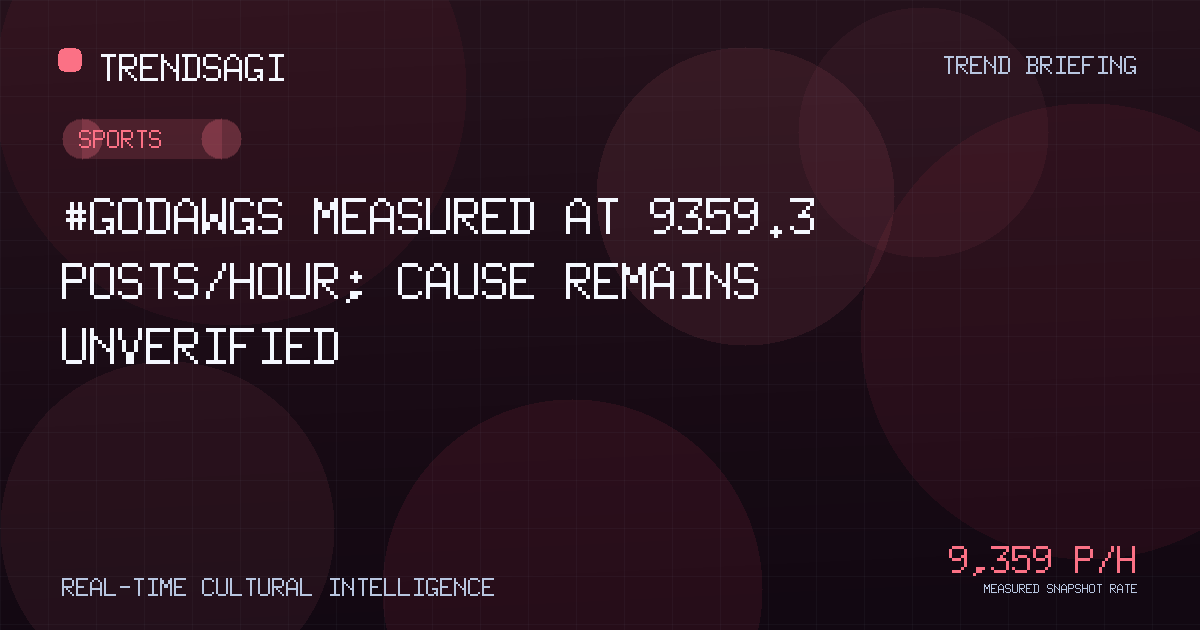
#GoDawgs measured at 9359.3 posts/hour; cause remains unverified
#GoDawgs logged 9359.3 posts/hour in the latest short-window snapshot; this briefing explains the signal, uncertainty, and next checks.
Automated briefing. Generated from stored signal measurements and source-backed research; it is not manually reviewed. Read the methodology and limitations.
Metrics in this briefing are a snapshot associated with its publication date and may not reflect current conditions.
What changed
#GoDawgs was moving rapidly in the latest snapshot. At 2026-10-11T03:10:30Z, the topic registered a measured snapshot rate of 9359.3 posts/hour. That indicates a concentrated burst of hashtag activity, but the measurement alone does not show what caused it.
The rate was measured over an exact 869-second window using 3 observations. The latest snapshot contained 3000 posts. The measures serve different purposes: 9359.3 posts/hour describes measured posting velocity, while 3000 posts is snapshot volume—not a rate, reach estimate, engagement count, or count of unique people.
| Metric | Recorded value |
|---|---|
| Observation time | 2026-10-11T03:10:30Z |
| Measured snapshot rate | 9359.3 posts/hour |
| Snapshot volume | 3000 posts |
The defensible read is that posting around #GoDawgs was intense within the measured interval, not that a particular game, person, or announcement caused the activity. The rate can reflect broad participation, concentrated reposting, or automated behavior; the available measurement does not separate those possibilities.
What the signal can establish
The signal establishes that posts associated with the hashtag accumulated rapidly during the exact short window. Combined with the latest 3000-post snapshot, it is enough to justify closer inspection: the topic had substantial message volume at that moment.
It also gives analysts a concrete benchmark. If the collection method and hashtag definition remain consistent, later observations can show whether activity persists, recedes, or shifts to a different pattern. That comparison must use the same measurement rules; otherwise, an apparent change could be a methodology artifact rather than a change in participation.
The measurement does not establish who posted, whether authors are fans, whether content is original, how many accounts participated, where they were, what sentiment dominated, or whether people saw the posts. A large post count can be produced by a narrow set of accounts or repeated content, so it should not be read as a proxy for unique audience size.
Why this topic may be moving
The cause remains unclear because no timestamp-matched public catalyst was verified for this briefing. The available evidence reports posting counts but does not provide enough content or external context to connect them confidently to a specific event. Assigning the movement to a game, roster update, controversy, or promotional post would therefore be speculation.
Several mechanisms could produce the observed pattern:
- A time-sensitive sports event could generate immediate reactions, questions, and follow-up comments.
- A player, team, creator, or media account could introduce a phrase or prompt that others imitate.
- Quote posts and reposts could lift the total count without adding equivalent original participation.
- A controversy or identity-based fan conversation could keep activity going after an initial wave.
- Non-news uses of the hashtag could overlap with sports discussion, including promotion, alumni activity, or informal fan banter.
The strongest explanation will be one supported by the earliest substantive posts and independent, timestamp-matched public reporting. Until then, these are hypotheses rather than findings.
Why it matters
For fan-facing organizations, community teams, and sports media, a rapid change in posting velocity can be an early prompt to inspect what is happening. A moderator may need to check for spam or coordinated behavior, a community team may need to understand the subject of the conversation, and a newsroom may need to determine whether the activity reflects a reportable development.
For trend and brand-safety teams, the measured snapshot rate is useful as a trigger for investigation, not as a verdict. A responsible response asks whether the conversation is event-driven, broadly participatory, repetitive, automated, or potentially harmful before drawing a broader conclusion.
For readers, the distinction between volume and consensus is especially important. The measured snapshot rate shows that many posts were being recorded per hour; it does not show that participants agreed. A smaller number of influential posts could also matter editorially even if total activity later recedes.
What to watch next
- Match the timestamp. Check official schedules, announcements, and reputable reporting around 2026-10-11T03:10:30Z. Do not attach an earlier event to this spike unless the timeline supports that connection.
- Collect another like-for-like observation. Reassess activity using the same 869-second window, hashtag-matching approach, and counting method. Persistence would provide stronger evidence of continued interest; a single-window peak suggests a more transient event. A methodology change would require a new comparison baseline.
- Inspect content composition. Separate original posts, quote posts, reposts, replies, media, and links. Determine whether a few dominant formats account for most of the burst.
- Check account concentration. Look at the number of distinct authors, repeated posting, and whether activity is concentrated among a small group. Concentration plus repetition points toward amplification; broader distinct participation supports wider reaction.
- Find the earliest substantive items. Review posts that first name a specific event and trace their citations. Independent corroboration is more useful than volume alone.
- Watch confirmation quality. A named official item, multiple credible publishers aligning on the timing, and continued original discussion would strengthen a causal explanation. Mixed references or no timestamp match would leave the cause open.
Methodology and limitations
The reported rate is 9359.3 posts/hour, associated with the observation at 2026-10-11T03:10:30Z and measured over an exact 869-second window using 3 observations. The latest snapshot volume is 3000 posts. The record does not establish that the 3000-post inventory is the full denominator behind the rate, so the two values should be reported side by side rather than reconciled into unsupported reach or audience totals.
The short measurement window is sensitive to abrupt events, while 3 observations do not establish a long-term trajectory. No earlier comparison rate is supplied, so the figure should not be presented as a percentage gain or evidence of how long activity has been elevated. The measured snapshot rate is historical for this observation, not a live rate or forecast.
Hashtag-level totals may also include original commentary, copying, replies, promotional material, and automated activity. Without content and account-level inspection, those forms cannot be separated. No external catalyst was verified, so this briefing identifies the movement and the checks required to explain it without making an unsupported attribution.
Bottom line
#GoDawgs merits monitoring because the latest snapshot recorded 9359.3 posts/hour alongside 3000 posts in volume. The immediate conclusion is not that a particular event caused the burst; that explanation remains unverified. Timestamp-matched public evidence, content composition, account distribution, and a comparable follow-up window are the most useful next signals.
Track This Topic for New Signals
Set alerts for future velocity or sentiment changes around this topic.
Explore Tracking PlansAbout TrendsAGI research
TrendsAGI's automated research pipeline publishes dated signal snapshots, methodology notes, and practical workflows for teams evaluating cultural momentum. Read how signals are scoped, scored, and limited in our research methodology.