901-second window · 3 observations · Measured Oct 21, 2026, 9:27 AM UTC · Provider: go_recent_snapshot_v2
Germany's Inflation to Stay Above ECB Target Into 2027
Euro-area inflation rose to 3.8% and the Bundesbank warns German inflation stays above the ECB target into 2027. What it means for rates and budgets.
Automated briefing. Generated from stored signal measurements and source-backed research; it is not manually reviewed. Read the methodology and limitations.
Metrics in this briefing are a snapshot associated with its publication date and may not reflect current conditions.
What changed
The clearest answer to why Germany's inflation is still above the ECB target in 2027 comes from the Bundesbank: in its October monthly report it warned that German inflation will remain “merklich erhöht” — markedly elevated — into next year, a message carried by both Handelsblatt and Börsen-Zeitung. That warning landed alongside a genuine multi-source wave of price news dated 15–19 October 2026, most notably Eurostat's estimate that euro-area annual inflation rose to 3.8% in September 2026 from 3.2% in August. In the United States, State Street Investment Management reported that CPI, PPI and import prices all surprised to the upside. TrendsAGI measured 1,286.7 posts per hour over an exact 901-second window at 09:27 UTC on 21 October 2026, with a snapshot volume of 867 posts — a measured snapshot rate, not a live rate or a forecast.
| Observation time | Measured posts/hour | Snapshot volume |
|---|---|---|
| 2026-10-21T09:27:19Z | 1,286.7 (measured over 901 seconds, 3 stored observations) | 867 posts |
Why this topic may be moving
The verified reason for the attention is straightforward: several official and market releases in mid-October pointed the same way at once. Eurostat put euro-area inflation at 3.8% for September, up from 3.2% in August. The Bundesbank's monthly report said German inflation would stay markedly elevated into 2027. And US inflation data surprised to the upside across consumer prices, producer prices and import prices. That combination — a higher euro-area headline, an explicit 2027 warning for Germany and hotter US data — explains why searches and posts around inflation picked up.
What the evidence does not establish is a single trigger for the measured spike at 09:27 UTC on 21 October 2026. No result in the brief is dated to that moment, and no single news event is identified. The most defensible reading is that the measured pickup is consistent with the accumulated German and euro-area coverage from 15–19 October rather than one breaking story. Readers should treat the timing of the spike as unexplained.
Why it matters
This is not an abstract statistic. If German inflation stays above the ECB's 2% target into 2027, as the Bundesbank warns, the practical consequences run through household budgets and borrowing costs:
- Interest rates: Persistent inflation above target keeps pressure on the ECB to hold rates higher for longer. The brief does not verify any specific ECB or Fed decision after 19 October 2026, so treat rate-path claims as expectations, not facts.
- Mortgages and savings: Higher-for-longer policy rates tend to keep mortgage costs elevated and can support savings rates, but the net effect depends on decisions not yet verified.
- Real wages: If prices stay markedly elevated, wage gains may not translate into higher purchasing power.
- Cost of living: The euro-area headline rising from 3.2% to 3.8% in one month is the number to watch for household budgets.
The verified picture is a broad re-acceleration — euro-area inflation at 3.8%, a Bundesbank warning for 2027 and upside US surprises — not a single confirmed event. That distinction matters for anyone making rate or budget decisions on the back of this coverage.
What is driving the increase
The brief verifies that inflation rose and that several drivers are discussed — oil and energy prices, tariffs, an Iran-war supply disruption and wages — but it does not verify the relative weight of each. Ranking pages tend to cite the headline figure without ranking the drivers, and the Iran-war supply-shock angle appears only in a BIS working paper rather than consumer-facing coverage. Until better data is published, treat any single-driver explanation as incomplete.
What to watch next
- Euro-area flash estimates: whether the 3.8% September figure is revised or extended in the next Eurostat release.
- German state and national CPI: the brief does not verify the September 2026 German inflation rate itself, so the first confirmed German print is a key data point.
- Bundesbank forecast numbers: the “2027 above target” claim is reported without underlying forecast figures; watch for the published numbers.
- US CPI, PPI and import prices: whether the upside surprises continue or fade.
- Energy and oil prices: a persistent move here would be the most visible driver to confirm or rule out.
- TrendsAGI velocity: whether the measured posts-per-hour rate stays elevated or fades as the October coverage ages.
Frequently asked questions
What is the current inflation rate in the euro area and the US?
Eurostat reported euro-area annual inflation at 3.8% in September 2026, up from 3.2% in August. For the US, State Street Investment Management reported that CPI, PPI and import prices all surprised to the upside; the brief does not verify a single headline US annual rate.
Why did inflation rise again in September 2026?
The verified fact is that euro-area inflation rose to 3.8% from 3.2%, and that US CPI, PPI and import prices surprised to the upside. The brief lists oil and energy prices, tariffs, an Iran-war supply disruption and wages as discussed drivers but does not verify their relative weights.
Will inflation stay above 2% in 2027, and in which countries?
The Bundesbank warned in its monthly report that German inflation will stay “merklich erhöht” into 2027, according to Handelsblatt and Börsen-Zeitung. That is a German warning; the brief does not verify 2027 forecasts for other individual countries.
How much are oil and energy prices driving the increase?
The brief does not verify how much of the increase is attributable to oil and energy. Energy is listed as one discussed driver, but no verified weighting is available, so a specific contribution cannot be stated.
What does this mean for ECB and Fed interest rate decisions?
Inflation above target keeps pressure on central banks to hold rates higher for longer, but the brief does not verify any specific ECB or Fed decision or probability after 19 October 2026. Treat rate-path commentary as expectation rather than confirmed fact.
Are wages and second-round effects making inflation persist?
Wages are listed among the discussed drivers, and the Bundesbank's 2027 warning is consistent with persistence concerns. However, the brief does not verify a measured wage contribution or confirm second-round effects, so this remains an open question.
Methodology and limitations
The velocity figure is a measured snapshot rate: 1,286.7 posts per hour over an exact 901-second window using 3 stored observations, measured at 2026-10-21T09:27:19Z. The snapshot volume of 867 posts is a count, not a rate, and is not a measure of reach, engagement or unique people. The brief does not verify the specific cause of the measured spike at that moment, the September 2026 German inflation rate, any central-bank decision after 19 October 2026, or any search-volume or ranking data. External facts are attributed to their publishers — Eurostat, Handelsblatt, Börsen-Zeitung and State Street Investment Management — and anything not verified in the brief is either omitted or flagged as unconfirmed.
Sources
- Annual inflation up to 3.8% in the euro area (Eurostat) — ec.europa.eu
- Bundesbank – Inflation bleibt bis ins nächste Jahr hinein „merklich erhöht“ (Handelsblatt) — handelsblatt.com
- Bundesbank: Inflation auch 2027 noch über EZB-Ziel (Börsen-Zeitung) — boersen-zeitung.de
- US inflation rises as rate expectations shift (State Street Investment Management) — ssga.com
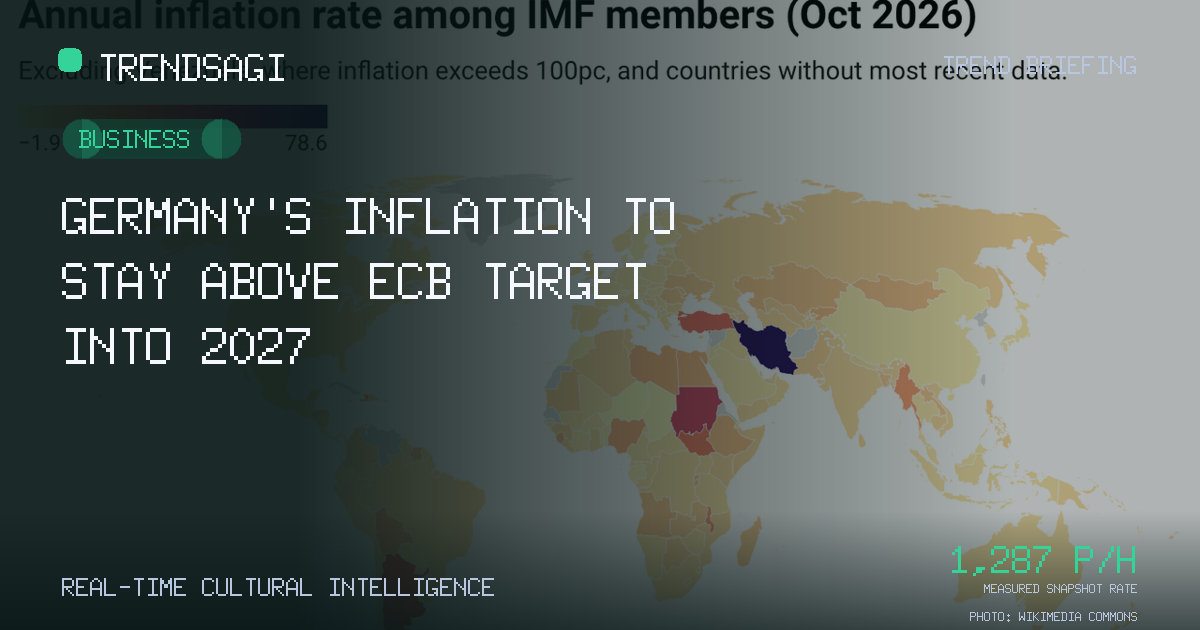
Image: Inflation by Justin Liu ( JJLiu112 ), CC0, via Wikimedia Commons.
Track This Topic for New Signals
Set alerts for future velocity or sentiment changes around this topic.
Explore Tracking PlansAbout TrendsAGI research
TrendsAGI's automated research pipeline publishes dated signal snapshots, methodology notes, and practical workflows for teams evaluating cultural momentum. Read how signals are scoped, scored, and limited in our research methodology.