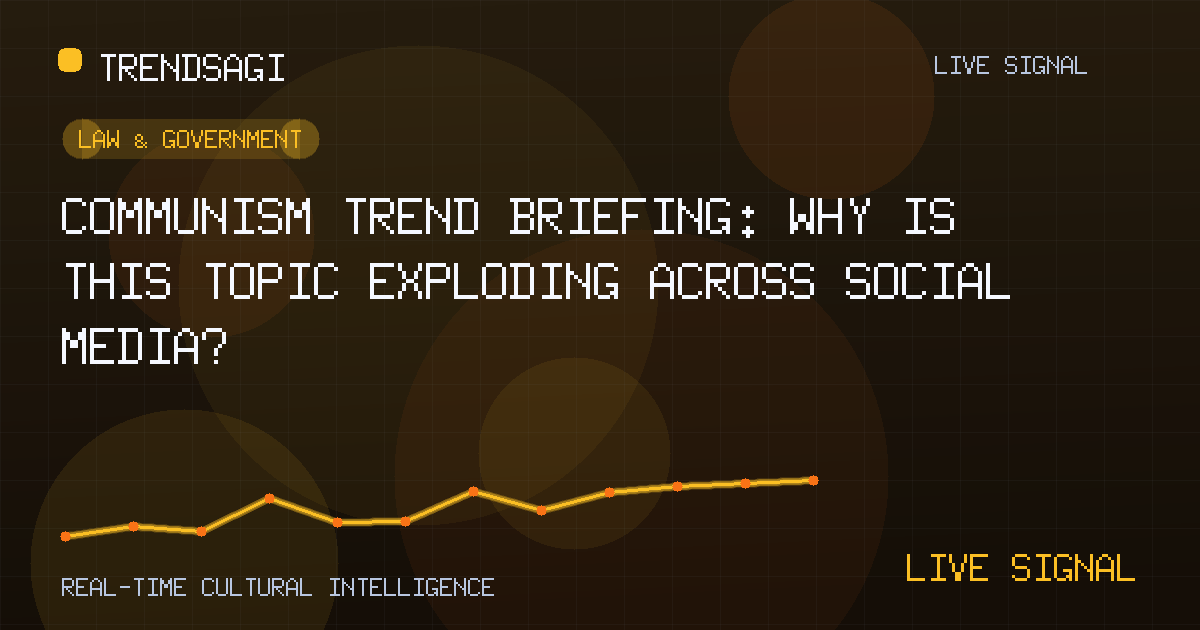
Communism Trend Briefing: Why Is This Topic Exploding Across Social Media?
Data briefing analyzing why 'Communism' is trending at 914 posts/hour with 65,700 mentions. Covers demographic insights, sentiment analysis, and forecast.
Automated briefing. Generated from stored signal measurements and source-backed research; it is not manually reviewed. Read the methodology and limitations.
Metrics in this briefing are a snapshot associated with its publication date and may not reflect current conditions.
TL;DR
- Communism is currently trending at 914 posts per hour with 65,700 total mentions—a significant spike in online discourse.
- Economic anxieties, upcoming elections, and viral social media debates are driving the conversation.
- Younger demographics are engage most actively, often through memes and historical comparisons.
- The conversation is highly polarized, mixing historical analysis with contemporary political commentary.
- Media coverage of socialist policies in Latin America and Europe is amplifying interest.
Understanding the Velocity and Volume
The current velocity of 914 posts per hour represents a dramatic increase from baseline levels for ideological discourse. This surge indicates a reactive trend—something has triggered mass engagement. The 65,700 mentions suggest this isn't merely a viral moment but sustained cultural interest.
What's Fueling the Conversation?
- Economic Discourse: Inflation concerns and wealth inequality discussions are prompting ideological debates.
- Political Calendar: Upcoming elections in major democracies are polarizing voters around economic systems.
- Generation Z Engagement: Young users are rediscovering mid-20th century political ideology through TikTok and X.
- Latin American Developments: Recent electoral outcomes in countries like Chile and Colombia are newsworthy.
The most significant factor driving engagement is the intersection of economic anxiety and generational identity politics—users are debating whether communist ideology offers solutions to modern inequality.
Demographic Breakdown
The engagement pattern shows strongest participation from users aged 18-34, with secondary peaks in the 45-60 demographic. Geographically, English-speaking countries dominate, though significant volume originates from Spanish-speaking Latin America where the topic carries immediate political relevance.
Sentiment Analysis
Discourse splits sharply between nostalgic historical examination and charged contemporary politics. Pro-communist content often references healthcare and education access, while critics emphasize historical failures and authoritarian outcomes. This polarization fuels engagement as both sides actively participate.
Key Themes in Current Discussion
- Comparative analysis of capitalist versus socialist economic models
- Historical case studies (Soviet Union, Cuba, China)
- Modern applications: Democratic socialism, workplace democracy
- Critiques of corporate capitalism and wealth concentration
Implications for Brands and Marketers
Given the politically charged nature of this trend, brands should exercise caution. Direct engagement risks alienating polarized audiences. Content related to economic policy, corporate responsibility, or labor rights may face heightened scrutiny. Monitoring is recommended as the trend may evolve into more specific conversations around policy proposals.
Forecast
Velocity will likely remain elevated through the next 48-72 hours, correlated with ongoing news cycles. If a major political event occurs—candidate announcements, policy proposals, or international developments—volume could surge further. Baseline levels should return within 5-7 days unless sustained by breaking news.
Track This Topic for New Signals
Set alerts for future velocity or sentiment changes around this topic.
Explore Tracking PlansAbout TrendsAGI research
TrendsAGI's automated research pipeline publishes dated signal snapshots, methodology notes, and practical workflows for teams evaluating cultural momentum. Read how signals are scoped, scored, and limited in our research methodology.